
Spatial Clustering and Determinants of Dengue Incidence Among the Young Population of Northern Thailand During the COVID-19 Pandemic
Article Sidebar
Main Article Content
Abstract
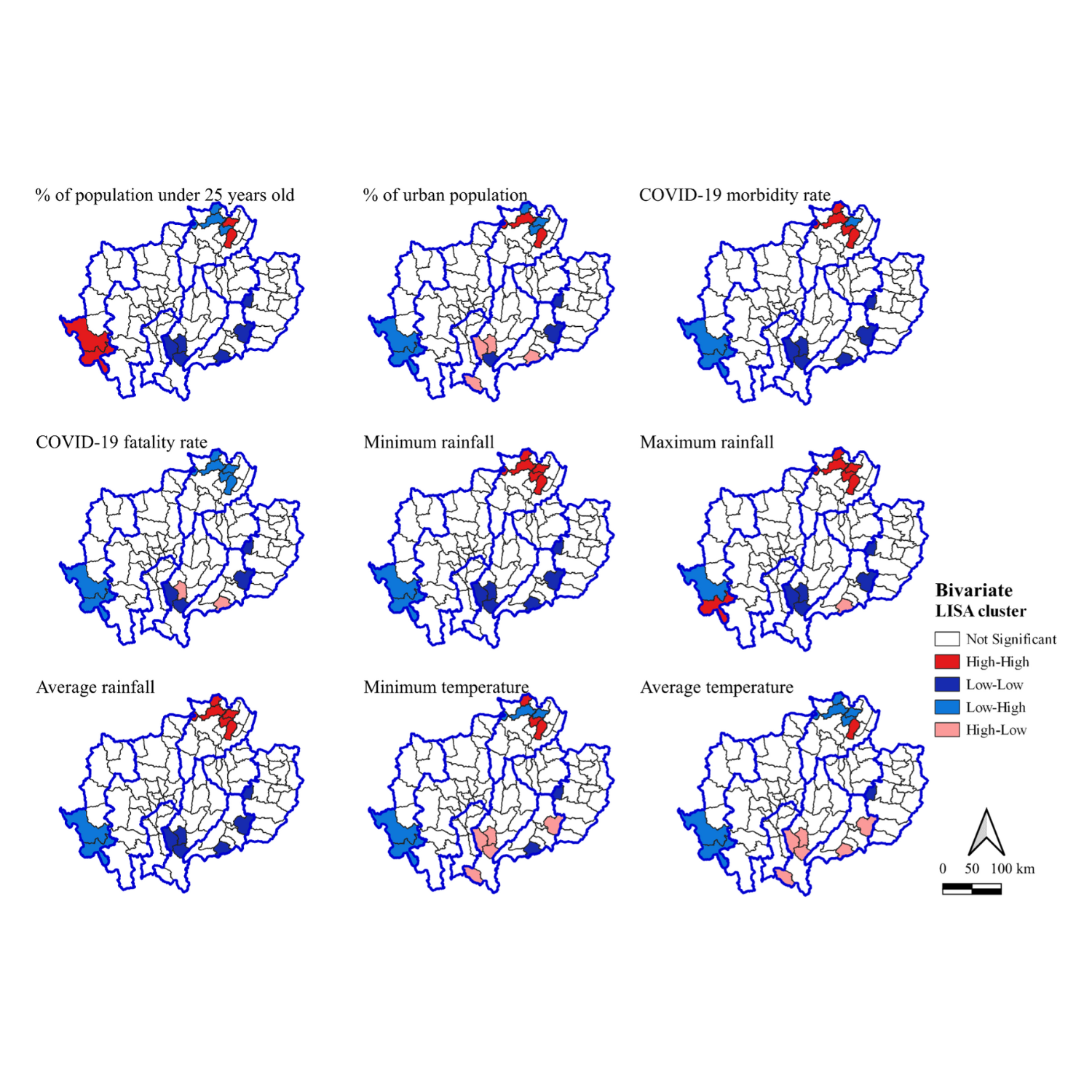
Dengue infection remains a significant public health concern in Thailand, particularly among young populations. The emergence of COVID-19 introduced additional complexity to disease surveillance and control efforts. This study aimed to determine the spatial clustering and determinants of dengue incidence among individuals under 25 years of age in Northern Thailand during the COVID-19 pandemic. Ecological analysis was conducted across 103 districts in eight northern provinces. District-level dengue incidence rates of individuals under 25 years of age for 2021 were calculated and analyzed using global Moran’s I and local indicators of spatial association (LISA) to detect spatial clustering. Bivariate LISA was employed to explore spatial correlations between dengue incidence and sociodemographic, environmental, and health service factors. Spatial regression models were applied to identify significant predictors while accounting for spatial dependence. There were 18 districts (17.48%) with dengue incidence rates higher than the national target. Global Moran’s I indicated a positive spatial autocorrelation (Moran’s I = 0.087), and LISA identified significant high-high clusters in two remote border districts. Bivariate LISA analysis revealed significant positive spatial associations between dengue incidence and the proportion of the population under 25 years of age, COVID-19 morbidity rate, and minimum, maximum, and average rainfall. In contrast, significant negative spatial associations were observed with the proportion of the urban population, COVID-19 fatality rate, and both minimum and average temperatures. Given the low spatial dependence observed, the ordinary least squares model was considered appropriate and identified the number of schools, the ratio of village health volunteers to households, and average temperature as significant determinants of dengue incidence (R² = 0.102). These findings indicated the need for geographically targeted health planning strategies and community design, school-based vector control, and climate-informed surveillance strategies. Integrated and resilient public health systems are essential for managing concurrent health threats.
Article Details

This work is licensed under a Creative Commons Attribution-NonCommercial-NoDerivatives 4.0 International License.
References
Agyekum, T. P., Arko-Mensah, J., Botwe, P. K., Hogarh, J. N., Issah, I., Dwomoh, D., Billah, M. K., Dadzie, S. K., Robins, T. G., & Fobil, J. N. (2022). Effects of elevated temperatures on the growth and development of adult anopheles gambiae (s.l.) (Diptera: Culicidae) Mosquitoes. Journal of Medical Entomology, 59(4), 1413–1420. https://doi.org/10.1093/jme/tjac046
Agyekum, T. P., Botwe, P. K., Arko-Mensah, J., Issah, I., Acquah, A. A., Hogarh, J. N., Dwomoh, D., Robins, T. G., & Fobil, J. N. (2021). A systematic review of the effects of temperature on anopheles mosquito development and survival: Implications for malaria control in a future warmer climate. International Journal of Environmental Research and Public Health, 18(14), Article 7255. https://doi.org/10.3390/ijerph18147255
Anselin, L. (1988). Spatial econometrics: Methods and models. Springer Science & Business Media.
Anselin, L. (1995). Local indicators of spatial association—LISA. Geographical Analysis, 27(2), 93–115. https://doi.org/10.1111/j.1538-4632.1995.tb00338.x
Anselin, L., & Bera, A. K. (1998). Spatial dependence in inear regression models with an introduction to spatial econometrics. Handbook of Applied Economic Statistics. CRC Press.
Anselin, L., Li, X., & Koschinsky, J. (2022). GeoDa, from the edsktop to an ecosystem for exploring spatial data. Geographical Analysis, 54(3), 439–466. https://doi.org/10.1111/gean.12311
Araujo, J. L. B., Bomfim, R., Filho, C. I. N. S., Cavalcanti, L. P. G., Neto, A. S. L., Jr, J. S. A., & Furtado, V. (2024). The impact of COVID-19 mobility restrictions on dengue transmission in urban areas. PLOS Neglected Tropical Diseases, 18(11), Article e0012644. https://doi.org/10.1371/journal.pntd.0012644
Bialy, L., Elliott, S. A., Melton, A., Ali, S., Scott, S. D., Knisley, L., & Hartling, L. (2024). Consequences of the coronavirus disease 2019 pandemic on child and adolescent mental, psychosocial, and physical health: A scoping review and interactive evidence map. Journal of Child Health Care, 0(0), 1–15. https://doi.org/10.1177/13674935241238794
Bohm, B. C., Morais, M. H. F., Cunha, M. d. C. M., Bruhn, N. C. P., Caiaffa, W. T., & Bruhn, F. R. P. (2024). Determining the relationship between dengue and vulnerability in a Brazilian city: A spatial modeling analysis. Pathogens and Global Health, 118(2), 120–130. https://doi.org/10.1080/20477724.2023.2247273
Brady, O., & Wilder-Smith, A. (2021). What is the impact of lockdowns on dengue? Current Infectious Disease Reports, 23(2), 1–8. https://doi.org/10.1007/s11908-020-00744-9
Bureau of Epidemiology, Department of Disease Control, Ministry of Public Health Thailand. (2021). Rabop fao rawang rok 506 [National disease surveillance (R506)]. http://doe1.moph.go.th/surdata/index.php
Bureau of Registration Administration, Ministry of Interior. (n.d.). Rabop sathiti thangkan thabian [Official statistics registration systems]. https://stat.bora.dopa.go.th/stat/statnew/statMenu/newStat/home.php
Chen, Y., Li, N., Lourenço, J., Wang, L., Cazelles, B., Dong, L., Li, B., Liu, Y., Jit, M., Bosse, N. I., Abbott, S., Velayudhan, R., Wilder-Smith, A., Tian, H., Brady, O. J., Procter, S. R., Wong, K. L., Hellewell, J., Davies, N. G., …Tully, D. C. (2022). Measuring the effects of COVID-19-related disruption on dengue transmission in southeast Asia and Latin America: A statistical modelling study. The Lancet Infectious Diseases, 22(5), 657–667. https://doi.org/10.1016/S1473-3099(22)00025-1
Community Development Department, Ministry of Interior. (2021). Prokraem chat kep banthuek lae pramuan phon khwam champen phuenthan [eBMN Application]. https://ebmn.cdd.go.th/#/jpt
Deb Nath, N., Khan, M. M., Schmidt, M., Njau, G., & Odoi, A. (2023). Geographic disparities and temporal changes of COVID-19 incidence risks in North Dakota, United States. BMC Public Health, 23(1), Article 720. https://doi.org/10.1186/s12889-023-15571-5
Department of Health Service Support, Ministry of Public Health. (n.d.). Chamnuan asasamak satharanasuk pracham muban rai tambon [Number of village health volunteers, by sub-district]. https://www.thaiphc.net/new2020/content/1
Educational Information Center, Ministry of Education. (2021). Sarasonthet dan sathan kansueksa [Information on the number of educational institutions]. https://edustatistics.moe.go.th/school
Hnusuwan, B., Kajornkasirat, S., & Puttinaovarat, S. (2020). Dengue risk mapping from geospatial data using GIS and data mining techniques. International Journal of Online and Biomedical Engineering (iJOE), 16(11), 57–79. https://doi.org/10.3991/ijoe.v16i11.16455
Jing, C., Wang, G., Ebi, K. L., Su, B., Wang, X., Chen, D., Jiang, T., & Kundzewicz, Z. W. (2024). Emerging risk to dengue in Asian metropolitan areas under global warming. Earth’s Future, 12(7), Article e2024EF004548. https://doi.org/10.1029/2024EF004548
Jiravanichkul, S., Pinich, S., Sreshthaputra, A., & Jarutach, T. (2024). The development of a well-being environment and age-friendly communities assessment criteria using the analytic hierarchy process: A case of Thailand. Nakhara: Journal of Environmental Design and Planning, 23(3), Article 416. https://doi.org/10.54028/NJ202423416
Khan, S., Akbar, S. M. F., & Nishizono, A. (2022). Co-existence of a pandemic (SARS-CoV-2) and an epidemic (dengue virus) at some focal points in Southeast Asia: Pathogenic importance, preparedness, and strategy of tackling. The Lancet Regional Health - Southeast Asia, 4, Article 100046. https://doi.org/10.1016/j.lansea.2022.100046
Kliengchuay, W., Mingkhwan, R., Kiangkoo, N., Suwanmanee, S., Sahanavin, N., Kongpran, J., Aung, H. W., & Tantrakarnapa, K. (2024). Analyzing temperature, humidity, and precipitation trends in six regions of Thailand using innovative trend analysis. Scientific Reports, 14(1), Article 7800. https://doi.org/10.1038/s41598-024-57980-5
Krassanairawiwong, T., Suvannit, C., Pongpirul, K., & Tungsanga, K. (2021). Roles of subdistrict health office personnel and village health volunteers in Thailand during the COVID-19 pandemic. BMJ Case Reports CP, 14(9), Article e244765. https://doi.org/10.1136/bcr-2021-244765
Li, H., Calder, C. A., & Cressie, N. (2007). Beyond Moran’s I: Testing for spatial dependence based on the spatial autoregressive model. Geographical Analysis, 39(4), 357–375. https://doi.org/10.1111/j.1538-4632.2007.00708.x
Lindsay, S. W., Wilson, A., Golding, N., Scott, T. W., & Takken, W. (2017). Improving the built environment in urban areas to control Aedes aegypti-borne diseases. Bulletin of the World Health Organization, 95(8), 607–608. https://doi.org/10.2471/BLT.16.189688
Liyanage, P., Rocklöv, J., & Tissera, H. A. (2021). The impact of COVID-19 lockdown on dengue transmission in Sri Lanka; A natural experiment for understanding the influence of human mobility. PLoS Neglected Tropical Diseases, 15(6), Article e0009420. https://doi.org/10.1371/journal.pntd.0009420
Lu, H.-Z., Sui, Y., Lobo, N. F., Fouque, F., Gao, C., Lu, S., Lv, S., Deng, S.-Q., & Wang, D.-Q. (2023). Challenge and opportunity for vector control strategies on key mosquito-borne diseases during the COVID-19 pandemic. Frontiers in Public Health, 11, Article 1207293. https://doi.org/10.3389/fpubh.2023.1207293
Mani, S., Ghosh, S., Sharma, R., Ajith, A., & Prabhakaran, P. (2021). Chapter 1—controlling dengue, an urban pandemic – a case study of Delhi, India. In R. Katz & M. Boyce (Eds.), Inoculating cities (pp. 1–19). Academic Press. https://doi.org/10.1016/B978-0-12-820204-3.00001-2
Manna, B., Bharati, P., Paul, S., Mahata, A., Mondal, S., Mukherjee, S., Dutta, A. K., & Roy, B. (2024). Results and discussion of dengue model with temperature effects in interval environment. SciNexuses, 1, 75–81. https://doi.org/10.61356/j.scin.2024.1372
Nik Abdull Halim, N. M. H., Che Dom, N., Dapari, R., Salim, H., & Precha, N. (2022). A systematic review and meta-analysis of the effects of temperature on the development and survival of the Aedes mosquito. Frontiers in Public Health, 10, Article 1074028. https://doi.org/10.3389/fpubh.2022.1074028
Office Statistics Registration System, Ministry of Interior. Chamnuan prachakon [Population statistics]. https://stat.bora.dopa.go.th/new_stat/webPage/statByYear.php
Pakaya, R., Daniel, D., Widayani, P., & Utarini, A. (2023). Spatial model of Dengue Hemorrhagic Fever (DHF) risk: Scoping review. BMC Public Health, 23(1), Article 2448. https://doi.org/10.1186/s12889-023-17185-3
Phanitchat, T., Zhao, B., Haque, U., Pientong, C., Ekalaksananan, T., Aromseree, S., Thaewnongiew, K., Fustec, B., Bangs, M. J., Alexander, N., & Overgaard, H. J. (2019). Spatial and temporal patterns of dengue incidence in northeastern Thailand 2006–2016. BMC Infectious Diseases, 19(1), Article 743. https://doi.org/10.1186/s12879-019-4379-3
Prasittisopin, L., Kitkuakul, P., Chotchakornpant, K., & Rugkhapan, N. T. (2024). Implementing the sister city policy: Perspectives from Thailand. Nakhara: Journal of Environmental Design and Planning, 23(2), Article 413. https://doi.org/10.54028/NJ202423413
Puttanapong, N., Luenam, A., & Jongwattanakul, P. (2022). Spatial analysis of inequality in Thailand: Applications of satellite data and spatial statistics/econometrics. Sustainability, 14(7), Article 3946. https://doi.org/10.3390/su14073946
QGIS Development Team. (2023). QGIS Geographic Information System [Computer software]. https://www.qgis.org
Rahastri, A., & Sulistyawati, S. (2024). The impact of COVID-19 on dengue cases in low-and middle-income countries: A systematic review. International Journal of Public Health Science (IJPHS), 13(4), 1560–1567. https://doi.org/10.11591/ijphs.v13i4.24454
Rahman, M. S., Ekalaksananan, T., Zafar, S., Poolphol, P., Shipin, O., Haque, U., Paul, R., Rocklov, J., Pientong, C., & Overgaard, H. J. (2021). Ecological, social, and other environmental determinants of dengue vector abundance in urban and rural areas of northeastern Thailand. International Journal of Environmental Research and Public Health, 18(11), Article 5971. https://doi.org/10.3390/ijerph18115971
Ratanawong, P., Kittayapong, P., Olanratmanee, P., Wilder-Smith, A., Byass, P., Tozan, Y., Dambach, P., Quinonez, C. A. M., & Louis, V. R. (2016). Spatial variations in dengue transmission in schools in Thailand. PLOS ONE, 11(9), Article e0161895. https://doi.org/10.1371/journal.pone.0161895
Romeo-Aznar, V., Telle, O., Santos-Vega, M., Paul, R., & Pascual, M. (2024). Crowded and warmer: Unequal dengue risk at high spatial resolution across a megacity of India. PLOS Climate, 3(3), Article e0000240. https://doi.org/10.1371/journal.pclm.0000240
Roster, K. O., Martinelli, T., Connaughton, C., Santillana, M., & Rodrigues, F. A. (2024). Impact of the COVID-19 pandemic on dengue in Brazil: Interrupted time series analysis of changes in surveillance and transmission. PLOS Neglected Tropical Diseases, 18(12), Article e0012726. https://doi.org/10.1371/journal.pntd.0012726
Ryan, S. J., Carlson, C. J., Mordecai, E. A., & Johnson, L. R. (2019). Global expansion and redistribution of Aedes-borne virus transmission risk with climate change. PLOS Neglected Tropical Diseases, 13(3), Article e0007213. https://doi.org/10.1371/journal.pntd.0007213
Saita, S., Maeakhian, S., & Silawan, T. (2022). Temporal variations and spatial clusters of dengue in Thailand: Longitudinal study before and during the coronavirus disease (COVID-19) pandemic. Tropical Medicine and Infectious Disease, 7(8), Article 171. https://doi.org/10.3390/tropicalmed7080171
Sasmita, H. I., Neoh, K.-B., Yusmalinar, S., Anggraeni, T., Chang, N.-T., Bong, L.-J., Putra, R. E., Sebayang, A., Silalahi, C. N., Ahmad, I., & Tu, W.-C. (2021). Ovitrap surveillance of dengue vector mosquitoes in Bandung city, West Java province, Indonesia. PLOS Neglected Tropical Diseases, 15(10), Article e0009896. https://doi.org/10.1371/journal.pntd.0009896
Singweratham, N., Nawsuwan, K., Suriya, N., Oupra, R., & Lillahkul, N. (2024). Factors perceived by village health volunteers to implement the strategies of the COVID-19 control centre in Thailand. Health Promotion Journal of Australia, 35(3), 683–687. https://doi.org/10.1002/hpja.798
Soukavong, M., Thinkhamrop, K., Pratumchart, K., Soulaphy, C., Xangsayarath, P., Mayxay, M., Phommachanh, S., Kelly, M., Wangdi, K., Clements, A. C. A., & Suwannatrai, A. T. (2024). Bayesian spatio-temporal analysis of dengue transmission in Lao PDR. Scientific Reports, 14(1), Article 21327. https://doi.org/10.1038/s41598-024-71807-3
Thisyakorn, U., Saokaew, S., Gallagher, E., Kastner, R., Sruamsiri, R., Oliver, L., & Hanley, R. (2022). Epidemiology and costs of dengue in Thailand: A systematic literature review. PLOS Neglected Tropical Diseases, 16(12), Article e0010966. https://doi.org/10.1371/journal.pntd.0010966
Togami, E., Chiew, M., Lowbridge, C., Biaukula, V., Bell, L., Yajima, A., Eshofonie, A., Saulo, D., Do, H. T. H., Otsu, S., Cong, D. T., Ngon, M. S., Lee, C.-K., Tsuyuoka, R., Tuseo, L., Khalakdina, A., Kab, V., Abeyasinghe, R. R., Yadav, R. P., … Olowokure, B. (2023). Epidemiology of dengue reported in the World Health Organization Western Pacific Region, 2013–2019. Western Pacific Surveillance and Response, 14(1), Article 1. https://doi.org/10.5365/wpsar.2023.14.1.973
Wilder-Smith, A., & Osman, S. (2020). Public health emergencies of international concern: A historic overview. Journal of Travel Medicine, 27(8), 1–13. https://doi.org/10.1093/jtm/taaa227
Wiyono, L., Rocha, I. C. N., Cedeño, T. D. D., Miranda, A. V., & Lucero-Prisno III, D. E. (2021). Dengue and COVID-19 infections in the ASEAN region: A concurrent outbreak of viral diseases. Epidemiology and Health, 43, Article e2021070. https://doi.org/10.4178/epih.e2021070
World Health Organization (Ed.). (1997). Dengue haemorrhagic fever: Diagnosis, treatment, prevention and control (2nd ed.). World Health Organization.
Xu, C., Xu, J., & Wang, L. (2024). Long-term effects of climate factors on dengue fever over a 40-year period. BMC Public Health, 24(1), Article 1451. https://doi.org/10.1186/s12889-024-18869-0
Yek, C., Pacheco, A. R., Lon, C., Leang, R., & Manning, J. E. (2022). Additional considerations for assessing COVID-19 impact on dengue transmission. The Lancet Infectious Diseases, 22(6), 762–763. https://doi.org/10.1016/S1473-3099(22)00293-6
Zaheer, S., Tahir, M. J., Ullah, I., Ahmed, A., Saleem, S. M., Shoib, S., & Asghar, M. S. (2022). Dengue outbreak in the times of COVID-19 pandemic: Common myths associated with the dengue. Annals of Medicine and Surgery, 81, Article 104535. https://doi.org/10.1016/j.amsu.2022.104535
Zheng, L., Ren, H.-Y., Shi, R.-H., & Lu, L. (2019). Spatiotemporal characteristics and primary influencing factors of typical dengue fever epidemics in China. Infectious Diseases of Poverty, 8(1), Article 24. https://doi.org/10.1186/s40249-019-0533-9
