The Design Process of a 2-DOF PID Controller Applying the Salp Swarm Algorithm for Position Control of a Linear DC Motor
DOI:
https://doi.org/10.55674/ias.v15i2.269161Keywords:
2-DOF PID Controller, Controller Optimization, Linear DC Motor, Position Control, Salp Swarm AlgorithmAbstract
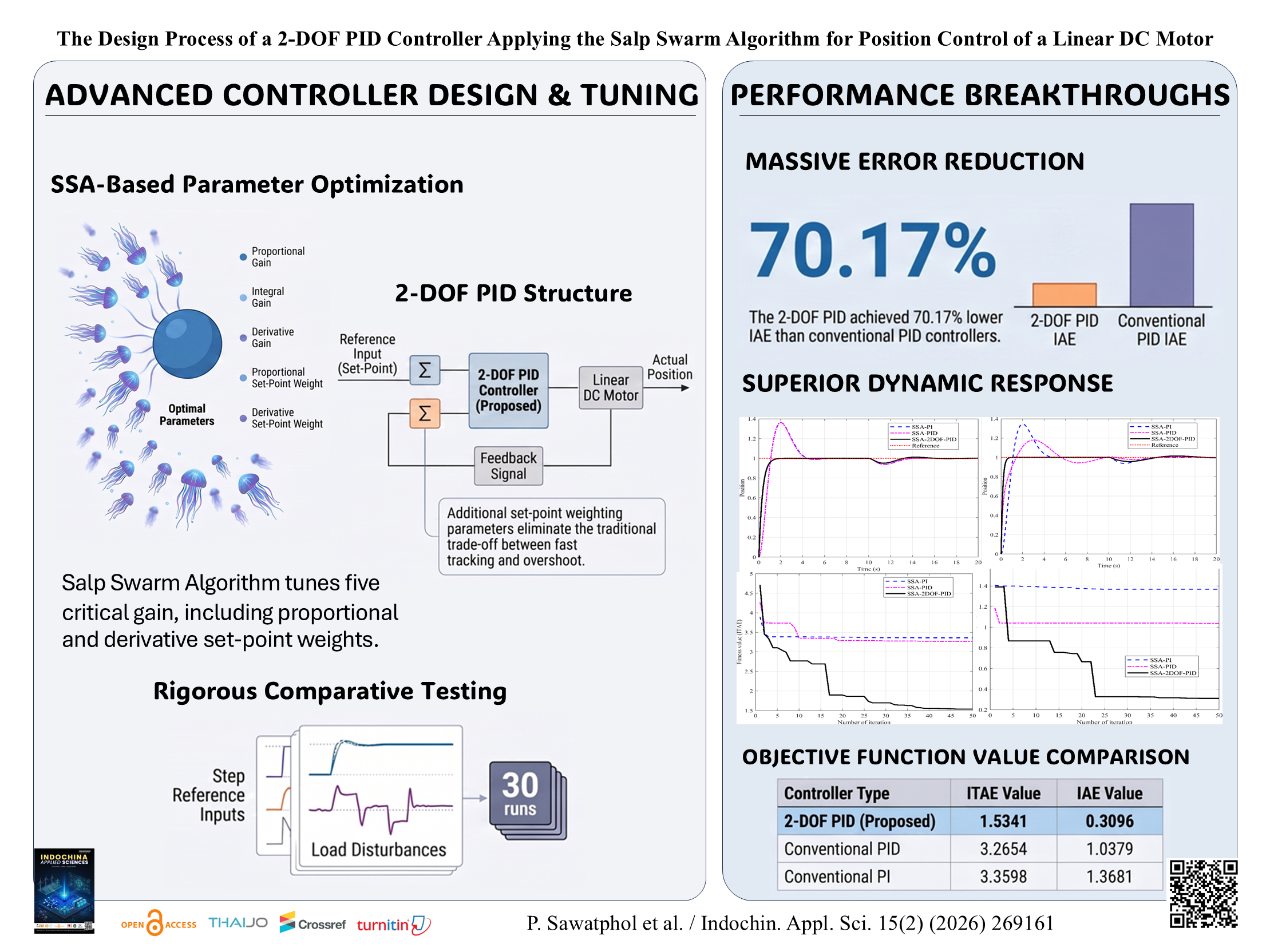
Conventional single-degree-of-freedom PI and PID controllers face a trade-off between fast tracking and low overshoot in precision position control. This paper investigates the design of a two-degree-of-freedom proportional-integral-derivative (2-DOF PID) controller for position control of a Linear DC Motor. The Salp Swarm Algorithm (SSA) is employed to tune the controller parameters, including the proportional gain, integral gain, derivative gain, proportional set-point weight, and derivative set-point weight. To provide a fair controller-structure comparison, the same SSA procedure is also applied to conventional PID and PI controllers under identical simulation conditions. The controller performance is evaluated in MATLAB/Simulink using a step reference input and a load disturbance of 0.10 N applied at t = 10 s over 30 independent runs. Two objective functions are considered: the integral of time-weighted absolute error (ITAE) and the integral of absolute error (IAE). The results show that the SSA-tuned 2-DOF PID controller provides the lowest objective function values for both tuning criteria. Under ITAE-based tuning, the proposed controller achieves an ITAE value of 1.5341, which is 53.02% lower than the PID controller and 54.34% lower than the PI controller. Under IAE-based tuning, it achieves an IAE value of 0.3096, which is 70.17% lower than the PID controller and 77.37% lower than the PI controller. The mean values over all runs are also the lowest among the three controllers. In addition, the proposed controller reduces overshoot (to 1.15% and 1.50% under ITAE and IAE, respectively) and undershoot compared with the SSA-tuned PID and PI controllers, with a fast rise time of 0.73 s and 0.30 s. These results demonstrate that the additional set-point weighting parameters of the 2-DOF PID structure improve the tracking performance of the Linear DC Motor position control system.
References
Y. Zhi, W. Weiqing, C. Jing, N. Razmjooy, Interval linear quadratic regulator and its application for speed control of DC motor in the presence of uncertainties, ISA Trans. 125 (2022) 252 – 259.
DOI: 10.1016/j.isatra.2021.07.004
V. Rajs, N.L. Rašević, M.Z. Bodić, M.M. Zuković, K.B. Babković, PID controller design for motor speed regulation with linear and non-linear load, IFAC-PapersOnLine 55(4) (2022) 225 – 229.
DOI: 10.1016/j.ifacol.2022.06.037
A. Matenga, E. Murena, G. Kanyemba, S. Mhlanga, A novel approach for developing a flexible automation system for rewinding an induction motor stator using robotic arm, Procedia Manuf. 33 (2019) 296 – 303.
DOI: 10.1016/j.promfg.2019.04.036
J. Gao, et al., A novel main drive system for the servo press: Combination of integrated motor and symmetrically toggle booster mechanism, CIRP J. Manuf. Sci. Technol. 37 (2022) 596 – 612.
DOI: 10.1016/j.cirpj.2022.03.006
J. Wang, et al., UTVC based thermal management of air-cored linear synchronous motor for high-precision CNC machine tool, Therm. Sci. Eng. Prog. 63 (2025) 103722.
DOI: 10.1016/j.tsep.2025.103722
V. Shirish Murty, S. Jain, A. Ojha, Linear switched reluctance motor for traction propulsion system using configuration of electric locomotive, Mechatronics 89 (2023) 102916.
DOI: 10.1016/j.mechatronics.2022.102916
I.S. Okoro, C.O. Enwerem, Robust control of a DC motor, Heliyon 6(12) (2020) e05777.
DOI: 10.1016/j.heliyon.2020.e05777
S.L. Ayinla, et al., Optimal control of DC motor using leader-based Harris Hawks optimization algorithm, Frankl. Open 6 (2024) 100058.
DOI: 10.1016/j.fraope.2023.100058
T. Tao, L. Hua, Decoupling control of bearingless brushless DC motor using particle swarm optimized neural network inverse system, Meas. Sens. 31 (2024) 100952.
DOI: 10.1016/j.measen.2023.100952
R. Zhang, L. Gao, The brushless DC motor control system based on neural network fuzzy PID control of power electronics technology, Optik 271 (2022) 169879.
DOI: 10.1016/j.ijleo.2022.169879
C.F. Yaşar, A. Ziraoui, A.A. Jneid, M. Ali, DC motor control lab: Comparative study of model predictive and PI control using MATLAB/Simulink, IFAC-PapersOnLine 59(7) (2025) 111 – 116.
DOI: 10.1016/j.ifacol.2025.08.032
I. Anshory, et al., Optimization DC-DC boost converter of BLDC motor drive by solar panel using PID and firefly algorithm, Results Eng. 21 (2024) 101727.
DOI: 10.1016/j.rineng.2023.101727
G. So, DS based 2-DOF PID controller for various integrating processes with time delay, ISA Trans. 153 (2024) 276 – 294.
DOI: 10.1016/j.isatra.2024.07.030
Z.U. Bayrak, Comprehensive analysis of classical and 2 DOF controllers for fuel cell powered nanogrids by Dwarf Mongoose algorithm, Int. J. Hydrogen Energy 75 (2024) 326 – 343.
DOI: 10.1016/j.ijhydene.2024.01.356
J. Lin, J. Lian, G. Zhao, H. Li, C. Xu, A 2-DOF drag-free control ground simulation system based on Stewart platform, ISA Trans. 146 (2024) 528 – 540.
DOI: 10.1016/j.isatra.2024.01.010
S. Mirjalili, A.H. Gandomi, S.Z. Mirjalili, S. Saremi, H. Faris, S.M. Mirjalili, Salp Swarm Algorithm: A bio-inspired optimizer for engineering design problems, Adv. Eng. Softw. 114 (2017) 163 – 191.
DOI: 10.1016/j.advengsoft.2017.07.002
S.N. Huang, K.K. Tan, T.H. Lee, Adaptive precision control of permanent magnet linear motors, Asian J. Control 4(2) (2002) 193 – 198.
DOI: 10.1111/j.1934-6093.2002.tb00345.x
W. Wang, B. Chen, R. Xu, D. Tian, Robust tracking control for fast steering mirror based on iterative learning enhanced 2-DOF disturbance observer, Sens. Actuators A Phys. 393 (2025) 116726.
DOI: 10.1016/j.sna.2025.116726
W. Liu, et al., Underwater remotely operated vehicle control system with optimized PID based on improved particle swarm optimization, Desalin. Water Treat. 314 (2023) 322 – 329.
DOI: 10.5004/dwt.2023.30037
K. Halder, D.K. Panda, S. Das, S. Das, A. Gupta, Specified QoS based networked observer and PI controller design with disturbance and noise rejection under random packet dropout, Physica A 604 (2022) 127965.
DOI: 10.1016/j.physa.2022.127965
K.P. Sanoj, V. Dhanya Ram, Optimal PID controller tuning for multivariable unstable systems by minimizing ITAE criteria, IFAC-PapersOnLine 57 (2024) 391 – 396.
DOI: 10.1016/j.ifacol.2024.05.067
P. Siva Krishna, P.V. Gopi Krishna Rao, Fractional-order PID controller for blood pressure regulation using genetic algorithm, Biomed. Signal Process. Control 88 (2024) 105564.
DOI: 10.1016/j.bspc.2023.105564
Downloads
Published
How to Cite
Issue
Section
License
Copyright (c) 2026 Indochina Applied Sciences

This work is licensed under a Creative Commons Attribution-NonCommercial-NoDerivatives 4.0 International License.