Optimization of Oxygen Flow for Tailoring the Properties of AZO Thin Films Deposited by DC Magnetron Sputtering
DOI:
https://doi.org/10.55674/ias.v15i3.266815Keywords:
AZO thin films, DC magnetron sputtering, Oxygen controlAbstract
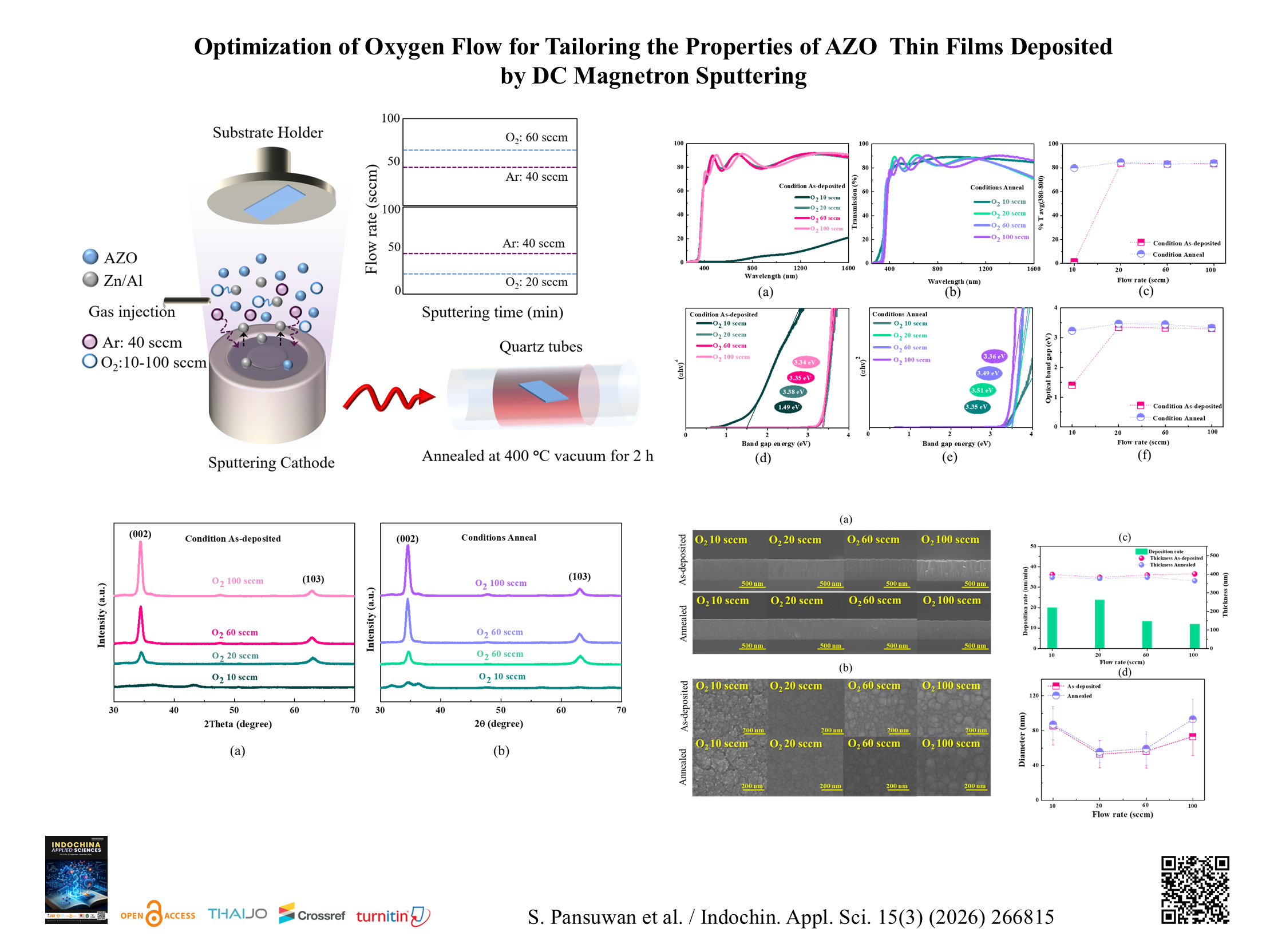
This study reports on the preparation of aluminum-doped zinc oxide (AZO) thin films by DC magnetron sputtering using a Zn/Al target. The influence of reactive oxygen gas flow rate (10–100 sccm) was investigated while maintaining a constant Ar flow rate of 40 sccm. Films were deposited on both silicon and glass substrates, and further examined in their as-deposited state as well as after annealing at 400 °C in vacuum for 2 h. Morphological, structural, optical, and electrical properties were systematically characterized by FE-SEM, GI-XRD, UV–Vis–NIR spectroscopy, and Hall effect measurements, respectively. The results reveal that increasing O₂ flow rate affects the deposition rate while the films consistently exhibit a hexagonal wurtzite structure with preferred orientations along (002) and (103). The degree of crystallinity strongly depends on the O₂ concentration. The optical transmittance was found to be in the range of 76.10–84.79%, with estimated band gap energies between 3.32 and 3.52 eV. Notably, AZO thin films deposited at an O₂ flow rate of 20 sccm exhibited optimum electrical properties, including a resistivity of 4.0 × 10⁻³ Ω·cm, conductivity of 246 S/cm, carrier mobility of 5.83 cm²·V⁻¹·s⁻¹, and carrier concentration of 2.66 × 10²⁰ cm⁻³. These findings highlight the critical role of O₂ flow control in tailoring the physical properties of AZO thin films, underscoring their potential for various optoelectronic applications.
References
M. Mohamedi, F. Challali, T. Touam, D. Mendil, S. Ouhenia, A.H. Souici, D. Djouadi, A. Chelouche, Role of substrate and annealing on microstructural, optoelectronic and luminescence properties of RF magnetron sputtered AZO thin films in confocal configuration, J. Lumin. 244 (2022) 118739.
M. Asemi, M. Ahmadi, M. Ghanaatshoar, Preparation of highly conducting Al-doped ZnO target by vacuum heat-treatment for thin film solar cell applications, Ceram. Int. 44(11) (2018) 12862 – 12868.
H. Kim, A. Piqué, J.S. Horwitz, H. Murata, Z.H. Kafafi, C.M. Gilmore, D.B. Chrisey, Effect of aluminum doping on zinc oxide thin films grown by pulsed laser deposition for organic light-emitting devices, Thin Solid Films. 377–378 (2000) 798 – 802.
P. Muthitamongkol, C. Thanachayanont, B. Samransuksamer, K. Seawsakul, M. Horprathum, P. Eiamchai, P. Chindaudom, A. Tuantranont, The effects of the argon plasma treatments on transparent conductive aluminum-dope zinc oxide thin films prepared by the pulsed DC magnetron sputtering, Mater. Today Proc. 4(5) (2017) 6248 – 6253.
R.A. Afre, N. Sharma, M. Sharon, M. Sharon, Transparent conducting oxide films for various applications: A review, Rev. Adv. Mater. Sci. 53(1) (2018) 79 – 89.
M.M. Idris, I.O. Olarinoye, M.T. Kolo, S.O. Ibrahim, Transparent conducting oxides thin film dosimetry: Present and the future, J. Rad. Nucl. Appl. 7(1) (2022) 49 – 58.
Y. Lu, S. Wang, M. Yang, X. Xu, Q. Li, Comparative study of AZO and ITO thin film sputtered at different temperatures and their application in Cu₂ZnSnS₄ solar cells, J. Mater. Sci.: Mater. Electron. 29(20) (2018) 17525 – 17532.
K. Seawsakul, M. Horprathum, P. Eiamchai, V. Patthanasettakul, P. Chindaudom, A. Tuantranont, Transparent conductive nanocolumnar AZO film coating by glancing angle deposition technique, AIP Conf. Proc. 2010 (2018) 020017.
M. Chaves, R. Ramos, E. Martins, E.C. Rangel, N.C. da Cruz, S.F. Durrant, J.R.R. Bortoleto, Al-doping and properties of AZO thin films grown at room temperature: Sputtering pressure effect, Mater. Res. 22(2) (2019) e20180665.
P. Nuchuay, C. Laongwan, W. Promcham, S. Limwichean, M. Horprathum, Effect of controlled operating pressure on physical optical and electrical properties of AZO thin film by DC magnetron sputtering technique, J. Mater. Sci. Appl. Energy. 11(3) (2022) 244616.
T. Minami, T. Miyata, Present status and future prospects for development of non- or reduced-indium transparent conducting oxide thin films, Thin Solid Films. 517(4) (2008) 1474 – 1477.
H. Liu, V. Avrutin, N. Izyumskaya, Ü. Özgür, H. Morkoç, Transparent conducting oxides for electrode applications in light emitting and absorbing devices, Superlattices Microstruct. 48(5) (2010) 458 – 484.
S. Saini, P. Mele, T. Oyake, J. Shiomi, J.-P. Niemelä, M. Karppinen, K. Miyazaki, C. Li, T. Kawaharamura, A. Ichinose, L. Molina-Luna, Porosity-tuned thermal conductivity in thermoelectric Al-doped ZnO thin films grown by mist-chemical vapor deposition, Thin Solid Films. 685 (2019) 180 – 185.
K. Necib, T. Touam, A. Chelouche, L. Ouarez, D. Djouadi, B. Boudine, Investigation of the effects of thickness on physical properties of AZO sol-gel films for photonic device applications, J. Alloys Compd. 735 (2018) 2236 – 2246.
M.H. Kabir, M.M. Ali, M.A. Kaiyum, M.S. Rahman, Effect of annealing temperature on structural morphological and optical properties of spray pyrolized Al-doped ZnO thin films, J. Phys. Commun. 3(10) (2019) 105007.
L. Ma, X. Ai, H. Quan, W. Yang, X. Du, Resistivity depends on preferred orientation for transparent conductive thin films, J. Korean Phys. Soc. 74(8) (2019) 806 – 811.
Y. Xia, P. Wang, S. Shi, M. Zhang, H. Wang, J. Zhang, Deposition and characterization of AZO thin films on flexible glass substrates using DC magnetron sputtering technique, Ceram. Int. 43(5) (2017) 4536 – 4544.
F. Challali, D. Mendil, T. Touam, T. Chauveau, V. Bockelée, A. Garcia Sanchez, A. Chelouche, M.-P. Besland, Effect of RF sputtering power and vacuum annealing on the properties of AZO thin films prepared from ceramic target in confocal configuration, Mater. Sci. Semicond. Process. 118 (2020) 105217.
D. Mendil, F. Challali, T. Touam, V. Bockelée, S. Ouhenia, A.H. Souici, D. Djouadi, A. Chelouche, Preparation of RF sputtered AZO/Cu/AZO multilayer films and the investigation of Cu thickness and substrate effects on their microstructural and optoelectronic properties, J. Alloys Compd. 860 (2021) 158470.
T.K. Subramanyam, P. Goutham, S. Pavan Kumar, S.R. Yadhuraj, K.S. Geetha, Optimization of sputtered AZO thin films for device application, Mater. Today Proc. 5(4) (2018) 10851 – 10859.
M.S. Alqahtani, N.M.A. Hadia, S.H. Mohamed, Tuning the optical, electrical resistivity and structural properties of DC magnetron sputtered aluminum zinc oxide films by changing the oxygen flow rate, Appl. Phys. A. 125(11) (2019) 776.
Y.-S. Lee, S.-Y. Zhao, Y.-Z. Lin, G.A. Porter, T.-C. Tien, Effects of oxygen flows and annealing temperatures on optical, electrical, and structural properties of co-sputtered In₂O₃-Ga₂O₃-Zn thin films, Crystals. 13(9) (2023) 1310.
B. Rajesh Kumar, B. Hymavathi, Effect of oxygen flow rate on structural, electrical and optical properties of zinc aluminum oxide thin films deposited by DC magnetron sputtering, Semiconductors. 53(4) (2019) 573 – 581.
S. Limwichean, N. Kasayapanand, C. Ponchio, H. Nakajima, V. Patthanasettakul, P. Eiamchai, G. Meng, M. Horprathum, Morphology-controlled fabrication of nanostructured WO₃ thin films by magnetron sputtering with glancing angle deposition for enhanced efficiency photo-electrochemical water splitting, Ceram. Int. 47(24) (2021) 34455 – 34462.
E. Hecht, Optics, fourth ed., Addison-Wesley, San Francisco, 2002.
K. Chandra, M.G. Mahesha, P.K. Shetty, Annealing-induced phase transformation in vapor deposited tellurium dioxide thin films and its structural, chemical analysis, Mater. Chem. Phys. 330 (2025) 130160.
S. Kundu, R. Majumder, R. Ghosh, M.P. Chowdhury, Superior positive relative humidity sensing properties of porous nanostructured Al thin films deposited by jet-atomizer spray pyrolysis technique, J. Mater. Sci.: Mater. Electron. 30(5) (2019) 4618 – 4625.
N. Haddad, Ş. Ţălu, Z. Ben Ayadi, K. Djessas, Tuning the morphology and optoelectronic performance of sputtered AZO thin films via nanopowder annealing temperature, Physica B: Condens. Matter. 735 (2026) 418675.
H.H. Nazari, L. Dejam, Investigation of post-annealing effect on Al thin films crystallinity and photoluminescence properties, Physica B: Condens. Matter. 626 (2022) 413461.
T. Minami, Transparent conducting oxide semiconductors for transparent electrodes, Semicond. Sci. Technol. 20(4) (2005) S35 – S44.
M. Zhu, H. Huang, J. Gong, C. Sun, X. Jiang, Role of oxygen desorption during vacuum annealing in the improvement of electrical properties of aluminum doped zinc oxide films synthesized by sol gel method, J. Appl. Phys. 102(4) (2007) 043106.
Downloads
Published
How to Cite
Issue
Section
License
Copyright (c) 2026 Indochina Applied Sciences

This work is licensed under a Creative Commons Attribution-NonCommercial-NoDerivatives 4.0 International License.