Balancing Accuracy and Efficiency: A Comparative Study of Deep Learning Architectures on a Limited Thai Food Dataset
DOI:
https://doi.org/10.55674/ias.v15i2.266431Keywords:
Thai food classification, Convolutional neural network, Resource-constrained learning, Model efficiency, Deployment-oriented evaluationAbstract
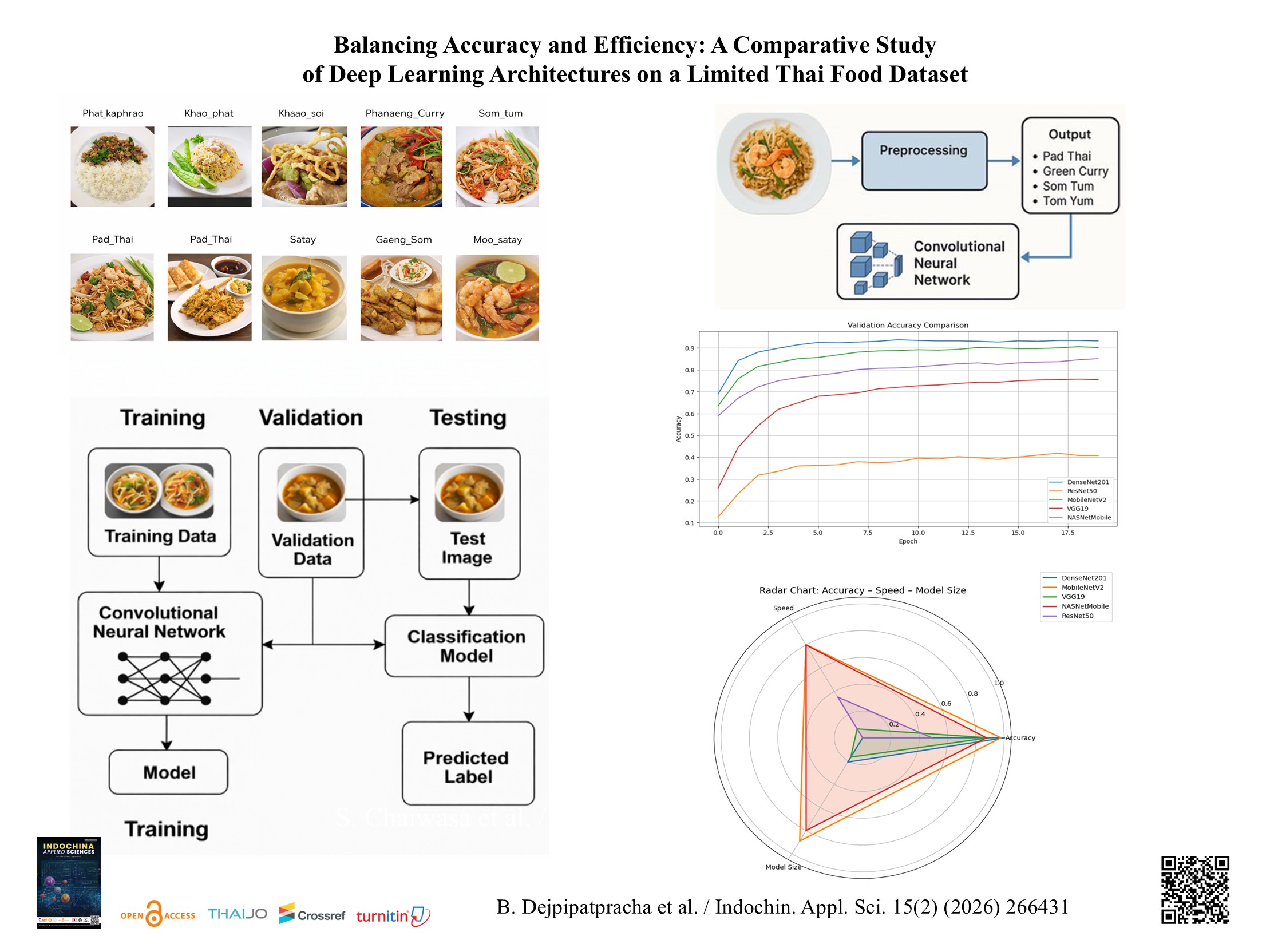
This study presents a structured benchmarking framework for evaluating five widely adopted convolutional neural network (CNN) architectures —namely DenseNet201, MobileNetV2, ResNet50, VGG19, and NASNetMobile, all initialized with ImageNet pre-trained weights and fine-tuned using transfer learning—under limited-data conditions for Thai food image classification using a curated dataset of 3,000 images across ten food categories. Rather than focusing solely on predictive accuracy, the proposed evaluation integrates computational efficiency metrics—training time, inference latency, and model size—to provide a balanced assessment of model suitability in resource-constrained contexts. Experimental results reveal a consistent trade-off between classification performance and computational demand, highlighting the importance of aligning architectural complexity with dataset scale and operational constraints. Notably, DenseNet201 achieved the highest test accuracy (0.94), while MobileNetV2 provided the most favorable efficiency profile with competitive accuracy (0.91) and the lowest computational overhead. The findings demonstrate that lightweight architectures can achieve competitive accuracy with substantially lower computational overhead, while high-capacity networks deliver marginal performance gains at increased resource cost. By introducing a normalized multi-criteria evaluation strategy, this work advances balanced benchmarking for culturally specific image classification tasks, particularly addressing the visual similarity among Thai dishes and limited availability of high-quality public datasets, and provides practical guidance for model selection in deployment-limited environments.
References
Y. He, S. Yin, Food Images Classification based on Improved Convolutional Neural Network, International Conference on Electronic Communication and Artificial Intelligence (ICECAI), IEEE, 12 – 14 May 2023, 290 – 293.
A. N. M. Zulfikri, F. Y. A. Rahman, S. Shabuddin, R. Mohamad, Food Recognition based on Deep Learning Algorithms, 2022 IEEE Symposium on Industrial Electronics & Applications (ISIEA), Langkawi Island, Malaysia, IEEE,16 – 17 July 2022, 1 – 4.
L. Luo, Research on Food Image Recognition of Deep Learning Algorithms, 2023 International Conference on Computers, Information Processing and Advanced Education (CIPAE), Ottawa, ON, Canada, IEEE, 26 – 28 August 2023, 733 – 737.
O. Russakovsky et al., ImageNet Large Scale Visual Recognition Challenge, Int. J. Comput. Vis. 115 (2015) 211 – 252.
L. Bossard et al., Food-101 – Mining Discriminative Components with Random Forests, ECCV2014, Lecture Notes in Computer Science, Computer Vision (ECCV), Zurich, Switzerland, 6 – 12 September 2014, 446 – 461.
K. He, X. Zhang, S. Ren, J. Sun, Deep Residual Learning for Image Recognition, 2016 IEEE Conference on Computer Vision and Pattern Recognition (CVPR), Las Vegas, NV, USA, 27 June 2016, 770 – 778.
G. Huang, Z. Liu, L. V. D. Maaten, Densely Connected Convolutional Networks, 2017 IEEE Conference on Computer Vision and Pattern Recognition (CVPR), 21 – 26 July 2017, 4700 – 470.
T.-H. Do, D.-D.-A. Nguyen, H.-Q. Dang, H.-N. Nguyen, P.-P. Pham and D.-T. Nguyen, 30VNFoods: A Dataset for Vietnamese Foods Recognition, 2021 IEEE International Conference on Communication, Networks and Satellite (COMNETSAT), Purwokerto, Indonesia, 17 – 18 July 2021, 311 – 315.
T. Trong Nguyen, T. Q. Nguyen, D. Vo, V. Nguyen, N. Ho, N. D. Vo, K. V. Nguyen, K. Nguyen, VinaFood21: A Novel Dataset for Evaluating Vietnamese Food Recognition, 2021 RIVF International Conference on Computing and Communication Technologies (RIVF), Hanoi, Vietnam, 19 – 21 Aug. 2021, 1 – 6.
G. Ciocca, P. Napoletano, R. Schettini, Food Recognition: A New Dataset, Experiments, and Results, IEEE J. Biomed. Health Inform. 21(3) (2017), 588 – 598.
N. Theera-Ampornpunt, P. Treepong, Thai Food Recognition Using Deep Learning with Cyclical Learning Rates, IEEE Access, 12 (2024) 174204 – 174221.
T. Chakkrit, K. Surachet, NU-InNet: Thai food image recognition using convolutional neural networks on smartphone, Journal of Telecommunication, JTEC. 9(2-6) (2017) 63 – 67.
O. M. Salim, R. M. Zeebaree, A. M. Sadeeq, A. H. Radie, Study for Food Recognition System Using Deep Learning, J. Phys.: Conf. Ser. 1963(1) 2021, 012014.
M. Sandler, A. Howard, M. Zhu, A. Zhmoginov and L.-C. Chen, MobileNetV2: Inverted Residuals and Linear Bottlenecks, 2018 IEEE/CVF Conference on Computer Vision and Pattern Recognition, Salt Lake City, UT, USA, 18 – 23 June 2018, 4510 – 4520.
Y. Kawano, K. Yanai, Food image recognition with deep convolutional features, Proceedings of the 2014 ACM International Joint Conference on Pervasive and Ubiquitous Computing: Adjunct Publication (UbiComp '14 Adjunct), New York, NY, USA, 13 September 2014, 589 – 593.
Z. Shen, A. Shehzad, S. Chen, H. Sun, J. Liu, Machine Learning Based Approach on Food Recognition and Nutrition Estimation, Procedia Comput. Sci. 174 (2020), 448 – 453.
B. Xu, X. He, Z. Qu, Asian Food Image Classification Based on Deep Learning, JCC. 9(03) (2021), 10 – 28.
S. Memiş, B. Arslan, O. Z. Batur, E. B. Sönmez, A Comparative Study of Deep Learning Methods on Food Classification Problem, 2020 Innovations in Intelligent Systems and Applications Conference (ASYU), Istanbul, Turkey, 15 – 17 October 2020, 1 – 4.
P. K. Singh, S. Susan, Transfer Learning using Very Deep Pre-Trained Models for Food Image Classification, 2023 14th International Conference on Computing Communication and Networking Technologies (ICCCNT), Delhi, India, 06 – 08 July 2023, 1 – 6.
S. Sreetha, G. Naveen Sundar, D. Narmadha, Enhancing Food Image Classification with Particle Swarm Optimization on NutriFoodNet and Data Augmentation Parameters, IJCESEN. 10(4) (2024).
P. K. Fahira, Z. P. Rahmadhani, P. Mursanto, A. Wibisono, H. A. Wisesa, Classical Machine Learning Classification for Javanese Traditional Food Image, 2020 4th International Conference on Informatics and Computational Sciences (ICICoS), Semarang, Indonesia, 10 – 11 November 2020, 1 – 5.
A. Şengür, Y. Akbulut, Ü. Budak, Food Image Classification with Deep Features, 2019 International Artificial Intelligence and Data Processing Symposium (IDAP), Malatya, Turkey, 21 – 22 September 2019, 1 – 6.
G. Ciocca, G. Micali, P. Napoletano, State Recognition of Food Images Using Deep Features, IEEE Access. 8 (2020), 32003 – 32017.
G. VijayaKumari, P. Vutkur, P. Vishwanath, Food classification using transfer learning technique, Glob. Transit. Proc. 3(1) 2022, 225 – 229.
K. Sanjeev, M. Meleet, Food Recognition Using Extreme Learning Machines, IJRASET. 10(XI) (2022), 2321 – 9653.
S. Phiphiphatphaisit, O. Surinta, Food Image Classification with Improved MobileNet Architecture and Data Augmentation, ICISS '20: Proceedings of the 3rd International Conference on Information Science and Systems, 20 April 2020, 51 – 56.
S. Yadav, Alpana, S. Chand, Automated Food image Classification using Deep Learning approach, 2021 7th InternationalConference on Advanced Computing and Communication Systems (ICACCS), Coimbatore, India, 19 – 20 March 2021, 542 – 545.
S. Yadav, S. Chand, Food image recognition based on MobileNetV2 using support vector machine, AIJR Proceedings, Proceedings of International Conference on Women Researchers in Electronics and Computing (WREC 2021), 22 – 24 April 2021, 92 – 200.
Y. Xiong, Food image recognition based on ResNet, Appl. Comput. Eng. 8 (2023), 605 – 611.
M. Chun, H. Jeong, H. Lee, T. Yoo, H. Jung, Development of Korean Food Image Classification Model Using Public Food Image Dataset and Deep Learning Methods, IEEE Access, 08 December 2022, 128732 – 128741.
A. A. Jeny, M. S. Junayed, I. Ahmed, M. T. Habib, M. R. Rahman, FoNet - Local Food Recognition Using Deep Residual Neural Networks, 2019 International Conference on Information Technology (ICIT), Bhubaneswar, India, 9 – 21 December 2019, 184 – 189.
Z. Zahisham, C. P. Lee, K. M. Lim, Food Recognition with ResNet-50, 2020 IEEE 2nd International Conference on Artificial Intelligence in Engineering and Technology (IICAIET), Kota Kinabalu, Malaysia, 26 – 27 September 2020, 1 – 5.
Downloads
Published
How to Cite
Issue
Section
License
Copyright (c) 2026 Indochina Applied Sciences

This work is licensed under a Creative Commons Attribution-NonCommercial-NoDerivatives 4.0 International License.