Bioethanol Synthesis from Extracted Cashew Apple Juice and Its Application in Bioethanol-Gel Production
DOI:
https://doi.org/10.55674/ias.v15i2.265644Keywords:
Bioethanol gel, Cashew apple, Caloric value, Moveable heat testAbstract
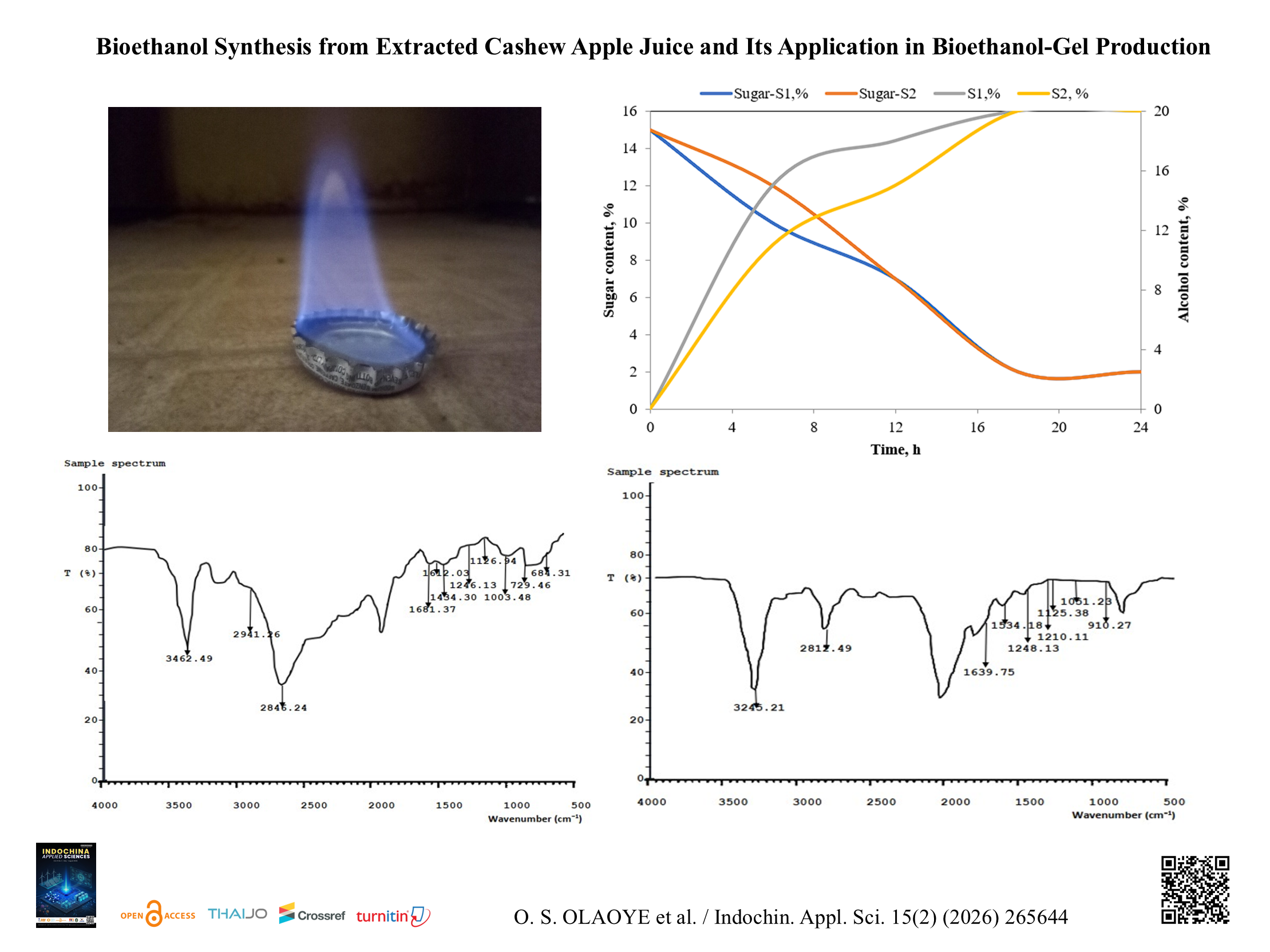
In an attempt to create accessible energy and safe cooking conditions, this investigation reports the preliminary findings on the feasibility of producing bioethanol from cashew apples and its application in producing BioEthanol Gel (BEG) for cooking activities. Bioethanol was produced from the fermentation of Extracted Cashew apple Juice (ECJ), both with the addition of baker's yeast and through spontaneous fermentation (without yeast). The fermented ECJs were distilled, and the recovered bioethanol was used for the blending of BEG with Carboxylmethyl Cellulose (CMC). The physicochemical properties of the distilled bioethanol fall within established ethanol standards. The percentage of ethanol distilled by both fermented juices is similar (10.50 and 10%), while the concentration of the ethanol distilled was 60%. The optimal gel-to-bioethanol ratio of 2.80 yielded the longest combustion time of 112 s and the lowest ash residue of 0.033 g. This approach demonstrates that cashew apple juice can be effectively processed into ethanol, and that bioethanol gel offers a practical safety advantage over liquid ethanol for cooking applications.
References
A. Emmanuel et al., “Household food insecurity and cooking energy access in Nigeria : A panel data approach,” Energy Nexus, vol. 12, no. February, p. 100242, 2023, doi: 10.1016/j.nexus.2023.100242.
A. R. Silwal and A. Mckay, “The Impact of Cooking with Firewood on Respiratory Health : Evidence from Indonesia The Impact of Cooking with Firewood on Respiratory Health : Evidence from Indonesia,” vol. 0388, no. February, 2016, doi: 10.1080/00220388.2015.1056784.
O. Bede-ojimadu and O. E. Orisakwe, “Exposure to Wood Smoke and Associated Health Effects in Sub-Saharan Africa : A Systematic Review,” vol. 86, no. 1, pp. 1–27, 2020.
O. Stabridis and E. Van Gameren, “Exposure to firewood : Consequences for health and labor force participation in Mexico,” World Dev., vol. 107, pp. 382–395, 2018, doi: 10.1016/j.worlddev.2018.03.009.
G. Ana, B. Adeniji, and O. Ige, “Exposure to emissions from firewood cooking stove and the pulmonary health of women in Olorunda community ,” pp. 465–471, 2013, doi: 10.1007/s11869-012-0183-6.
A. M. Stanley, D. W. Dadu, I. A. Joshua, and E. R. Uchenna, “PERCEPTION OF HAZARDS ASSOCIATED WITH COOKING FUEL IN,” Niger. J. Technol., vol. 32, no. 3, pp. 550–555, 2013.
A. Vita, F. Fibriana, T. Widiatningrum, and R. Dwita, “Biocatalysis and Agricultural Biotechnology Bioconversion and valorization of cassava-based industrial wastes to bioethanol gel and its potential application as a clean cooking fuel,” vol. 35, no. June, 2021.
M. A. Okusanya, G. W. Ibrahim, and C. B. Ogunlade, “The Use of Ethanol Gel Cook-Stove as a more Accessible Alternative Cooking The Use of Ethanol Gel Cook-Stove as a more Accessible Alternative Cooking Energy,” Interational J. Eng. Sci. Invent., vol. 8, no. 1, pp. 15–22, 2019.
P. O. Oketch, H. M. Ndiritu, and B. B. Gathitu, “Experimental Study of Fuel Efficiency and Emissions Comparison from Bio-ethanol Gel Stoves,” in Proceedings of 2014 International Conference on Sustainable Research and Innovation, 2014, pp. 7–13.
N. C. Princewill, N. U. Charles, and U. S. Ekene, “Performance Assessment of a Portable Improved Bio-Ethanol Gel Clean-Cook stove,” Int. J. Adv. Sci. Eng., vol. 10, no. 1, pp. 3237–3245, 2023, doi: 10.29294/ijase.10.1.2023.3237-3245.
J. A. Osei, “Utilization of Corn ( Zea Mays ) wastes in Bioethanol production by Separate Hydrolysis and Fermentation,” J. Environ. Sustain., vol. 5, no. 3, pp. 146–154, 2021.
M. Persson, M. Galbe, and O. Wallberg, “A strategy for synergistic ethanol yield and improved production predictability through blending feedstocks,” Biotechnol. Biofuels, vol. 13, pp. 1–11, 2020, doi: 10.1186/s13068-020-01791-z.
L. Luque et al., “Biotechnology for Biofuels Comparison of ethanol production from corn cobs and switchgrass following a pyrolysis ‑ based biorefinery approach,” Biotechnol. Biofuels, vol. 9, pp. 1–14, 2016, doi: 10.1186/s13068-016-0661-4.
A. Bušić, G. Morzak, H. Belskaya, and I. Šantek, “Bioethanol Production from Renewable Raw Materials and Its Separation and Purification : A Review,” Food Technol. Biotechnol., vol. 56, no. 3, pp. 289–311, 2018, doi: 10.17113/ftb.56.03.18.5546.
S. Beluhan, K. Mihajlovski, B. Santek, and M. I. Santek, “The Production of Bioethanol from Lignocellulosic Biomass : Pretreatment Methods, Fermentation and Downstream Processing,” Energies, vol. 16, pp. 1–38, 2023.
N. Delphine et al., “Waste Cashew Apple ( Anacardium occidentale ) as Feedstock for Simultaneous Production of Two Main Ecofriendly Fuels,” J. Power Energy Eng., vol. 11, pp. 16–31, 2023, doi: 10.4236/jpee.2023.118002.
E. D. Deenanath, K. Rumbold, and S. Iyuke, “ The Production of Bioethanol from Cashew Apple Juice by Batch Fermentation Using Saccharomyces cerevisiae Y2084 and Vin13 ,” ISRN Renew. Energy, vol. 2013, pp. 1–11, 2013, doi: 10.1155/2013/107851.
A. K. Adesanya et al., “Opportunities in Nigerian cashew nut value chain,” World J. Adv. Res. Rev., vol. 9, no. 1, pp. 168–174, 2021.
E. I. Ohimain, “Energy for Sustainable Development The bene fi ts and potential impacts of household cooking fuel substitution with bio-ethanol produced from cassava feedstock in Nigeria,” Energy Sustain. Dev., vol. 16, no. 3, pp. 352–362, 2012, doi: 10.1016/j.esd.2012.06.003.
A. M. Ige and A. E. Adeleke, “Investigation of Thermo Physical Properties of Bioethanol Production from Cashew Pulps using Palm Wine Yeast,” Adeleke Univ. J. Eng. Technol., vol. 5, no. 2, pp. 50–55, 2022.
D. Shenoy et al., “A study on bioethanol production from cashew apple pulp and coffee pulp waste,” Biomass and Bioenergy, vol. 35, no. 10, pp. 4107–4111, 2011, doi: 10.1016/j.biombioe.2011.05.016.
V. A. Amalia, F. Fibriana, T. Widiatningrum, and R. Dwita, “Bioconversion and valorization of cassava-based industrial wastes to bioethanol gel and its potential application as a clean cooking fuel,” Biocatal. Agric. Biotechnol., vol. 35, no. June, p. 102093, 2021, doi: 10.1016/j.bcab.2021.102093.
W. F. Az-zahra, N. N. Harahap, S. H. Putra, and M. Z. E. Sinaga, “Production of Bioethanol Gel from Sugar Cane Waste with Carbopol as Alternative Fuel,” in 1st International Conference on Chemical Science andTechnology Innovation (ICOCSTI 2019), 2019, pp. 124–129. doi: 10.5220/0008857501240129.
ASTM D445-21, “Standard Test Method for Kinematic Viscosity of Transparent and Opaque Liquids (and Calculation of Dynamic Viscosity),” 2021.
ASTM D240-19, “Standard Test Method for Heat of Combustion of Liquid Hydrocarbon Fuels by Bomb Calorimeter,” 2019.
A. E3085-17, “Standard Guide for Fourier Transform Infrared Spectroscopy in Forensic Tape Examinations,” 2022.
V. Hanun and D. H. Sutjahjo, “Komparasi Karakteristik Bioetanol Gel dengan Pengental Karbopol dan Carboxy Methyl Cellulose (CMC) sebagai Bahan Bakar Alternatif,” J. Pendidik. Tek. Mesin, vol. 7, no. 2, pp. 14–20, 2018.
I. Telussa, E. Fransina, J. Singerin, and M. Taipabu, “Bioethanol Production From Tropical Marine Microalgae Ambon Bay Navicula sp. of The Inner Ambon Bay Strain,” Indones. J. Chem. Res., vol. 10, no. 3, pp. 136–142, 2023, doi: 10.30598//ijcr.2023.10-ivo.
Z. Hamden, Y. El-ghoul, F. M. Alminderej, and S. M. Saleh, “High-Quality Bioethanol and Vinegar Production from Saudi Arabia Dates : Characterization and Evaluation of Their Value and Antioxidant Efficiency,” Antioxidants, vol. 11, pp. 1–19, 2022.
A. S. Bala, D. D. Musa, and F. T. Muhammad, “Production of Bioethanol from Rotten Watermelon ( Citrullus lanatus ) and Banana ( Musa sapientum ) Using Enzymatic Approach,” Sahel J. Life Sci., vol. 1, no. r, pp. 163–168, 2023.
A. K. Rabiu, C. M. Elinge, M. M. Ambursa, A. K. Rabiu, and D. S. Samaila, “Characterization of Bioethanol Fuel from Rice and Corn Straws : A Comparative Study,” Equity J. Sci. Technol., vol. 8, no. 1, pp. 74–78, 2021.
Downloads
Published
How to Cite
Issue
Section
License
Copyright (c) 2026 Indochina Applied Sciences

This work is licensed under a Creative Commons Attribution-NonCommercial-NoDerivatives 4.0 International License.