A Feasibility of Applying Phase Change Materials Derived from Polymer/VO2 Composites to Enhance Performance of PV Modules
DOI:
https://doi.org/10.55674/ias.v14i2.260512Keywords:
Polymer composites, Vanadium dioxides, NIR shielding films, PV coolingAbstract
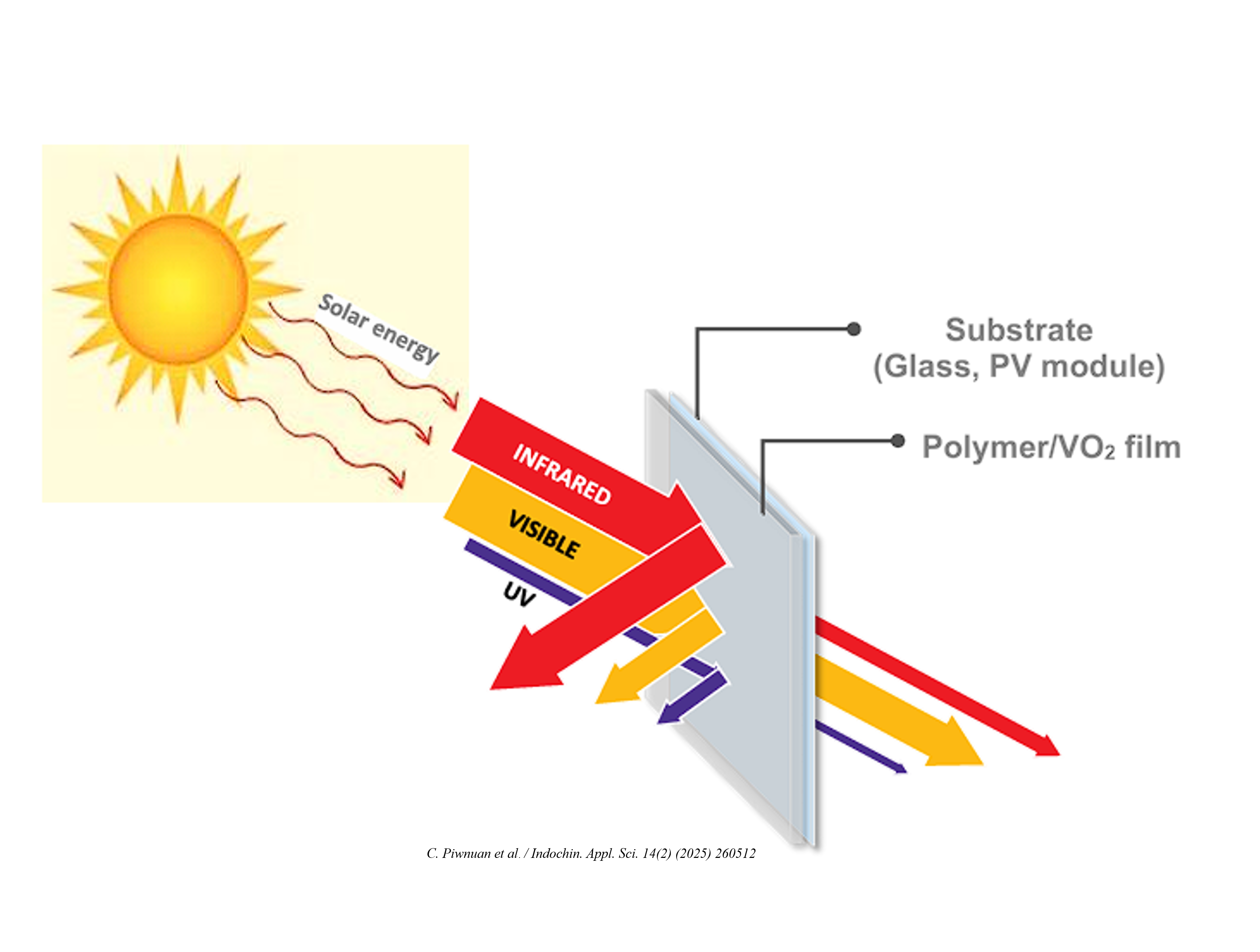
This study investigates the feasibility of using vanadium dioxide (VO2), a thermochromic and phase change material, to enhance the performance of photovoltaic (PV) modules. By coating a polymer film loaded with VO2 onto the modules, it was hypothesized that the module temperature can be reduced due to the endothermic latent heat associated with the phase transition of VO2. As a result, an improvement in power conversion efficiency (PCE) is expected. Firstly, VO2 particles were synthesized via a hydrothermal method and subsequently mixed with an acrylic binder at various concentrations (0.1-1.5 wt%) prior to film casting. Crystalline structure and morphology of the polymer composite films were characterized by X-ray diffraction and scanning electron microscopy techniques. Transition temperatures and optical properties of the composite films were determined by differential scanning calorimetry and UV/Vis spectroscopy. Heat shielding properties of the films were evaluated by monitoring temperature change inside a model house installed with the polymer composite films. The system exhibited remarkable temperature reduction with higher particle loading resulting in a more temperature drop. Additionally, the feasibility of applying these films to enhance the efficiency of PV modules was explored. Compared to reference PV modules without coating, the efficiency of the devices coated with polymer/VO2 film increased by approximately 1.74 %. The results were discussed in relation to phase transition, latent heat of VO2.
References
D.B. Seto, B. Kristiawan, Ubaidillah, Z. Arifin, Solar cell cooling with phase change material (PCM) for enhanced efficiency: a review, IOP Conf. Ser.: Mater. Sci. Eng. 1096 (2021) 012052.
A. Ahmad, H. Navarro, S. Ghosh, Y. Ding, J.N. Roy, Evaluation of new PCM/PV configurations for electrical energy efficiency improvement through thermal management of PV systems, Energies 14(14) (2021) 4130.
N.R. Patel, P.B. Shah, A.M. Mavani, A review on solar photovoltaic system with phase change material cooling, J. Emerg. Technol. Innov. Res. 7(5) (2020) 843 – 853.
D.B. Seto, Z. Arifin, B. Kristiawan, S.D. Prasetyo, Nanoparticle-enhanced phase change materials (NePCM) in passive cooling systems to improve solar panel efficiency, Int. Rev. Mech. Eng. 18(1) (2024) 24149.
L.T. Siow, J.R. Lee, E.H. Ooi, E.V. Lau, Application of graphene and graphene derivatives in cooling of photovoltaic (PV) solar panels: a review, Renew. Sust. Energ. Rev. 193 (2024) 114288.
Z.R. Tahir, A. Kanwal, M. Asim, M. Bilal, M. Abdullah, S. Saleem, M.A. Mujtaba, I. Veza, M. Mousa, M.A. Kalam, Effect of temperature and wind speed on efficiency of five photovoltaic module technologies for different climatic zones, Sustainability 14(23) (2022) 15810.
M. Sharaf, M.S. Yousef, A.S. Huzayyin, Review of cooling techniques used to enhance the efficiency of photovoltaic power systems, Environ. Sci. Pollut. Res. 29 (2022) 26131 – 26159.
A. Hasan, H. Alnoman, Y. Rashid, Impact of integrated photovoltaic-phase change material system on building energy efficiency in hot climate, Energy Build. 130 (2016) 495 – 505.
S.A. Nada, D.H. El-Nagar, H.M.S. Hussein, Improving the thermal regulation and efficiency enhancement of PCM-Integrated PV modules using nano particles, Energy Convers. Manag. 166 (2018) 735 – 743.
L. Siahkamari, M. Rahimi, N. Azimi, M. Banibayat, Experimental investigation on using a novel phase change material (PCM) in micro structure photovoltaic cooling system, Int. Commun. Heat Mass Transf. 100 (2019) 60 – 66.
T. Cheng, N. Wang, H. Wang, R. Sun, C.P. Wong, A newly designed paraffin@VO2 phase change material with the combination of high latent heat and large thermal conductivity, J. Colloid Interface Sci. 559 (2020) 226 – 235.
A.H.A. Al-Waeli, K. Sopian, M.T. Chaichan, H.A. Kazem, A. Ibrahim, S. Mat, M.H. Ruslan, Evaluation of the nanofluid and nano-PCM based photovoltaic thermal (PVT) system: an experimental study, Energy Convers. Manag. 151 (2017) 693 – 708.
Y. Gao, H. Luo, Z. Zhang, L. Kang, Z. Chen, J. Du, M. Kanehira, C. Cao, Nanoceramic VO2 thermochromic smart glass: a review on progress in solution processing, Nano Energy 1(2) (2012) 221 – 246.
M.L.F. Bayard, T.G. Reynolds, M. Vlasse, H.L. McKinzie, R.J. Arnott, A. Wold, Preparation and properties of oxyfluoride systems V2O5-xFx and VO2-xFx, J. Solid State Chem. 3(4) (1971) 484 – 489.
D. Li, M. Li, J. Pan, Y. Luo, H. Wu, Y. Zhang, G. Li, Hydrothermal synthesis of Mo-doped VO2/TiO2 composite nanocrystals with enhanced thermochromic performance, ACS Appl. Mater. Interfaces 6(9) (2014) 6555 – 6561.
Z. Peng, W. Jiang, H. Liu, Structural phase transition of tungsten-doped vanadium dioxide nanopowders prepared by thermolysis, J. Nanosci. Nanotechnol. 8(3) (2008) 1417 – 1421.
O. Srirodpai, J. Wootthikanokkhan, S. Nawalertpanya, Preparation, characterizations and oxidation stability of polyethylene coated nanocrystalline VO2 particles and the thermo-chromic performance of EVA/VO2@PE composite film, J. Nanosci. Nanotechnol. 19(6) (2019) 3356 – 3366.
T. Sakuldeemeekiat, N. Luamsri, J. Wootthikanokkhan, M. Phiriyawirut, The effects of thermochromic pigments on optical, mechanical and heat insulation properties of plasticized PVC window film, J. Thermoplast. Compos. Mater. 33(9) (2020) 1196 – 1216.
O. Srirodpai, J. Wootthikanokkhan, S. Nawalertpanya, Thermochromic and temperature regulation properties of phase change materials derived from polymer composites loaded with VO2 particles, Polym. Adv. Technol. 34(6) (2023) 1933 – 1947.
O. Srirodpai, J. Wootthikanokkhan, S. Nawalertpanya, K. Yuwawech, V. Meeyoo, Preparation, characterization and thermo-chromic properties of EVA/VO2 laminate films for smart window applications and energy efficiency in building, Materials 10(1) (2017) 53.
Technical data sheet PLIOTEC™ HDT12 M, https:// www.synthomer.com/Media/tds/PLIOTEC%20HDT12%20M.pdf, 1 October 2024.
L. Janamphansang, J. Wootthikanokkhan, S. Nawalertpanya, Preparation of VO2 nanoparticles with surface functionalization for thermochromic application, Eng. J. 23(5) (2019) 205 – 215
N. Luamsri, J. Wootthikanokkhan, E. Wimolmala, P. Rakkwamsuk, W. Sangkhun, Spectral selectivity and stability of energy-saving window films based on poly(vinyl chloride) reinforced with ATO nanoparticles, Polym. Test. 80 (2019) 106157.
C. Takai, M. Senna, S. Hoshino, H. Razavi-Khosroshahi, M. Fuji, Chemical and thermal properties of VO2 mechanochemically derived from V2O5 by co-milling with paraffin wax, RSC Adv. 8(38) (2018) 21306 – 21315.
C. LI, S. Chen, R. Gao, R. Li, C. Hou, H. Wang, H. Xie, Q. Zhang, Sb-doped Tin Oxide Thin Film: Preparation and Effect on Cooling Silicon Solar Cells. J. Ino. Mater., 34(5) (2019) 515 – 520.
R. Gao, H. Ziong, R. Li, C. Hou, Y. Li, Q. Zhang, H. Wang, Antimony Doped Tin Oxide Infrared Shielding Films for Cooling Silicon Solar Cells. In: Han, Y. (eds) Advanced Functional Materials. Proceedings of Chinese Materials Conference (CMC 2017), Springer, Singapore. (2018) 817 – 829.
P. Dwivedi, K. Sudhakar, A. Soni, E. Solomin, I. Kirpichnikova, Advanced cooling techniques of P.V. modules: a state of art, Case Stud. Therm. Eng. 21 (2020) 100674.
A. Waqas, J. Ji, A. Bahadar, L. Xu, Zeshan, M. Modjinou, Thermal management of conventional photovoltaic module using phase change materials-an experimental investigation, Energy Explor. Exploit. 37(5) (2019) 1516 – 1540.
Y.S. Indartono, A. Suwono, F.Y. Pratama, Improving photovoltaics performance by using yellow petroleum jelly as phase change material, Int. J. Low Carbon Technol. 11(3) (2016) 333 – 337.
F.K. Aldawood, Y. Munusamy, M. Kchaou, M. Alquraish, Effect of elastomeric coating on the properties and performance of myristic acid (MA) phase change material (PCM) used for photovoltaic cooling, Coatings 13(9) (2023) 1606.
Thermal Conductivity, Specific Heat Capacity and Density, https:// help.iesve.com/ve2021/table_6_thermal_ conductivity__ specific_heat_capacity_and_density.htm, 1 October 2024.
M. Kok, K. Demirelli, Y. Aydogdu, Thermophysical properties of blend of poly(vinyl chloride) with poly(isobornyl acrylate), Int. J. Sci. Technol. 3(1) (2008) 37 – 42.
H. Nabi, M. Gholinia, M. Khiadani, A. Shafieian, Performance enhancement of photovoltaic-thermal modules using a new environmentally friendly paraffin wax and red wine-rGO/H2O nanofluid, Energies 16(11) (2023) 4332.
Downloads
Published
How to Cite
Issue
Section
License
Copyright (c) 2025 Indochina Applied Science

This work is licensed under a Creative Commons Attribution-NonCommercial-NoDerivatives 4.0 International License.