
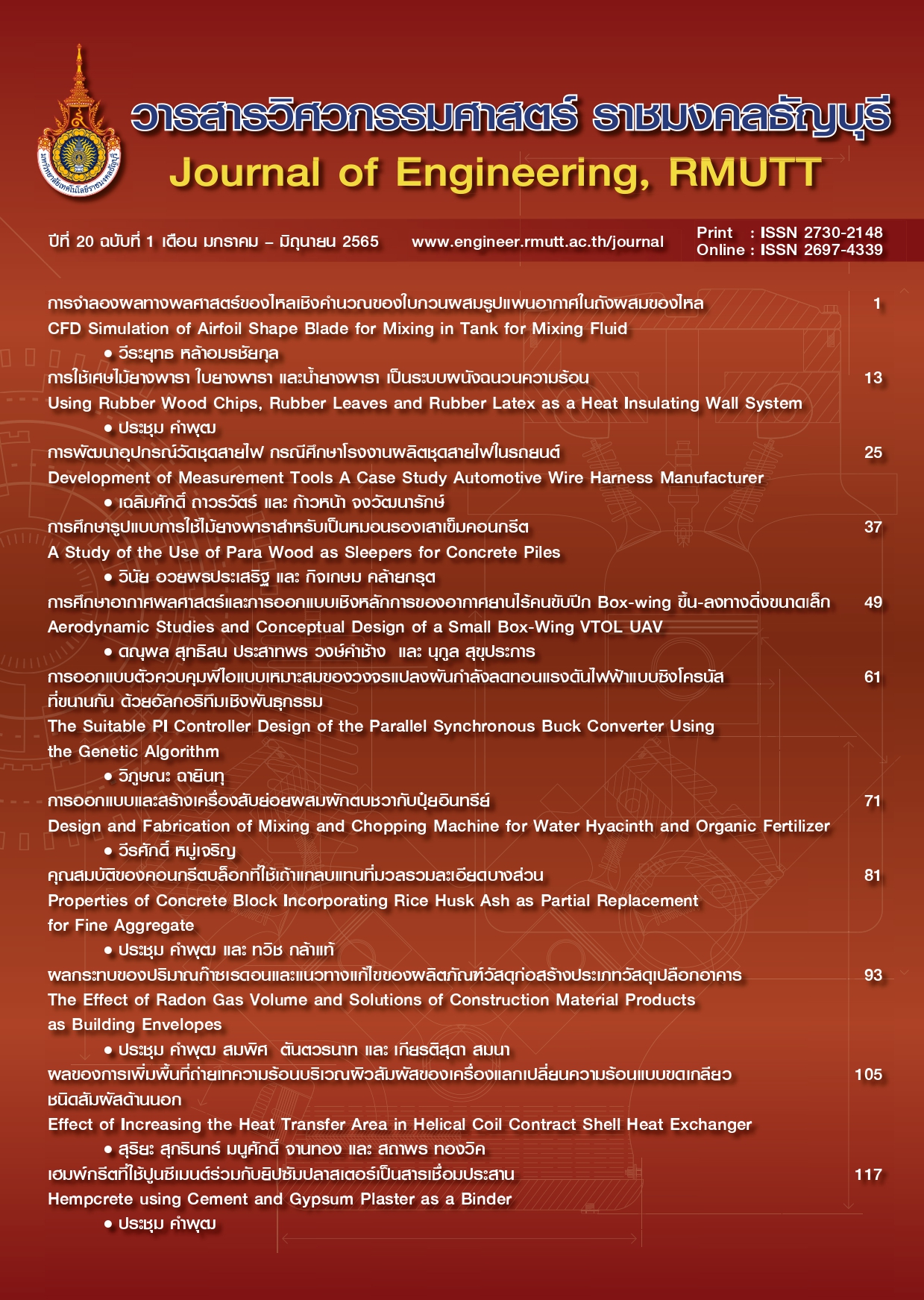
ผลของการเพิ่มพื้นที่ถ่ายเทความร้อนบริเวณผิวสัมผัสของเครื่องแลกเปลี่ยนความร้อนแบบขดเกลียวชนิดสัมผัสด้านนอก
Article Sidebar
Main Article Content
บทคัดย่อ
บทความฉบับนี้เป็นการนำเสนอการวิเคราะห์ทางความร้อนของขดท่อสารทำงาน (helical coil) ในเครื่องแลกเปลี่ยนความร้อนแบบขดเกลียวชนิด coil-contract-shell (CCS) ซึ่งใช้งานร่วมกับระบบปั๊มความร้อน (Heat pump) ที่ผ่านขั้นตอนการเพิ่มพื้นที่ผิวสัมผัสด้านข้างของขดท่อสารทำงาน ด้วยกรรมวิธีการรีดจากท่อที่มีหน้าตัดกลม (OC) ให้หน้าตัดของท่อมีลักษณะแบน (FC) ผลของการทดสอบในตัวอย่างขดท่อสารทำงานทั้ง 3 แบบ โดยใช้น้ำอุณหภูมิ 50 ◦C เป็นสารทำงาน และควบคุมอัตราการไหลในอยู่ช่วง 0.2-2.5 ลิตรต่อนาทีภายใต้สภาวะอุณหภูมิบริเวณผิวท่อคงที่ พบว่าตัวอย่างขดท่อที่ผ่านกรรมวิธีการรีดแล้วนั้นจะไฮดรอลิกไดมิเตอร์สูงขึ้น จากการทดสอบตัวอย่าง FC ที่มีไฮดรอลิกไดมิเตอร์สูงสุด มีการถ่ายเทความร้อนรวมลดลงเฉลี่ย 21% และความสามารถในการพาความร้อนลดลง เมื่อเทียบกับตัวอย่าง FC ที่มีไฮดรอลิกไดมิเตอร์ต่ำที่สุด โดยมีอัตราการไหลเป็นปัจจัยเสริม ในทางกลับกันตัวอย่าง FC ที่มีไฮดรอลิกไดมิเตอร์สูงสุดนั้น มีการถ่ายเทพลังงานความร้อนบริเวณผิวข้างเพิ่มขึ้นเฉลี่ย 37% ซึ่งถือว่าเป็นผลดีต่อเครื่องแลกเปลี่ยนความร้อนชนิดนี้ เพราะเป็นการถ่ายเทพลังงานความร้อนในด้านที่สัมผัสกับถังเก็บสารตัวนำ เมื่อเทียบกับท่อกลมหรือ FC ที่มีไฮดรอลิกไดมิเตอร์ต่ำที่มีการถ่ายเทความร้อนรวมที่สูงกว่า แต่กลับเป็นการถ่ายเทความร้อนไปสู่ด้านที่หุ้มฉนวนกันความร้อนเสียเป็นส่วนใหญ่
Article Details

อนุญาตภายใต้เงื่อนไข Creative Commons Attribution-NonCommercial-NoDerivatives 4.0 International License.
บทความ ข้อมูล เนื้อหา รูปภาพ ฯลฯ ที่ได้รับการตีพิมพ์ในวารสารแนวหน้าวิจัยนวัตกรรมทางวิศวกรรม ถือเป็นลิขสิทธิ์ของวารสารฯ เท่านั้น ไม่อนุญาติให้บุคคลหรือหน่วยงานใดคัดลอกเนื้อหาทั้งหมดหรือส่วนหนึ่งส่วนใดไปเผยแพร่เพื่อกระทำการใด ๆ ที่ไม่ถูกต้องตามหลักจริยธรรม
เอกสารอ้างอิง
Yang L, Yuan H, Peng J-W, Zhang C-L. Performance modeling of air cycle heat pump water heater in cold climate. Renewable Energy. 2016;87:1067-75.
Ramaraj S, Braun JE, Groll EA, Horton WT. Performance analysis of liquid flooded compression with regeneration for cold climate heat pumps. International Journal of Refrigeration. 2016;68:50-8.
Nouri G, Noorollahi Y, Yousefi H. Solar assisted ground source heat pump systems – A review. Applied Thermal Engineering. 2019;163.
Yang Z, Qu M, Gluesenkamp KR. Ammonia-based chemisorption heat pumps for cold-climate heating applications: A comprehensive review. Applied Thermal Engineering. 2020;179.
Arpagaus C, Bless F, Schiffmann J, Bertsch SS. Multi-temperature heat pumps: A literature review. International Journal of Refrigeration. 2016;69:437-65.
Gao P, Chang M-M, Zhang C-L, Shao L-L. System principles and applications of hybrid sorption–compression heat pump – A review. International Journal of Refrigeration. 2019;108:14-25.
Lazzarin R. Heat pumps and solar energy: A review with some insights in the future. International Journal of Refrigeration. 2020;116 :146-60.
Bellos E, Tzivanidis C, Moschos K, Antonopoulos KA. Energetic and financial evaluation of solar assisted heat pump space heating systems. Energy Conversion and Management. 2016;120:306-19.
Kong R, Deethayat T, Asanakham A, Kiatsiriroat T. Performance and economic evaluation of a photovoltaic/thermal (PV/T)-cascade heat pump for combined cooling, heat and power in tropical climate area. Journal of Energy Storage. 2020;30.
Yang H, Cui P, Fang Z. Vertical-borehole ground-coupled heat pumps: A review of models and systems. Applied Energy. 2010; 87(1):16-27.
Ortega I, Sieres J, Cerdeira F, Álvarez E, Rodríguez J. Performance analysis of a R407C liquid-to-water heat pump: Effect of a liquid–vapor heat exchanger and domestic hot water production. International Journal of Refrigeration. 2019;101:125-35.
Chingulpitak S, Wongwises S. A comparison of flow characteristics of refrigerants flowing through adiabatic straight and helical capillary tubes. International Communications in Heat and Mass Transfer. 2011;38(3):398-404.
Blanco DL, Nagano K, Morimoto M. Experimental study on a monovalent inverter-driven water-to-water heat pump with a desuperheater for low energy houses. Applied Thermal Engineering. 2013;50(1):826-36.
Jamshidi N, Farhadi M, Ganji DD, Sedighi K. Experimental analysis of heat transfer enhancement in shell and helical tube heat exchangers. Applied Thermal Engineering. 2013;51(1-2):644-52.
Ghorbani N, Taherian H, Gorji M, Mirgolbabaei H. An experimental study of thermal performance of shell-and-coil heat exchangers. International Communications in Heat and Mass Transfer. 2010;37(7):775-81.
Askar E, Schröder V, Schmid T, Schwarze M. Explosion characteristics of mildly flammable refrigerants ignited with high-energy ignition sources in closed systems. International Journal of Refrigeration. 2018;90:249-56.
Colbourne D, Suen KO. Comparative evaluation of risk of a split air conditioner and refrigerator using hydrocarbon refrigerants. International Journal of Refrigeration. 2015;59:295-303.
Yunus AC. Heat and mass transfer: fundamentals and applications: McGraw-Hill Education; 2019.
Hussein AM, Dawood HK, Bakara RA, Kadirgamaa K. Numerical study on turbulent forced convective heat transfer using nanofluids TiO 2 in an automotive cooling system. Case Studies in Thermal Engineering. 2017;9:72-8.
Pavan Kumar E, Kumar Solanki A, Mohan Jagadeesh Kumar M. Numerical investigation of heat transfer and pressure drop characteristics in the micro-fin helically coiled tubes. Applied Thermal Engineering. 2021;182.
Schmidt EFJCIT. Wärmeübergang und druckverlust in rohrschlangen. 1967;39(13) :781-9.
Hardik BK, Baburajan PK, Prabhu SV. Local heat transfer coefficient in helical coils with single phase flow. International Journal of Heat and Mass Transfer. 2015;89:522-38.
Kong R, Deethayat T, Asanakham A, Kiatsiriroat T. Heat transfer phenomena on waste heat recovery of combustion stack gas with deionized water in helical coiled heat exchanger. Case Studies in Thermal Engineering. 2018;12:213-22.
Abdolbaqi MK, Azmi WH, Mamat R, Mohamed NMZN, Najafi G. Experimental investigation of turbulent heat transfer by counter and co-swirling flow in a flat tube fitted with twin twisted tapes. International Communications in Heat and Mass Transfer. 2016;75:295-302.
