
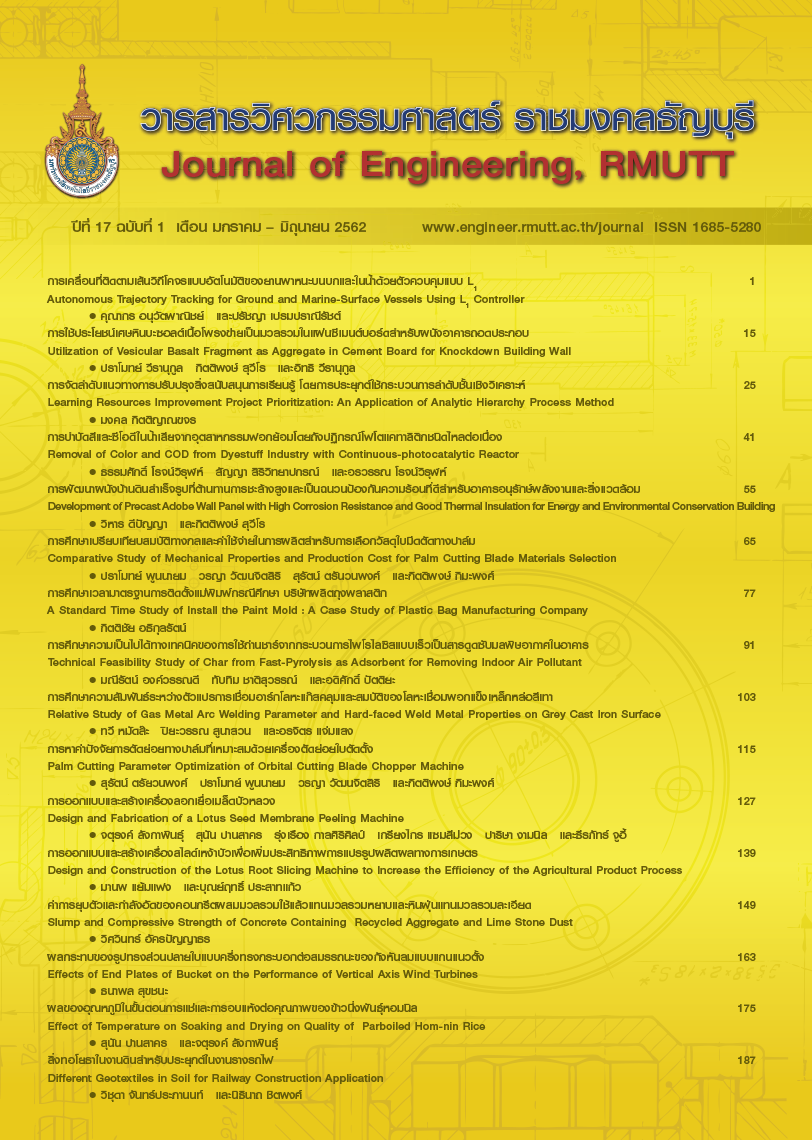
การศึกษาความสัมพันธ์ระหว่างตัวแปรการเชื่อมอาร์กโลหะแก๊สคลุมและ สมบัติของโลหะเชื่อมพอกแข็งเหล็กหล่อสีเทา
Article Sidebar
Main Article Content
บทคัดย่อ
การเชื่อมพอกแข็งเป็นหนึ่งในวิธีการเพิ่มสมบัติทางกลของพื้นผิวชิ้นส่วนเครื่องจักร เช่น ความแข็ง หรือความต้านทานการเสียดสี ที่สามารถทำได้ง่ายและการปฏิบัติการไม่ซับซ้อน อย่างไรก็ตามการเปลี่ยนแปลงวัสดุพื้นผิวหรือวัสดุของผิวพอกแข็งที่มีการกระทำอย่างต่อเนื่องส่งผลทำให้ต้องมีการศึกษาเพื่อจัดทำข้อกำหนดจำเพาะขั้นตอนการเชื่อมใหม่ งานวิจัยนี้มีจุดประสงค์ในการศึกษาตัวแปรการเชื่อมอาร์กโลหะแก๊สคลุมประกอบด้วยกระแสเชื่อมและจำนวนชั้นการพอกแข็ง ที่มีผลต่อความต้านทานการสึกหรอ ความแข็ง โครงสร้างจุลภาค และการแตกร้าวของโลหะเชื่อมพอกแข็งบนพื้นผิวเหล็กหล่อเทา ผลการทดลองโดยสรุปมีดังนี้ กระแสเชื่อมที่เพิ่มขึ้นส่งผลทำให้ความแข็งของแนวเชื่อมพอกแข็งและความต้านทานการสึกหรอของแนวเชื่อมเพิ่มขึ้น ตัวแปรการเชื่อมที่ให้ค่าความแข็งสูงสุด 550 HV และอัตราการต้านทานการสึกหรอต่ำสุด 1.23 % คือแนวเชื่อมพอกแข็งกระแสเชื่อม 160 A การเพิ่มจำนวนชั้นในการพอกแข็งส่งผลทำให้ความแข็งและความต้านทานการสึกหรอเพิ่มขึ้น แต่ส่งผลทำให้ปริมาณการแตกร้าวในโลหะเชื่อมเพิ่มขึ้น
Article Details
บทความ ข้อมูล เนื้อหา รูปภาพ ฯลฯ ที่ได้รับการตีพิมพ์ในวารสารแนวหน้าวิจัยนวัตกรรมทางวิศวกรรม ถือเป็นลิขสิทธิ์ของวารสารฯ เท่านั้น ไม่อนุญาติให้บุคคลหรือหน่วยงานใดคัดลอกเนื้อหาทั้งหมดหรือส่วนหนึ่งส่วนใดไปเผยแพร่เพื่อกระทำการใด ๆ ที่ไม่ถูกต้องตามหลักจริยธรรม
เอกสารอ้างอิง
Wang XH, Han F, Liu XM, Qu SY, Zou ZD. Effect of molybdenum on the microstructure and wear resistance of fe-based hardfacing coatings. Materials Science and Engineering: A. 2008; 489:193-200.
American Society for Metals. ASM Metals HandBook Volume 8 - Mechanical Testing and Evaluation. USA: ASTM International, 1995.
Yang K, Yu S, Li Y, Li C. Effect of carbonitride precipitates on the abrasive wear behaviour of hardfacing alloy. Applied Surface Science. 2008;254:5023-5027.
Kimapong K, Triwanapong S, Prasomthng S, Wattanajitsiri V. Effect of buffering and hard-faced welding on mechanical properties of JIS-S50C carbon steel. Journal of Engineering, RMUTT. 2016;14:77-86 (In Thai).
Selvi S, Sankaran SP, Srivatsavan R. Comparative study of hardfacing of valve seat ring using MMAW process. Journal of Materials Processing Technology. 2008;207:356-362.
Poonnayom P, Wattanajitsiri V, Chanchana A, Meechakha S, Kimapong K. Effect of milling process parameter on chip morphology and cutting edge wear in faced milling process of hardfacing weld metal on JIS-S50C carbon steel surface. Journal of Research and Development. 2016;27-37-42 (In Thai).
Buchanan VE, Shipway PH, McCartney DG. Microstructure and abrasive wear behaviour of shielded metal arc welding hardfacings used in the sugarcane industry. Wear. 2007; 263:99-110.
Fan C, Chen MC, Chang CM, Wu W. Microstructure change caused by (Cr,Fe)23C6 carbides in high chromium Fe–Cr–C hardfacing alloys. Surface and Coatings Technology. 2006;201:908-912.
Japanese Industrial Standard, Welding: JIS Z 3114 (1990) Method of Hardness Test for Deposited Metal. Tokyo: Japanese Standards Association. 1997.
Buchely MF, Gutierrez JC, León LM, Toro A. The effect of microstructure on abrasive wear of hardfacing alloys. Wear. 2005;259:52-61.
Klocke F, Hensgen L, Klink A, Ehle L, Schwedt A. Structure and composition of the white layer in the Wire-EDM process. Procedia CIRP. 2016;42:673-678.
Poonnayom P, Yamphurn P, Wattanajitsiri V, Triwanapong S, Kimapong K. Microstructure and wear of hard-faced weld metal on FC25 grey cast iron. Journal of Research and Development. 2016;27:35-41 (In Thai).
Wu Y, Cai Y, Wang H, Shi S, Hua X, Wu Y. Investigation on microstructure and properties of dissimilar joint between SA553 and SUS304 made by laser welding with filler wire. Materials & Design. 2015;87:567-578.
Hemmati I, Ocelík V, De Hosson JTM. Dilution effects in laser cladding of Ni–Cr–B–Si–C hardfacing alloys. Materials Letters. 2012;84:69-72.
Jeshvaghani RA, Harati E, Shamanian M. Effects of surface alloying on microstructure and wear behavior of ductile iron surface-modified with a nickel-based alloy using shielded metal arc welding. materials & design. 2011;32:1531-1536.
Coronado JJ, Caicedo HF, Gómez AL. The effects of welding processes on abrasive wear resistance for hardfacing deposits. Tribology International. 2009;42:745-749.
Chatterjee S, Pal TK. Weld procedural effect on the performance of iron based hardfacing deposits on cast iron substrate. Journal of Materials Processing Technology. 2006; 173:61-69.
