Generative AI Literacy, Ethical Awareness, and Its Role in Supporting University Adaptation
Article Sidebar
Main Article Content
Abstract
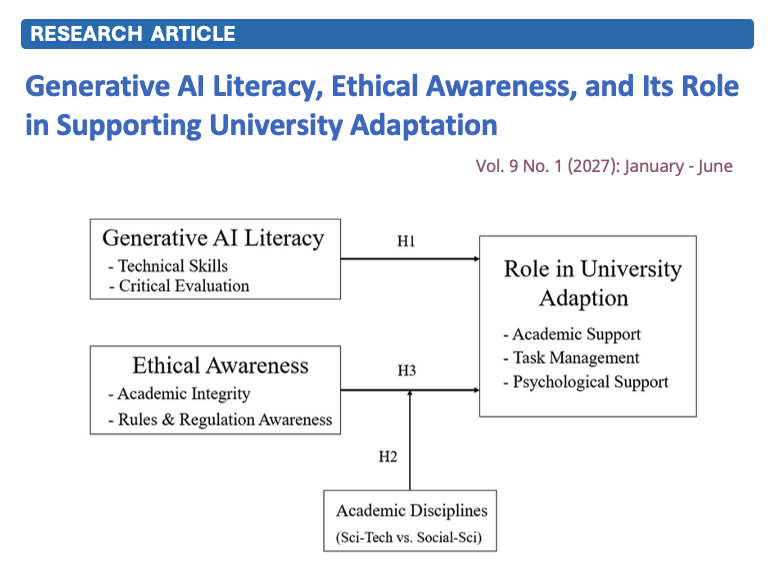
The rapid proliferation of Generative Artificial Intelligence (GenAI) necessitates a strategic understanding of its impact on higher education. This study investigates GenAI literacy, ethical awareness, and the perceived role of AI in supporting university adaptation among 525 first-year undergraduate students at Mahasarakham University. Using a quantitative survey grounded in the AI Literacy Framework and the Technology Acceptance Model (TAM), the study evaluates technical proficiency, critical evaluation skills, and perceived benefits across academic and psychological dimensions.Contrary to conventional assumptions, the comparative analysis revealed no statistically significant differences between students in Science and Technology disciplines and those in Social Sciences and Humanities (all p > 0.05$, Cohen's d < 0.15$), suggesting the widespread adoption of GenAI across academic fields. Furthermore, Pearson correlation analysis demonstrated strong positive relationships between AI literacy and university adaptation (r = 0.647, p < 0.001), as well as between ethical awareness and university adaptation (r = 0.646, p < 0.001). Notably, the only significant disciplinary difference was observed at the item level, where Science and Technology students reported greater concern regarding cognitive atrophy resulting from excessive reliance on AI (t = 2.778, p = 0.006). These findings suggest that students with higher levels of AI competency and stronger ethical awareness perceive greater adaptive benefits from GenAI tools. The results further indicate that universities should prioritize AI literacy and ethics education as a universal component of General Education curricula.
Article Details

This work is licensed under a Creative Commons Attribution-NonCommercial-NoDerivatives 4.0 International License.
All authors need to complete copyright transfer to Journal of Applied Informatics and Technology prior to publication. For more details click this link: https://ph01.tci-thaijo.org/index.php/jait/copyrightlicense
References
Baker, R. W. and Siryk, B. (1984). Measuring adjustment to college. Journal of Counseling Psychology, 31(2):179–189. DOI: 10.1037/0022-0167.31.2.179.
Bandura, A. (1997). Self-Efficacy: The Exercise of Control. W. H. Freeman, New York.
Becher, T. and Trowler, P. R. (2001). Academic Tribes and Territories: Intellectual Enquiry and the Culture of Disciplines. Open University Press, 2 edition.
Chan, C. K. Y. and Hu, W. (2023). Students’ voices on generative AI: perceptions, benefits, and challenges in higher education. International Journal of Educational Technology in Higher Education, 20(1). DOI: 10.1186/s41239-023-00411-8.
Davis, F. D. (1989). Perceived usefulness, perceived ease of use, and user acceptance of information technology. MIS Quarterly, 13(3):319–340. DOI: 10.2307/249008.
Digital Education Council (2024). Global ai student survey 2024. Technical report, Digital Education Council. Retrieved November 11, 2025, from https://www.digitaleducationcouncil.com/resource-library-items/digital-education-council-global-ai-student-survey-2024.
Freeman, J. (2025). Student generative AI survey 2025. Technical Report Policy Note 61, Higher Education Policy Institute. Retrieved November 10, 2025, from https://www.hepi.ac.uk/reports/student-generative-ai-survey-2025/.
Kuhlthau, C. C. (1991). Inside the search process: Information seeking from the user’s perspective. Journal of the American Society for Information Science, 42(5):361–371. DOI: 10.1002/(SICI)1097-4571(199106)42:5¡361::AID-ASI6¿3.0.CO;2-
Lee, H.-P. H., Sarkar, A., Tankelevitch, L., Drosos, I., Rintel, S., Banks, R., and Wilson, N. (2025). The impact of generative AI on critical thinking: Self-reported reductions in cognitive effort and confidence effects from a survey of knowledge workers. In Proceedings of the 2025 CHI Conference on Human Factors in Computing Systems, page 1–22. ACM. DOI: 10.1145/3706598.3713778.
Long, D. and Magerko, B. (2020). What is AI literacy? Competencies and design considerations. In Proceedings of the 2020 CHI Conference on Human Factors in Computing Systems, page 1–16. ACM. DOI: 10.1145/3313831.3376727.
Say, K., Srisawatsakul, C., and Boontarig, W. (2025). Talktutorai: Empowering english language proficiency through chatgpt-assisted conversational practice: A case study at ubon ratchathani rajabhat university, thailand. Journal of Applied Informatics and Technology, 7(1):12–26. DOI: 10.14456/jait.2025.2.
Strzelecki, A. (2023). To use or not to use ChatGPT in higher education? A study of students’ acceptance and use of technology. Interactive Learning Environments, 32(9):5142–5155. DOI: 10.1080/10494820.2023.2209881.
Tinto, V. (1987). Leaving College: Rethinking the Causes and Cures of Student Attrition. University of Chicago Press, Chicago.
