
Roady: The Application for Assessing Risk Factors in Driving Activities
Article Sidebar
Main Article Content
Abstract
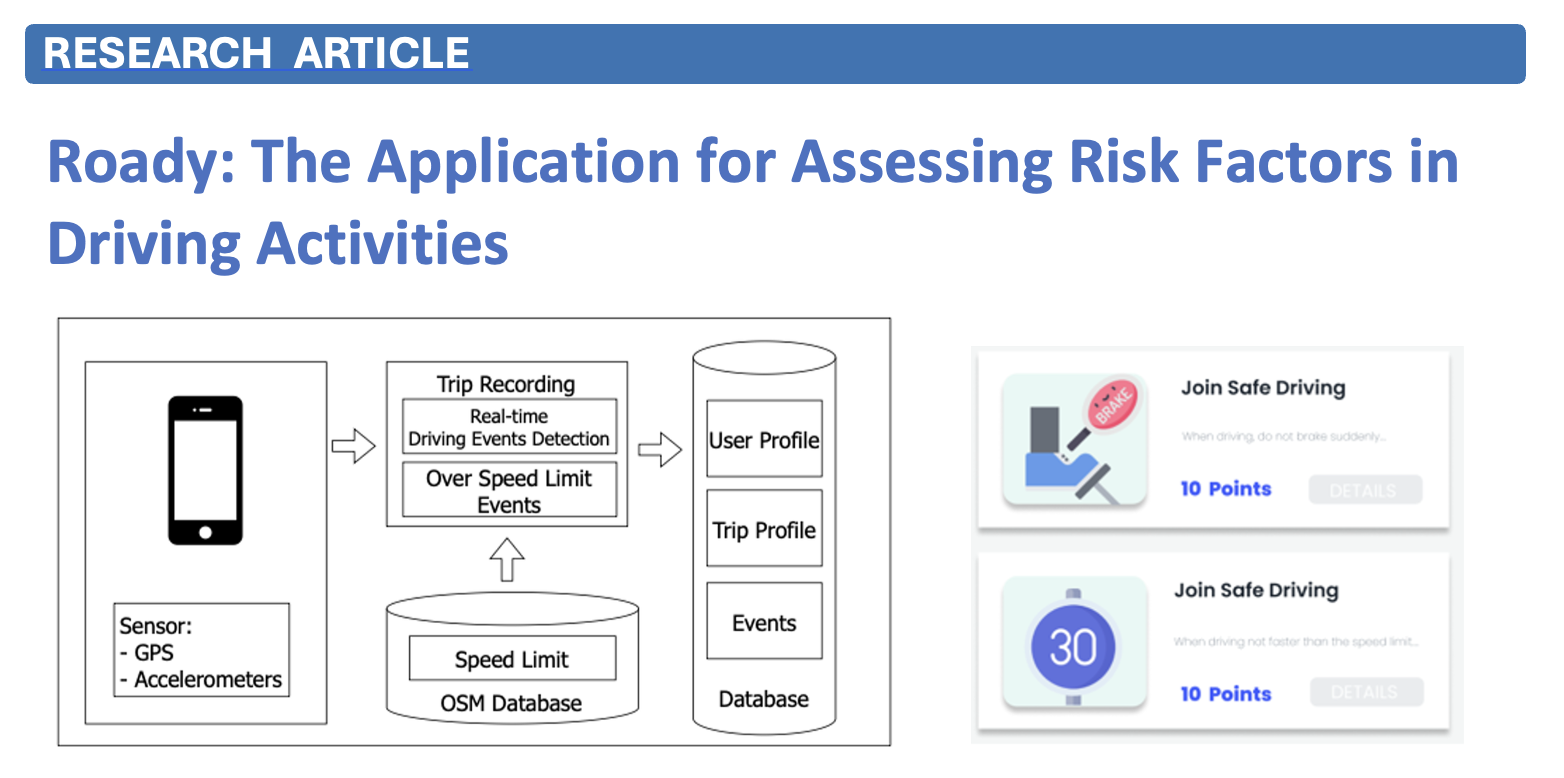
Road traffic accidents are a major global cause of mortality. Factors contributing to accidents include exceeding the speed limit, environmental conditions, and vehicle issues. Thailand has the second-highest fatality rate in Asia. The top three causes of accidents in Thailand are driving faster than the legal limit, dangerous lane changes, and driving too close to the vehicle ahead. One way to encourage safe driving is to identify risk factors. In this work, we: (1) propose a framework and develop a mobile application (Roady) to assess risk factors for driving over speed limits, and (2) develop a design prototype that incorporates gamification principles to encourage and motivate users toward safe driving practices. This application was evaluated on a university campus. The evaluation of driving behavior detection regarding overspeeding showed an accuracy of 87.7%. We deployed the Roady application to the App Store and tested it with 53 users. The usability test showed the highest usability level of 4.53 (\bar{x}). We then evaluated our gamification design prototype. The results showed mean scores as high as 4.57 (\bar{x}). While various technologies are available today to assist in risk detection, we believe that using mobile phones—which are widely used—to identify driving hazards can encourage safe driving and reduce the number of traffic accidents.
Article Details

This work is licensed under a Creative Commons Attribution-NonCommercial-NoDerivatives 4.0 International License.
All authors need to complete copyright transfer to Journal of Applied Informatics and Technology prior to publication. For more details click this link: https://ph01.tci-thaijo.org/index.php/jait/copyrightlicense




References
Alyamani, H., Alharbi, N., Roboey, A., and Kavakli, M. (2023). The impact of gamifications and serious games on driving under unfamiliar traffic regulations. Applied Sciences, 13(5):3262. DOI: 10.3390/app13053262.
Bunchball, Inc. (2010). Gamification 101: An introduction to the use of game dynamics to influence behavior.
Ciceri, M. R. and Ruscio, D. (2014). Does driving experience in video games count? Hazard anticipation and visual exploration of male gamers as function of driving experience. Transportation Research Part F: Traffic Psychology and Behaviour, 22:76–85. DOI: 10.1016/j.trf.2013.11.001.
Creswell, J. W. and Poth, C. N. (2018). Qualitative Inquiry and Research Design: Choosing Among Five Approaches. SAGE Publications, Thousand Oaks, California, 4th edition.
Desjardins, F. and Lavalli`ere, M. (2023). Evaluation of a road safety awareness campaign deployed along the roadside in Saguenay (Qu´ebec, Canada). International Journal of Environmental Research and Public Health, 20(11):6012. DOI: 10.3390/ijerph20116012.
El hafidy, A., Rachad, T., Idri, A., and Zellou, A. (2021). Gamified mobile applications for improving driving behavior: A systematic mapping study. Mobile Information Systems, 2021:1–24. DOI: 10.1155/2021/6677075.
Etika, A. A., Adeke, P. T., and Ubana, G. O. (2023). An assessment of the relationship between speed and road safety. Transactions on Engineering and Computing Sciences, 11(3):98–107. DOI: 10.14738/tecs.113.14796.
Florence School of Regulation (FSR), European University Institute (2020). Speed and speed management in road safety policy. https://fsr.eui.eu/wp-content/uploads/2020/06/programme_final.pdf. Accessed 2025-10-21.
Freidlin, R. Z., Dave, A. D., Espey, B. G., Stanley, S. T., Garmendia, M. A., Pursley, R., Ehsani, J. P., Simons-Morton, B. G., and Pohida, T. J. (2018). Measuring risky driving behavior using an mHealth smartphone app: Development and evaluation of gForce. JMIR mHealth and uHealth, 6(4):e69. DOI: 10.2196/mhealth.9290.
Health Information System Development Office (2013). Accidents and dangerous roads in Thailand. Technical report, Health Information System Development Office, Ministry of Public Health, Bangkok, Thailand.
Kaikkonen, A., Kek¨al¨ainen, A., Cankar, M., Kallio, T., and Kankainen, A. (2005). Usability testing of mobile applications: A comparison between laboratory and field testing. J. Usability Studies, 1(1):4–16.
Likert, R. (1932). A technique for the measurement of attitudes. Archives of Psychology, 22(140):1–55. Lindow, F. and Kashevnik, A. (2019). Driver behavior monitoring based on smartphone sensor data and machine learning methods. In Proceedings of the 25th Conference of the FRUCT Association, pages 201–202. DOI: 10.23919/FRUCT48121.2019.8981511.
Maga˜na, V. C. and Organero, M. M. (2014). The Impact of Using Gamification on the Eco-driving Learning, page 45–52. Springer International Publishing. DOI: 10.1007/978-3-319-07596-9 5.
Mahmood, K., Bashir, T., Rehman, H. M., Rehman, M., and Nayyar, Z. (2024). Analysing the role of driver behaviors in road traffic accidents: An application of machine learning. International Journal of Management Studies, 31(1):269–298. DOI: 10.32890/ijms2024.31.1.10.
Malyshkina, N. V. and Mannering, F. L. (2008). Analysis of the effect of speed limit increases on accident-injury severities. Mantouka, E., Barmpounakis, E., Vlahogianni, E., and Golias, J. (2021). Smartphone sensing for understanding driving behavior: Current practice and challenges. International Journal of Transportation Science and Technology, 10(3):266–282. DOI: 10.1016/j.ijtst.2020.07.001.
Morschheuser, B., Hassan, L., Werder, K., and Hamari, J. (2018). How to design gamification? A method for engineering gamified software. Information and Software Technology, 95:219–237. DOI: 10.1016/j.infsof.2017.10.015.
Nielsen, J. (1993). Usability Engineering. Morgan Kaufmann Publishers Inc., San Francisco, CA, USA.
Office of Transport and Traffic Policy and Planning (OTP), Ministry of Transport (2017). Road accident situation analysis report 2016. Technical report, Office of Transport and Traffic Policy and Planning (OTP), Ministry of Transport, Bangkok, Thailand.
Park, S. and Kim, S. (2021). Leaderboard design principles to enhance learning and motivation in a gamified educational environment: Development study. JMIR Serious Games, 9(2):e14746. DOI: 10.2196/14746.
Royal Thai Police (2015). Statistics on road traffic accident cases. http://service.nso.go.th/nso/web/statseies/statseries21.html. Accessed 2025-10-21.
Sawant, P. R. and Pande, S. S. (2015). A mobile application for monitoring inefficient and unsafe driving behavior. In Proceedings of the Fourth Post Graduate Conference (iPGCON 2015), pages 1–5, Pune, India. Savitribai Phule Pune University. Accessed 2025-10-
Steinberger, F., Schroeter, R., Foth, M., and Johnson, D. (2017). Designing gamified applications that make safe driving more engaging. In Proceedings of the 2017 CHI Conference on Human Factors in Computing Systems (CHI’17), page 2826–2839. ACM. DOI: 10.1145/3025453.3025511.
Summala, H. (2000). Brake reaction times and driver behavior analysis. Transportation Human Factors, 2(3):217–226. DOI: 10.1207/sthf0203 2.
Wilmot, C. G. and Khanal, M. (1999). Effect of speed limits on speed and safety: A review. Transport Reviews, 19(4):315–329. DOI: 10.1080/014416499295420.
Witten, I. H., Frank, E., and Hall, M. A. (2011). Data Mining: Practical Machine Learning Tools and Techniques. Morgan Kaufmann Publishers, Burlington, MA, USA, 3rd edition.
World Health Organization (2015). Report on the World Situation on Road Safety 2015. Bureau of Noncommunicable Diseases, Department of Disease Control, Ministry of Public Health, Geneva, Switzerland.
World Health Organization (2018). Global Status Report on Road Safety 2018. World Health Organization, Geneva, Switzerland.
Zaidan, R. A., Alamoodi, A. H., Zaidan, B. B., Zaidan, A. A., Albahri, O. S., Talal, M., Garfan, S., Sulaiman, S., Mohammed, A., Kareem, Z. H., Malik, R. Q., and Ameen, H. A. (2022). Comprehensive driver behaviour review: Taxonomy, issues and challenges, motivations and research direction towards achieving a smart transportation environment. Engineering Applications of Artificial Intelligence, 111:104745. DOI: 10.1016/j.engappai.2022.104745.
