
The use of Marketing Technology in Stock Firms Based on Insourcing and Outsourcing Strategy
Article Sidebar
Main Article Content
Abstract
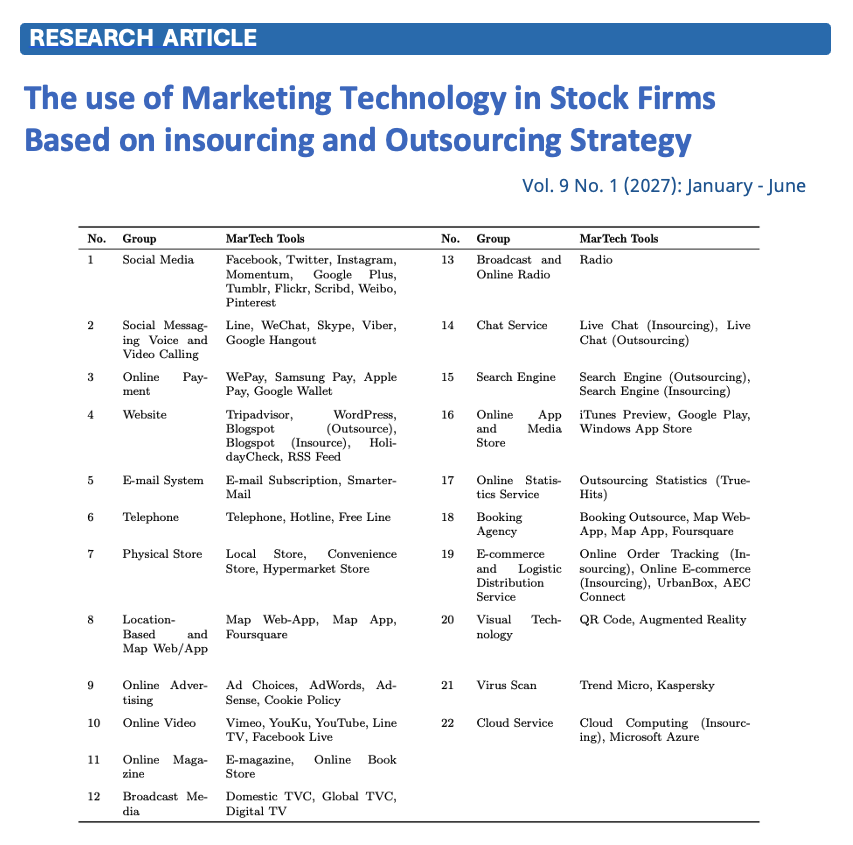
Marketing technology (MarTech) is becoming increasingly important for businesses and marketers. Firms use MarTech tools and technologies to support marketing activities. This study attempts to understand how marketing technology is used in firms and to explore research evidence regarding how MarTech tools enhance marketing functions. Data were collected from 100 firms listed on the Stock Exchange of Thailand. The data were analyzed to classify 53 MarTech tools into 22 MarTech categories. The study classifies MarTech based on insourcing–outsourcing information technology and the marketing mix framework. The results identify three dimensions of MarTech tools: insourcing, outsourcing, and hybrid sourcing. Finally, the study provides recommendations and future research directions for the adoption of marketing technology practices. This paper provides a comprehensive literature review and proposes a classification of marketing technology based on an insourcing–outsourcing perspective.
Article Details

This work is licensed under a Creative Commons Attribution-NonCommercial-NoDerivatives 4.0 International License.
All authors need to complete copyright transfer to Journal of Applied Informatics and Technology prior to publication. For more details click this link: https://ph01.tci-thaijo.org/index.php/jait/copyrightlicense
References
Appel, G., Grewal, L., Hadi, R., and Stephen, A. T. (2020). The future of social media in marketing. Journal of the Academy of Marketing Science, 48(1):79–95. DOI: 10.1007/s11747-019-00695-1.
Bailoul, Y., Anoir, L., Khaldi, M., and Khaldi, M. (2025). Analysis of the existing e-mailing management tools and systems: Methodology for the study of the existing situation. International Journal of Advanced Research, 13(5):872–877. DOI: 10.21474/IJAR01/20971.
Bapna, R., Gupta, A. K., Ray, G., and Singh, S. S. V. (2023). Single-sourcing vs. multisourcing: An empirical analysis of large information technology outsourcing arrangements. Information Systems Research, 34(3):1109–1130. DOI: 10.1287/isre.2022.1170.
Bartoloni, S. and Ancillai, C. (2024). Twenty years of social media marketing: A systematic review, integrative framework, and future research agenda. International Journal of Management Reviews, 26(3):435–457. DOI: 10.1111/ijmr.12360.
Bharadwaj, N. and Roggeveen, A. L. (2008). The impact of offshored and outsourced call service centers on customer appraisals. Marketing Letters, 19(1):13–23. DOI: 10.1007/s11002-007-9025-y.
Biemans, W. (2023). The impact of digital tools on sales-marketing interactions and perceptions. Industrial Marketing Management, 115:395–407. DOI: 10.1016/j.indmarman.2023.10.015.
Brady, M., Saren, M. A. J., and Tzokas, N. (2002). Integrating information technology into marketing practice: The it reality of contemporary marketing practice. Journal of Marketing Management, 18(5–6):555–577. DOI: 10.1362/0267257022683703.
Brinker, S. (2015). Marketing technology landscape supergraphic (2015). chiefmartec, Published January 12, 2015. Accessed December 10, 2024, http://chiefmartec.com/2015/01/marketing-technology-landscape-supergraphic-2015/.
Brodie, R. J., Winklhofer, H., Coviello, N. E., and Johnston, W. J. (2007). Is e-marketing coming of age? An examination of the penetration of e-marketing and firm performance. Journal of Interactive Marketing, 21(1):2–21. DOI: 10.1002/dir.20071.
Cassiman, B. and Veugelers, R. (2006). In search of complementarity in innovation strategy: Internal R&D and external knowledge acquisition. Management Science, 52(1):68–82. DOI: 10.1287/mnsc.1050.0470.
Chen, S. H., Tzeng, S. Y., Tham, A., and Chu, P. X. (2021). Hospitality services in the post COVID-19 era: Are we ready for high-tech and no-touch service delivery in smart hotels? Journal of Hospitality Marketing & Management, 30(8):905–928. DOI: 10.1080/19368623.2021.1916669.
Constantinides, E. (2006). The marketing mix revisited: Towards the 21st century marketing. Journal of Marketing Management, 22(3–4):407–438. DOI: 10.1362/026725706776861190.
Gong, S., Zhang, J., Zhao, P., and Jiang, X. (2017). Tweeting as a marketing tool: A field experiment in the TV industry. Journal of Marketing Research, 54(6):833–850. DOI: 10.1509/JMR.14.0348.
Govender, K. (2016). Outsourcing in-bound call centers: Impact on customers’ service experience. Journal of Accounting & Marketing, 5(3):1000187. DOI: 10.4172/2168-9601.1000187.
Graesch, J. P., Hensel-B¨orner, S., and Henseler, J. (2021). Information technology and marketing: An important partnership for decades. Industrial Management & Data Systems, 121(1):123–157. DOI: 10.1108/IMDS-08-2020-0510.
Gr¨onroos, C. (1994). From marketing mix to relationship marketing: Towards a paradigm shift in marketing. Management Decision, 32(2):4–20. DOI: 10.1108/00251749410054774.
Gudema, L. (2014). 7 marketing technologies every company must use. Harvard Business Review, Published November 4, 2014. Accessed November 3, 2024, https://hbr.org/2014/11/7-marketing-technologies-every-company-must-use.
Gujar, P., Paliwal, G., and Panyam, S. (2024). Revolutionizing in-house digital marketing with end-to-end marketing automation powered by AI and SaaS. In 2024 IEEE Colombian Conference on Communications and Computing (COLCOM), pages 1–7. IEEE.
DOI: 10.1109/colcom62950.2024.10720305.
Gupta, G. and Goel, S. (2024). A study on the impact of marketing automation adoption. International Education and Research Journal, 10(8):7–11. DOI: 10.21276/IERJ24112158742696.
Han, K. and Mithas, S. (2013). Information technology outsourcing and non-IT operating costs: An empirical investigation. MIS Quarterly, 37(1):315–332. DOI: 10.25300/MISQ/2013/37.1.14.
Hanafizadeh, P. and Zare Ravasan, A. (2018). An empirical analysis on outsourcing decision: The case of e-banking services. Journal of Enterprise Information Management, 31(1):146–172. DOI: 10.1108/JEIM-11-2016-0182.
Horsky, S., Michael, S. C., and Silk, A. J. (2012). The internalization of advertising services: An interindustry analysis. Review of Marketing Science, 10(1). DOI: 10.1515/1546-5616.1142.
J¨arvinen, J. and Karjaluoto, H. (2015). The use of web analytics for digital marketing performance measurement. Industrial Marketing Management, 50:117–127. DOI: 10.1016/j.indmarman.2015.04.009.
Kalaignanam, K. and Varadarajan, R. (2012). Offshore outsourcing of customer relationship management: Conceptual model and propositions. Journal of the Academy of Marketing Science, 40(2):347–363. DOI: 10.1007/s11747-011-0291-0.
Kaur, J. and Biswas, B. (2024). Outsourcing of IT: Reason, benefit and potential risks for USA companies. Journal of Information Technology Management and Business Horizons, 1(1):jitmbh24005. DOI: 10.63471/jitmbh24005.
King, W. R. and Malhotra, Y. (2000). Developing a framework for analyzing IS sourcing. Information & Management, 37(6):323–334. DOI: 10.1016/s0378-7206(00)00046-x.
Kotabe, M., Mol, M. J., and Murray, J. Y. (2008). Outsourcing, performance, and the role of e-commerce: A dynamic perspective. Industrial Marketing Management, 37(1):37–45. DOI: 10.1016/j.indmarman.2007.06.011.
Kranz, J. (2021). Strategic innovation in IT outsourcing: Exploring the differential and interaction effects of contractual and relational governance mechanisms. The Journal of Strategic Information Systems, 30(1):101656. DOI: 10.1016/j.jsis.2021.101656.
Lacity, M. C. (2002). Lessons in global information technology sourcing. Computer, 35(8):26–33. DOI: 10.1109/MC.2002.1023785.
Larpsiri, R. and Speece, M. (2004). Technology integration: Perceptions of sales force automation in Thailand’s life assurance industry. Marketing Intelligence & Planning, 22(4):392–406. DOI: 10.1108/02634500410542752.
Lastner, M. M., Locander, D. A., Pimentel, M. A., Pueschel, A., Schrock, W. A., Deitz, G. D., and Rapp, A. (2024). Salesperson motivation, compensation, training and deployment within the sales ecosystem. European Journal of Marketing, 58(3):812–841. DOI: 10.1108/EJM-04-2023-0233.
Lim, W. M., Kumar, S., Verma, S., and Chaturvedi, R. (2022). Alexa, what do we know about conversational commerce? Insights from a systematic literature review. Psychology & Marketing, 39(6):1129–1155. DOI: 10.1002/mar.21654.
Madare, P. M. (2025). The role of cloud technologies in enhancing customer experience. Journal of Computer Science and Technology Studies, 7(3):157–164. DOI: 10.32996/jcsts.2025.7.3.17.
Mariam, S. (2024). Building competitive advantage through information technology integration in marketing and branding management strategies. Golden Ratio of Mapping Idea and Literature Format, 4(2):111–139. DOI: 10.52970/grmilf.v4i2.356.
MarTech (2025). Martech. Accessed January 10, 2025, https://martech.org.
Meshko, N. and Mamedova, D. (2024). Digital marketing outsourcing as a development driver for small and medium-sized businesses. European Journal of Management Issues, 32(4):215–224. DOI: 10.15421/192419.
Moskalenko, V., Matviienko, A., and Fonta, N. (2023). Research and design of the marketing cloud salesforce CRM architecture depending on the company’s marketing strategy. Bulletin of National Technical University “KhPI”. Series: System Analysis, Control and Information Technologies, 10(2):21–30. DOI: 10.20998/2079-0023.2023.02.04.
Nia, M. R. and Shokouhyar, S. (2020). Analyzing the effects of visual aesthetic of web pages on users’ responses in online retailing using the VisAWI method. Journal of Research in Interactive Marketing, 14(4):357–389. DOI: 10.1108/JRIM-11-2018-0147.
Pandey, N., Nayal, P., and Rathore, A. S. (2020). Digital marketing for B2B organizations: Structured literature review and future research directions. Journal of Business & Industrial Marketing, 35(7):1191–1204. DOI: 10.1108/JBIM-06-2019-0283.
Plangger, K., Grewal, D., de Ruyter, K., and Tucker, C. (2022). The future of digital technologies in marketing: A conceptual framework and an overview. Journal of the Academy of Marketing Science, 50(6):1125–1134. DOI: 10.1007/s11747-022-00906-2.
Quach, S., Thaichon, P., Martin, K. D., Weaven, S. K. W., and Palmatier, R. W. (2022). Digital technologies: Tensions in privacy and data. Journal of the Academy of Marketing Science, 50(6):1299–1323. DOI: 10.1007/s11747-022-00845-y.
Reji, S. K. (2025). The hybrid IT sourcing model: Will it work for media enterprises? Journal of Information Technology Teaching Cases. DOI: 10.1177/20438869251376668.
Rikhi, D. (2022). Tailored vs. off-the-shelf: An in-depth look at software implementation choices. Journal of Health Statistics Reports, 1(1):1. DOI: 10.47363/jhsr/2022(1)e109.
Rouse, A. C. (2009). Information Technology Outsourcing, pages 2030–2035. IGI Global. DOI: 10.4018/978-1-60566-026-4.ch319.
Santini, F. d. O., Ladeira, W. J., Pinto, D. C., Herter, M. M., Sampaio, C. H., and Babin, B. J. (2020). Customer engagement in social media: A framework and meta-analysis. Journal of the Academy of Marketing Science, 48(6):1211–1228. DOI: 10.1007/s11747-020-
-5.
Schibrowsky, J. A., Peltier, J. W., and Nill, A. (2007). The state of internet marketing research: A review of the literature and future research directions. European Journal of Marketing, 41(7–8):722–733. DOI: 10.1108/03090560710752366.
Schneider, S. and Sunyaev, A. (2016). Determinant factors of cloud-sourcing decisions: Reflecting on the IT outsourcing literature in the era of cloud computing. Journal of Information Technology, 31(1):1–31. DOI: 10.1057/jit.2014.25.
Sharma, A., Sharma, N., and Singh, H. (2025). The Digital Shift: Transforming Business Models Through Technology, pages 17–31. Book Rivers. DOI: 10.64267/97893688465672.
Sripathi, M. (2024). The Future of MarTech, page 113–152. IGI Global. DOI: 10.4018/979-8-3693-4361-6.ch005.
Steenburgh, T. J., Avery, J., and Dahod, N. A. (2009). Hubspot: Inbound marketing and web 2.0. Harvard Business School Case 509-049, Harvard Business School. Revised January 2011.
S¨uthoff, H. (2018). Digitale Transformation im Marketing: Voraussetzungen schaffen mit den 4 Rs, page 91–104. Springer Fachmedien Wiesbaden. DOI: 10.1007/978-3-658-22032-7 6.
Van Waterschoot, W. and Van den Bulte, C. (1992). The 4P classification of the marketing mix revisited. Journal of Marketing, 56(4):83–93. DOI: 10.1177/002224299205600407.
Verma, S. (2025). The role of digital marketing in modern business growth. International Journal of Advanced Research in Science, Communication and Technology, 5(7):322–324. DOI: 10.48175/IJARSCT-28037.
Veugelers, R. (1997). Internal R&D expenditures and external technology sourcing. Research Policy, 26(3):303–315. DOI: 10.1016/S0048-7333(97)00019-X.
Wang, C. L. (2021). New frontiers and future directions in interactive marketing: Inaugural editorial. Journal of Research in Interactive Marketing, 15(1):1–9. DOI: 10.1108/JRIM-03-2021-270.
Watjatrakul, B. and Drennan, J. (2005). Factors affecting e-mail marketing sourcing decisions: A transaction cost perspective. Journal
of Marketing Management, 21(7-8):701–723. DOI: 10.1362/026725705774538444.
Wernerfelt, N., Tuchman, A., Shapiro, B. T., and Moakler, R. (2025). Estimating the value of offsite tracking data to advertisers: Evidence from Meta. Marketing Science, 44(2):268–286. DOI: 10.1287/mksc.2023.0274.
Worthington, S. L. (2021). Navigating the marketing technology landscape. IEEE Engineering Management Review, 50(1):20–23. DOI: 10.1109/emr.2021.3133424.
Ye, C. (2025). Mapping out digital luxury marketing: A systematic review and future research agenda. Marketing Intelligence & Planning, 44(2):326–349. DOI: 10.1108/MIP-10-2024-0770.
Zhang, D. (2022). Design of massive marketing data mining system based on WeChat. In Second International Conference on Digital Signal and Computer Communications (DSCC 2022), page 1230617. DOI: 10.1117/12.2641278.
Zhang, X. A., Kumar, V., and Cosguner, K. (2017). Dynamically managing a profitable email marketing program. Journal of Marketing Research, 54(6):851–866. DOI: 10.1509/jmr.16.0210.
Zhang, Y., Geng, D., Wang, J., and Chen, J. (2025). How manufacturers make decision of digital service collaboration in ecosystem: a niche selection perspective. Journal of Business & Industrial Marketing, 40(2):432–447. DOI: 10.1108/jbim-03-2024-0200.
