
Modeling to Measure the Diffusion Distance of Particulate Matter 2.5 from Combustion of Agricultural Areas
Article Sidebar
Main Article Content
Abstract
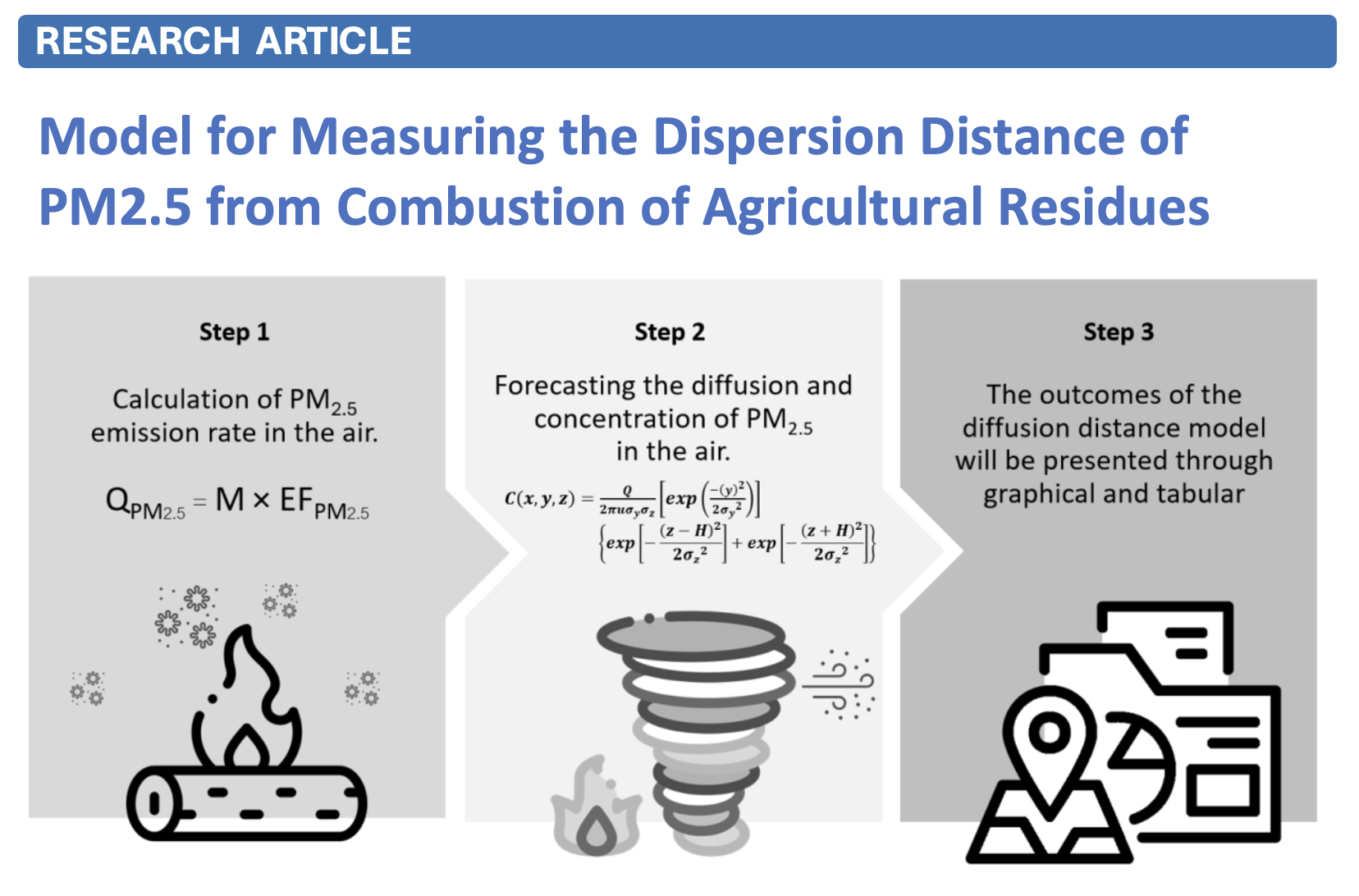
This research aims to establish a predictive model for determining the dispersion distance of PM 2.5 emissions resulting from burning activities in agricultural areas, with a focus on applications in Nakhon Sawan province. The primary objective is to provide a robust tool for forecasting PM 2.5 accumulation and developing effective control plans to mitigate its environmental and health impacts. The Gaussian Plume Model forms the foundation of this study, offering a structured approach to analyzing pollutant dispersion across varying distances. The model evaluates dispersion at eight specific intervals along the x-axis: 125 meters, 250 meters, 375 meters, 500 meters, 675 meters, 750 meters, 875 meters, and 1,000 meters, identifying 675 meters as the optimal dispersion distance. Wind speed, a critical factor in the model, is categorized into three levels: light, moderate, and strong. At two reference locations (latitude 15.85902, longitude 100.6547 and latitude 15.84715, longitude 100.6347), PM 2.5 concentrations were calculated for each wind level. Results show identical values across both locations, with concentrations measured at 0.00245 micrograms per cubic meter under light winds, 0.00095 micrograms per cubic meter under moderate winds, and 0.00049 micrograms per cubic meter under strong winds. These findings underline the Gaussian Plume Model's capability in accurately predicting pollutant dispersion and contribute valuable insights for environmental management in agricultural regions.
Article Details

This work is licensed under a Creative Commons Attribution-NonCommercial-NoDerivatives 4.0 International License.
All authors need to complete copyright transfer to Journal of Applied Informatics and Technology prior to publication. For more details click this link: https://ph01.tci-thaijo.org/index.php/jait/copyrightlicense




References
Abdel-Rahman, A. A. (2008). On the atmospheric dispersion and Gaussian plume model. In the 2nd International Conference on Waste Management, Water Pollution, Air Pollution, and Indoor Climate (WWAI’08), pages 31–39, Corfu, Greece. WSEAS Press. http://www.wseas.us/e-library/conferences/2008/corfu/wwai/wwai04.pdf.
Air Quality and Noise Management Bureau, Pollution Control Department (2020). Summary of air quality data 2014–2020. Technical report, Pollution Control Department, Bangkok, Thailand. Retrieved 12 July 2024, from http://air4thai.pcd.go.th/webV2/download.php [In Thai].
Alemayehu, D. and Hackett, F. (2015). Gaussian dispersion model to estimate the dispersion of particulate matters (PM2.5) and sulfur dioxide (So2) concentrations on tribal land, oklahoma. American Journal of Environmental Sciences, 11(6):440–449. DOI: 10.3844/ajessp.2015.440.449.
Colls, J. (2002). Air Pollution. Spon Press, New York, USA, 2nd edition.
Feng, X., Feng, Y., Chen, Y., Cai, J., Li, Q., and Chen, J. (2022). Source apportionment of PM2.5 during haze episodes in Shanghai by the PMF model with PAHs. Journal of Cleaner Production, 330:129850. DOI: 10.1016/j.jclepro.2021.129850.
Huang, W. (2016). A hybrid ARIMA-SVM algorithm for PM2.5 concentration prediction using binary orthogonal wavelet transformation. International Journal of Simulation: Systems, Science & Technology. DOI: 10.5013/ijssst.a.17.32.59.
Junpen, A., Pansuk, J., Kamnoet, O., Cheewaphongphan, P., and Garivait, S. (2018). Emission of air pollutants from rice residue open burning in Thailand, 2018. Atmosphere, 9(11):449. DOI: 10.3390/atmos9110449.
Li, R., Gong, J., Chen, L., and Wang, Z. (2015). Estimating ground-level PM2.5 using fine-resolution satellite data in the megacity of Beijing, China. Aerosol and Air Quality Research, 15(4):1347–1356. DOI: 10.4209/aaqr.2015.01.0009.
Li, Y. and Wu, J. (2024). Prediction of Beijing’s PM2.5 concentration based on the LSTM model. Applied and Computational Engineering, 112(1):35–41. DOI: 10.54254/2755-2721/2024.17907.
Lotrecchiano, N., Sofia, D., Giuliano, A., Barletta, D., and Poletto, M. (2020). Pollution dispersion from a fire using a Gaussian plume model. International Journal of Safety and Security Engineering, 10(4):431–439. DOI: 10.18280/ijsse.100401.
Ma, D., He, F., Yue, Y., Guo, R., Zhao, T., and Wang, M. (2024). Graph convolutional networks for street network analysis with a case study of urban polycentricity in Chinese cities. International Journal of Geographical Information Science, 38(5):931–955. DOI: 10.1080/13658816.2024.2321229.
National Oceanic and Atmospheric Administration (NOAA) (2020). Beaufort wind scale. Retrieved 13 May 2024, from https://www.weather.gov/mfl/beaufort.
Office of Agricultural Economics, Ministry of Agriculture and Cooperatives (2020). Rice: Cultivated area, harvested area, production, and yield per hectare by district, cropping year 2020/21 at 15% moisture content. Technical report, Office of Agricultural Economics, Ministry of Agriculture and Cooperatives, Bangkok, Thailand. Retrieved 13 May 2024, from https://oae.go.th.
Pollution Control Department (2019). Action plan for driving the national agenda on solving the problem of particulate air pollution. Technical report, Pollution Control Department, Bangkok, Thailand. [In Thai].
Qin, D., Yu, J., Zou, G., Yong, R., Zhao, Q., and Zhang, B. (2019). A novel combined prediction scheme based on CNN and LSTM for urban PM2.5 concentration. IEEE Access, 7:20050–20059. DOI: 10.1109/access.2019.2897028.
Tırınk, S. (2025). Machine learning-based forecasting of air quality index under long-term environmental patterns: A comparative approach with XGBoost, LightGBM, and SVM. PLOS One, 20(10):e0334252. DOI: 10.1371/journal.pone.0334252.
U.S. Environmental Protection Agency (1995). User’s guide for the industrial source complex (ISC3) dispersion models, volume II – description of model algorithms. Technical Report EPA-454/B-95-003b, U.S. Environmental Protection Agency, Office of Air Quality Planning and Standards, Research Triangle Park, NC, USA. Retrieved 13 May 2024, from https://nepis.epa.gov.
Wongwaitayakool, S. (2018). Report on the pollution situation in Nakhon Sawan province, 2020. Technical report, Nakhon Sawan Provincial Office, Nakhon Sawan, Thailand. Retrieved 13 May 2023, from https://www.nakhonsawan.go.th.
Wu, F., Min, P., Jin, Y., Zhang, K., Liu, H., Zhao, J., and Li, D. (2023). A novel hybrid model for hourly PM2.5 prediction considering air pollution factors, meteorological parameters and GNSS-ZTD. Environmental Modelling & Software, 167:105780. DOI: 10.1016/j.envsoft.2023.105780.
Yang, Z., Yao, Q., Buser, M. D., Alfieri, J. G., Li, H., Torrents, A., McConnell, L. L., Downey, P. M., and Hapeman, C. J. (2020). Modification and validation of the Gaussian plume model (GPM) to predict ammonia and particulate matter dispersion. Atmospheric Pollution Research, 11(7):1063–1072. DOI: 10.1016/j.apr.2020.03.012.
Zhang, X.-L., Zhao, J.-H., and Cai, B. (2018). Prediction model with dynamic adjustment for single time series of PM2.5. Acta Automatica Sinica, 44(10):1790–1798. DOI: 10.16383/j.aas.2017.c170026.
