Tamarind (Tamarindus indica L.) Charcoal Color for the Use in Woodcut Printmaking
Article Sidebar
Main Article Content
Abstract
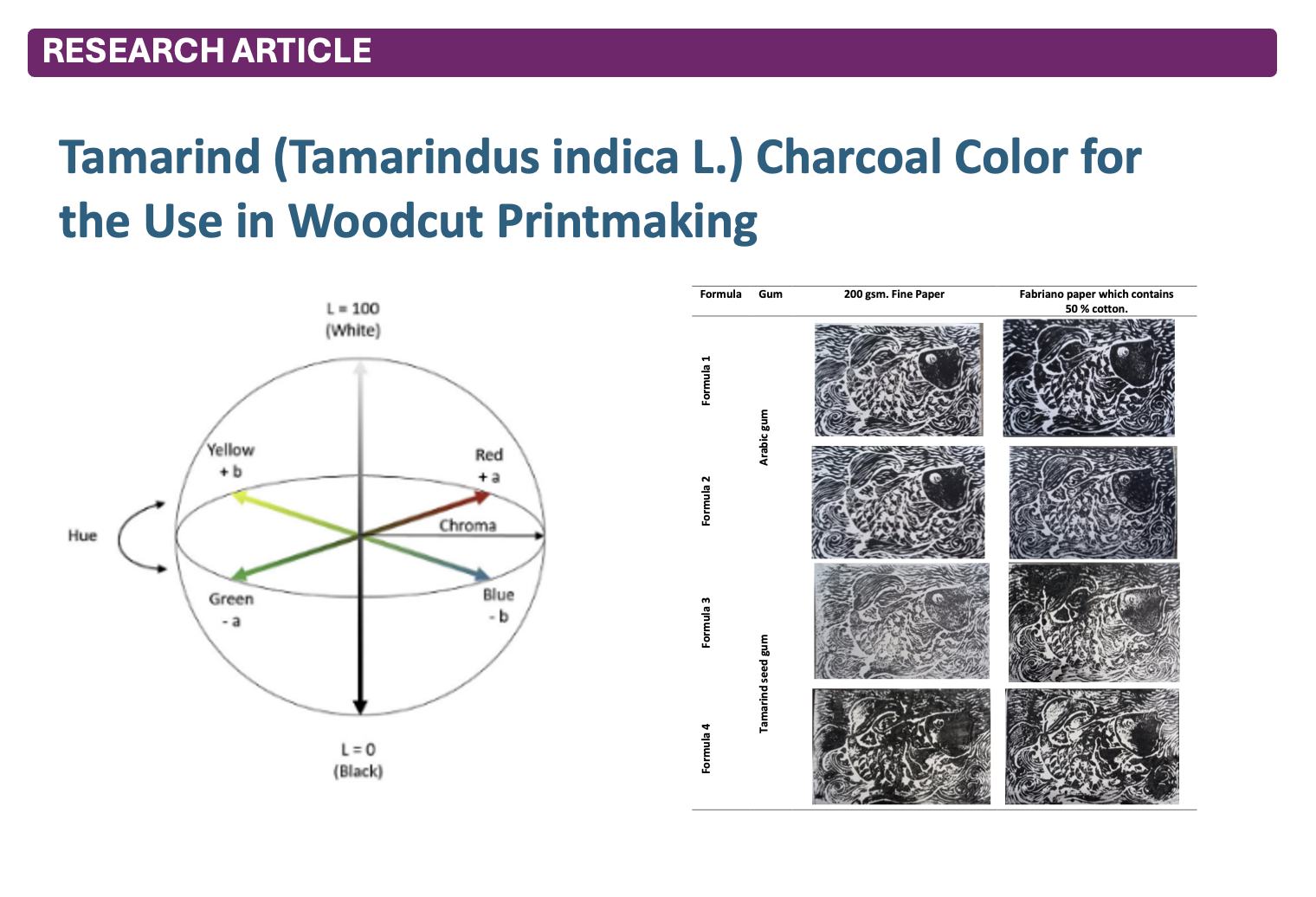
This research aimed to study the quality of color produced from tamarind (Tamarindus indica L.) charcoal for use in woodcut printmaking and to compare the color fastness of woodcut prints on various types of paper by examining four color formulas blended with mixtures of Arabic gum and tamarind seed gum. The results revealed that Fabriano paper was the most suitable material for woodcut printmaking using tamarind charcoal color, particularly with Formula 1, which consisted of tamarind charcoal powder, Arabic gum, glycerin (C3H8O3), honey, and deionized water (H2O), as well as Formula 2, which additionally contained indigo (Indigofera tinctoria L.) powder. The comparison of hue and fastness, as determined by a colorimeter, showed that Formula 2 on Fabriano paper exhibited the highest L* value and intensity at 20.80. The +a value indicated a shift toward the green zone, while the –b value indicated a shift toward the blue zone, reaching its highest level at –1.90 due to the addition of indigo powder. Moreover, the average intensity (L* value) on Fabriano paper across the four color formulas showed consistent results. Applying these colors in the woodcut printmaking process demonstrated smooth hues with high intensity, durability, and detailed color expression. In contrast, the color blended with tamarind seed gum showed unstable endurance when applied with a paint roller, resulting in unclear details and hues due to color coagulation. All four color formulas demonstrated good solubility and could be used with either water or deionized water as solvents.
Article Details

This work is licensed under a Creative Commons Attribution-NonCommercial-NoDerivatives 4.0 International License.
All authors need to complete copyright transfer to Journal of Applied Informatics and Technology prior to publication. For more details click this link: https://ph01.tci-thaijo.org/index.php/jait/copyrightlicense




References
Chanunpanich, N., Pinsem, W., Boonyapalanant, B., and Byun, H. (2009). Purification of glycerine from biodiesel production. The Journal of KMUTNB, 19(1):66–72.
Dutta, K. and Nath, R. (2023). Application of colorimetry in food industries. In Samanta, A. K., editor, Advances in Colorimetry, pages 111–131. IntechOpen. DOI: 10.5772/intechopen.112099.
Inchar, C. (2019). The study of Monoprint Techniques in printmaking with gelatin plates by using local material and natural colors from plants. Udonthani Rajabhat University Journal of Humanities and Social Science, 8(2):109–124.
Kiatajin, J. (2012). Print from forest; beauty at mind Yanawit Kungchaethong. https://www.posttoday.com/life/healthy/164663. Retrieved August 1, 2022.
Narongdecha, W. and Soodsang, N. (2019). Natural color extraction for painting. Asia-Pacific Journal of Science and Technology, 24(3):1–11.
Pansuwan, J., Ounwong, C., and Intharapat, P. (2012). A study of factors affecting on the efficiency of an odorabsorbing rubber. In Proceedings of the 6th UBRC Local Development toward ASEAN: Global Change and Natural Disasters, pages 36–45, Ubon Ratchathani, Thailand.
Phillips, K. (2024). What is a colorimeter, and how does it work? https://www.hunterlab.com/blog/lab-vs-lch-coordinates/. Retrieved December 4, 2024.
Sathaporn, C. (2012). Creating printmaking artworks with natural dyes from plants in Nakhon Si Thammarat Province. Journal of Fine Arts, 3(1):267–301.
Somdee, P., Nuilek, K., Hasuk, A., Bunon, C., and Wasantasenanon, P. (2016). Investigation of the properties of smokeless charcoal briquette with added binder from polystyrene and polypropylene plastic waste. Rajamangala University of Technology Tawan-ok Research Journal, 9(1):61–67.
Su, J. and Saengprom, K. (2021). A study of techniques in using colors of ancient chinese people. Journal of Fine Arts, 12(1):73–93.
Sulong, K. (2024). What is color measurement and how does the colorimeter work? https://ikki-group.com/cie/. Retrieved December 4, 2024.
Tepsing, P. (2005). Asian Art. Chulalongkorn University Press, Bangkok, Thailand.
