
The Semantic Web of Digital Technology and Learning in the 21st Century for Undergraduate using Ontology Techniques
Article Sidebar
Main Article Content
Abstract
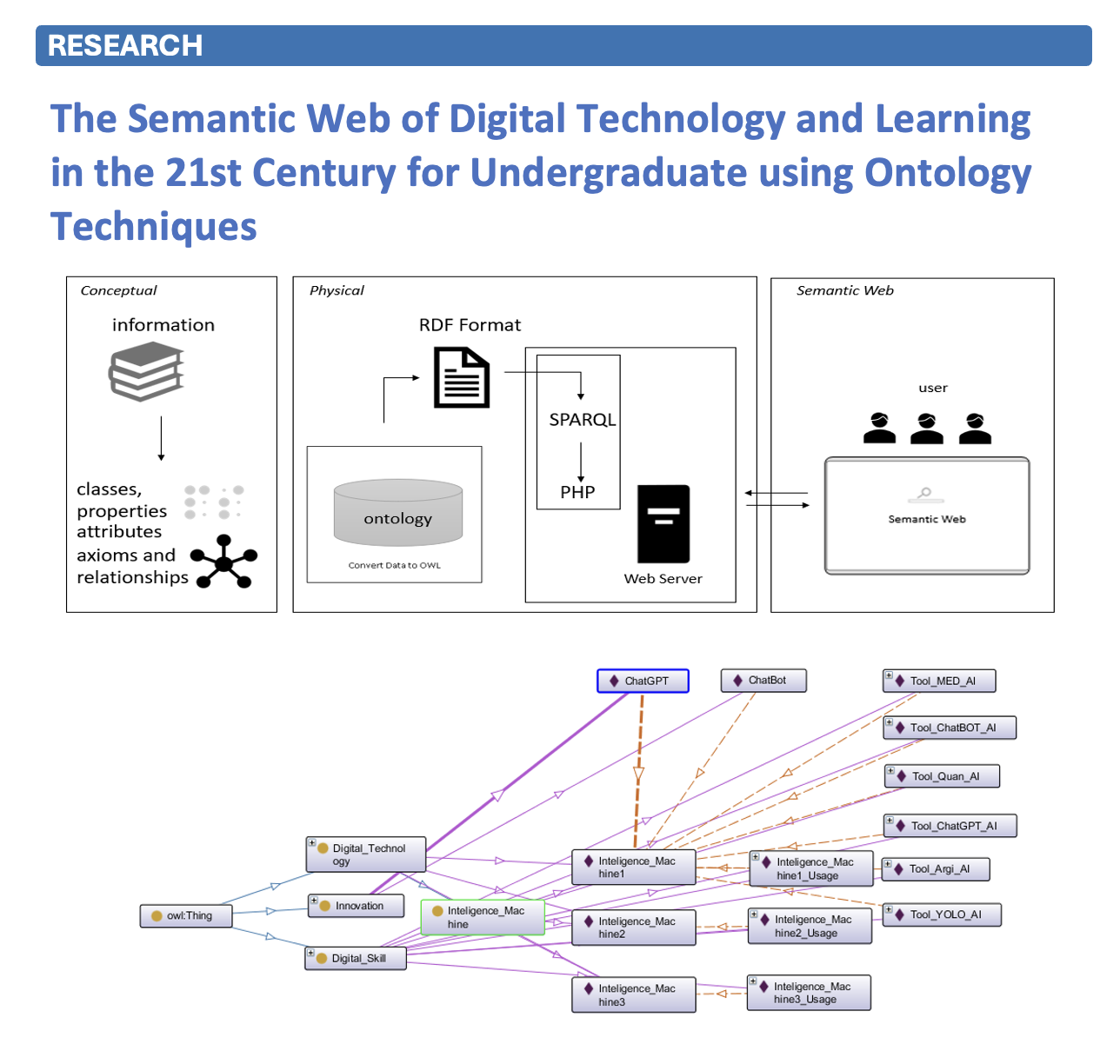
In the 21st century, digital technology has become integral to daily life, significantly impacting the skills and knowledge of undergraduate students. This research aims to develop a Semantic Web for learning digital technology in the 21st century by employing ontology techniques to enhance the efficiency of information retrieval. The system is designed to offer flexible learning, adaptable to students' needs, and focuses on categorizing content into three main classes and twelve subclasses. These classes define relationships using four object properties to connect main classes, subclasses, and instances, and four data type properties to link instances with data and relationships between digital technologies. This approach clarifies information and makes it more relevant for undergraduate students. Despite the advantages of ontology techniques in improving information retrieval and recommendation processes, challenges remain due to the complexity of constructing data relationships and establishing rules for data storage and retrieval. Effectively managing semantic data requires specialized knowledge to ensure accurate and efficient outcomes. The ontology knowledge base primarily consists of digital technology, innovation, and digital skills. Based on evaluations by three experts, the Semantic Web for digital technology learning in the 21st century, developed using ontology techniques, was rated at a very good level (\bar{x} = 4.52, S.D. = 0.19). The system's performance was also validated, showing precision at 96.25%, recall at 92.08%, and an F-measure of 95.29%, indicating its effectiveness in supporting learning through digital technology.
Article Details

This work is licensed under a Creative Commons Attribution-NonCommercial-NoDerivatives 4.0 International License.
All authors need to complete copyright transfer to Journal of Applied Informatics and Technology prior to publication. For more details click this link: https://ph01.tci-thaijo.org/index.php/jait/copyrightlicense




References
Anam, S., Kim, Y. S., Kang, B. H., and Liu, Q. (2015). Review of ontology matching approaches and challenges. International Journal of Computer Science and Network Solutions, 3(3):1–27.
Beck, R., Avital, M., Rossi, M., and Thatcher, J. B. (2017). Blockchain technology in business and information systems research. Business & Information Systems Engineering, 59(6):381–384. DOI: 10.1007/s12599-017-0505-1.
Berners-Lee, T., Hendler, J., and Lassila, O. (2001). The semantic web: A new form of web content that is meaningful to computers will unleash a revolution of new possibilities. Scientific American, 284(5):35–43. https://www.lassila.org/publications/2001/SciAm.pdf.
Chutney, I., Thongkam, J., and Phuboon-ob, J. (2014). Development of an ontology for a tourism information recommendation system in Northeastern Thailand. Journal of Science and Technology Mahasarakham University, 33(3):123–135.
Ciarli, T., Kenney, M., Massini, S., and Piscitello, L. (2021). Digital technologies, innovation, and skills: Emerging trajectories and challenges. Research Policy, 50(7):104289. DOI: 10.1016/j.respol.2021.104289.
Colucci, S., Donini, F. M., and Di Sciascio, E. (2024). A review of reasoning characteristics of RDF-based semantic web systems. WIREs Data Mining and Knowledge Discovery, 14(4). DOI: 10.1002/widm.1537.
El-Gayar, M. M., Mekky, N. E., Atwan, A., and Soliman, H. (2019). Enhanced search engine using proposed framework and ranking algorithm based on semantic relations. IEEE Access, 7:139337–139349. DOI: 10.1109/access.2019.2941937.
Glowacka, D., Youngs, R., Pintea, A., and Wolosik, E. (2021). Digital technologies as a means of repression and social control. Technical Report PE 653.636 — April 2021, European Parliament, Policy Department for External Policies, Brussels. DOI: 10.2861/953192.
Grimm, S., Abecker, A., V¨olker, J., and Studer, R. (2011). Ontologies and the Semantic Web, page 507–579. Springer Berlin Heidelberg. DOI: 10.1007/978-3-540-92913-0 13.
Gruber, T. R. (1993). A translation approach to portable ontology specifications. Knowledge Acquisition, 5(2):199–220. DOI: 10.1006/knac.1993.1008.
Guarino, N., Oberle, D., and Staab, S. (2009). What Is an Ontology?, page 1–17. Springer Berlin Heidelberg. DOI: 10.1007/978-3-540-92673-3 0.
Hogan, A. (2020). SPARQL query language. In Hogan, A., editor, The Web of Data, pages 323–448. Springer.
International Telecommunication Union (ITU) (2021). Digital skills insights 2021. Technical report, International Telecommunication Union, Geneva, Switzerland. Retrieved 18 May 2024.
Khabour, S. M., Al-Radaideh, Q. A., and Mustafa, D. (2022). A new ontology-based method for Arabic sentiment analysis. Big Data and Cognitive Computing, 6(2):48. DOI: 10.3390/bdcc6020048.
Lin, Y., Gao, Z., Du, H., Niyato, D., Kang, J., Deng, R., and Shen, X. S. (2024). A unified blockchain-semantic framework for wireless edge intelligence enabled web 3.0. IEEE Wireless Communications, 31(2):126–133. DOI: 10.1109/mwc.018.2200568.
Martinelli, A., Mina, A., and Moggi, M. (2021). The enabling technologies of industry 4.0: Examining the seeds of the fourth industrial revolution. Industrial and Corporate Change, 30(1):161–188. DOI: 10.1093/icc/dtaa060.
Mehta, A., Makkar, P., Palande, S., and Wankhede, P. S. B. (2015). Semantic web search engine. International Journal of Engineering Research and, V4(04). DOI: 10.17577/ijertv4is040908.
Panchal, R. and Chokshi, P. R. (2022). Using Apache Jena Fuseki Server for execution of SPARQL queries in job search ontology using semantic technology. International Journal of Innovative Research in Computer Science & Technology (IJIRCST), 10(2):497–
DOI: 10.55524/ijircst.2022.10.2.99.
Patel, A. and Jain, S. (2019). Present and future of semantic web technologies: A research statement. International Journal of Com-
puters and Applications, 43(5):413–422. DOI: 10.1080/1206212x.2019.1570666.
Pauwels, P. and McGlinn, K. (2022). Buildings and Semantics: Data Models and Web Technologies for the Built Environment. CRC Press.
Pileggi, S. F., Fernandez-Llatas, C., and Traver, V. (2012). When the social meets the semantic: Social semantic web or web 2.5. Future Internet, 4(3):852–864. DOI: 10.3390/fi4030852.
Qi, W., Sun, M., and Hosseini, S. R. A. (2022). Facilitating big-data management in modern business and organizations using cloud computing: A comprehensive study. Journal of Management & Organization, 29(4):697–723. DOI: 10.1017/jmo.2022.17.
Rindfleisch, A., O’Hern, M., and Sachdev, V. (2017). The digital revolution, 3D printing, and innovation as data. Journal of Product Innovation Management, 34(5):681–690. DOI: 10.1111/jpim.12402.
Srisa-ard, B. (2017). Introduction to Research. Suweeriyasarn, Bangkok, 10th edition.
Taherdoost, H. (2022). An overview of trends in information systems: Emerging technologies that transform the information technology industry. Cloud Computing and Data Science, page 1–16. DOI: 10.37256/ccds.4120231653.
Ting, D. S. W., Carin, L., Dzau, V., and Wong, T. Y. (2020). Digital technology and COVID-19. Nature Medicine, 26(4):459–461. DOI: 10.1038/s41591-020-0824-5.
