
Advancing Dermatological Care through AI: A Deep Learning-Based LINE Chatbot for Skin Disease Diagnosis
Article Sidebar
Main Article Content
Abstract
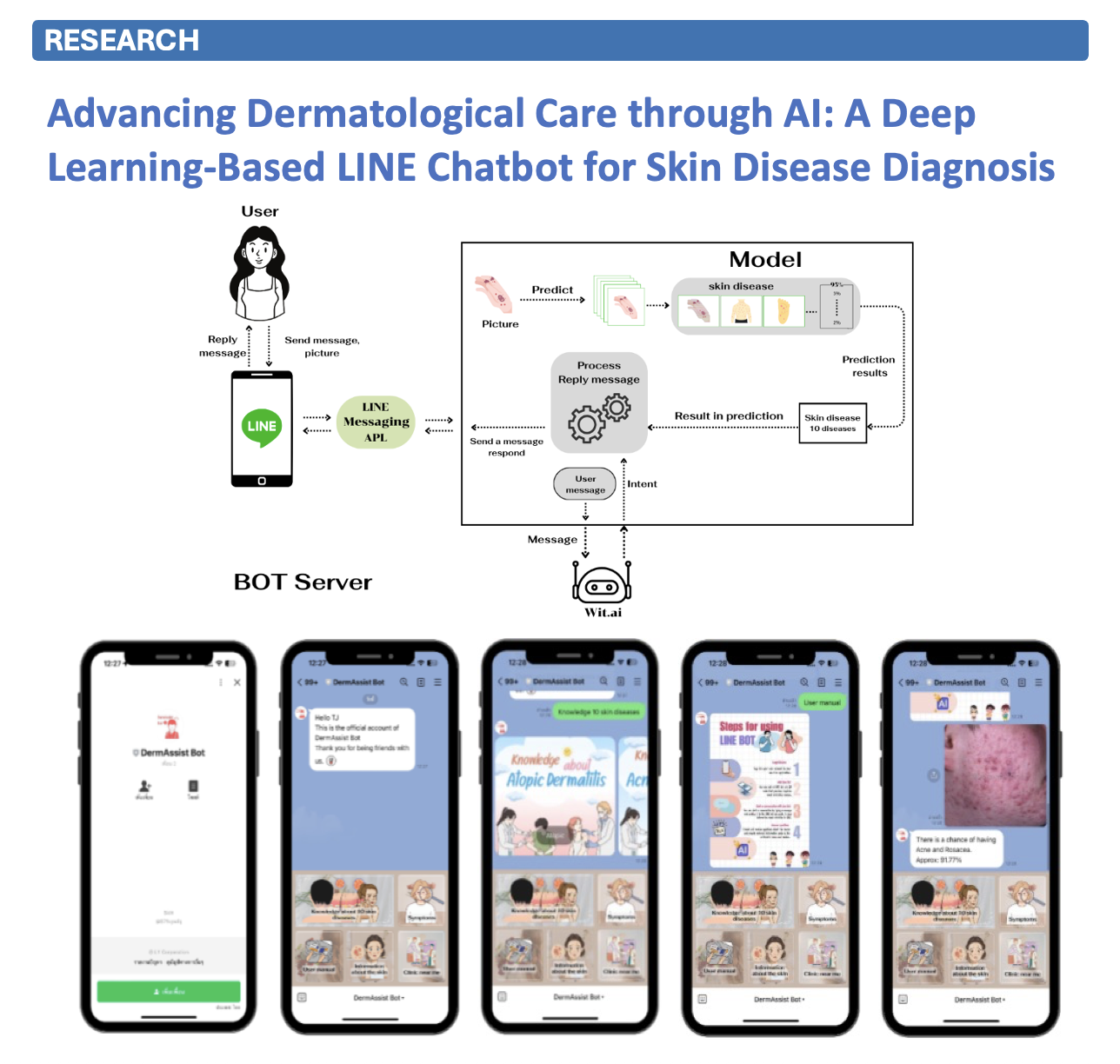
This paper presents the development and deployment of a LINE chatbot for diagnosing skin diseases using advanced deep learning techniques, addressing the challenge of timely and accurate diagnosis in resource-limited settings. While previous studies have explored convolutional neural networks (CNNs) for medical image classification, our research distinguishes itself by integrating MobileNetV2, DenseNet201, and EfficientNetB4 architectures within a mobile messaging platform. These CNN architectures are well-recognized for their robustness in image analysis, yet few studies have harnessed their potential in real-time diagnostic tools accessible to the general public via widely-used platforms like LINE. Our chatbot facilitates the immediate assessment of user-uploaded images, offering a proactive tool for managing skin health. By leveraging deep learning, we enhance diagnostic accuracy and reduce the reliance on traditional medical consultations. Experimental results indicate that our approach not only improves diagnosis precision but also extends the accessibility of dermatological care, particularly in underserved regions. This work contributes to the growing body of mobile health technologies by showcasing the transformative potential of AI-driven solutions in healthcare. The novelty of our research lies in the seamless integration of cutting-edge CNNs into an easy-to-use chatbot, enabling real-time, remote diagnostics in a practical, scalable manner.
Article Details

This work is licensed under a Creative Commons Attribution-NonCommercial-NoDerivatives 4.0 International License.
All authors need to complete copyright transfer to Journal of Applied Informatics and Technology prior to publication. For more details click this link: https://ph01.tci-thaijo.org/index.php/jait/copyrightlicense




References
Aboulmira, A., Hrimech, H., and Lachgar, M. (2022). Comparative study of multiple CNN models for classification of 23 skin diseases. International Journal of Online and Biomedical Engineering (iJOE), 18(11):127–142. DOI: 10.3991/ijoe.v18i11.32517.
Akrout, M., Gyepesi, B., Holl´o, P., Po´or, A., Kincs˝o, B., Solis, S., Cirone, K., Kawahara, J., Slade, D., Abid, L., Kov´acs, M., and Fazekas, I. (2024). Diffusion-Based Data Augmentation for Skin Disease Classification: Impact Across Original Medical Datasets to Fully Synthetic Images, page 99–109. Springer Nature Switzerland. DOI: 10.1007/978-3-031-53767-7 10.
Albuquerque, R., Rodrigues, A., Ferrucio, G., Aguiar, J., Filho, J. A., and Madeiro, F. (2022). Efficientnets aplicadas `a estegan´alise em imagens digitais. Revista de Engenharia e Pesquisa Aplicada, 7(2):32–41. DOI: 10.25286/repa.v7i2.2215.
Alptekin, O. and Isik, Z. (2022). Analysis of data augmentation on skin lesion classification by using deep learning models. In 2022 International Symposium on Multidisciplinary Studies and Innovative Technologies (ISMSIT), page 629–634. IEEE. DOI: 10.1109/ismsit56059.2022.9932815.
Altaf, Y., Wahid, A., and Kirmani, M. M. (2023). Deep learning approach for sign language recognition using DenseNet201 with transfer learning. In 2023 IEEE International Students’ Conference on Electrical, Electronics and Computer Science (SCEECS), page 1–6. IEEE. DOI: 10.1109/sceecs57921.2023.10063044.
Bansal, P., Malik, K., Kumar, S., and Singh, C. (2023). EfficientNet-based image captioning system. In 2023 International Conference on Device Intelligence, Computing and Communication Technologies, (DICCT), page 643–647. IEEE. DOI: 10.1109/dicct56244.2023.10110117.
Cork, M. and Danby, S. (2017). The British skin foundation: 20 years of supporting dermatology research. British Journal of Dermatology, 177(3):608–609. DOI: 10.1111/bjd.15786.
Enkvetchakul, P., Surinta, O., and Noppitak, S. (2022). Effective data resampling and meta-learning convolutional neural networks for diabetic retinopathy recognition. ICIC Express Letters, Part B: Applications, 13(9):939–948. DOI: 10.24507/icicelb.13.09.939.
Esteva, A., Kuprel, B., Novoa, R. A., Ko, J., Swetter, S. M., Blau, H. M., and Thrun, S. (2017). Dermatologist-level classification of skin cancer with deep neural networks. Nature, 542(7639):115–118. DOI: 10.1038/nature21056.
Geetha, A. and B. Prakash, N. (2022). Classification of glaucoma in retinal images using EfficientnetB4 deep learning model. Computer Systems Science and Engineering, 43(3):1041–1055. DOI: 10.32604/csse.2022.023680.
Gupta, A. K., Baviskar, V., Sethi, P., and Bhise, D. (2023). Application of deep learning in skin disease diagnosis: A review. In 2023 International Conference on Inventive Computation Technologies (ICICT), page 1773–1780. IEEE. DOI: 10.1109/icict57646.2023.10134158.
Hameed, N., Ruskin, A., Abu Hassan, K., and Hossain, M. (2016). A comprehensive survey on image-based computer aided diagnosis systems for skin cancer. In 2016 10th International Conference on Software, Knowledge, Information Management & Applications (SKIMA), page 205–214. IEEE. DOI: 10.1109/skima.2016.7916221.
Hameed, N., Shabut, A., and Hossain, M. A. (2018). A computer-aided diagnosis system for classifying prominent skin lesions using machine learning. In 2018 10th Computer Science and Electronic Engineering (CEEC), page 186–191. IEEE. DOI: 10.1109/ceec.2018.8674183.
Kondaveeti, H. K., Guturu, S. V. N. S. V., Jayan Praveen, K. S., and Kumar, S. V. S. (2023). A transfer learning approach to bird species recognition using MobileNetV2. In 2023 7th International Conference on Intelligent Computing and Control Systems (ICICCS), page 787–794. IEEE. DOI: 10.1109/iciccs56967.2023.10142795.
Kumar, S. V. and Kondaveeti, H. K. (2024). Bird species recognition using transfer learning with a hybrid hyperparameter optimization scheme (HHOS). Ecological Informatics, 80:102510. DOI: 10.1016/j.ecoinf.2024.102510.
Lapthanachai, N., Chomthong, A., Waijanya, S., and Promrit, N. (2023). Classification of nail abnormalities using convolutional neural network. Journal of Applied Informatics and Technology, 5(1):18–35. DOI: 10.14456/jait.2023.2.
Li, L.-F., Wang, X., Hu, W.-J., Xiong, N. N., Du, Y.-X., and Li, B.-S. (2020). Deep learning in skin disease image recognition: A review. IEEE Access, 8:208264–208280. DOI: 10.1109/access.2020.3037258.
Li, Z., Wang, Y., Guan, B., and Yin, J. (2023). Semantic data augmentation for long-tailed facial expression recognition. In 2023 8th International Conference on Computer and Communication Systems (ICCCS), page 1052–1055. IEEE. DOI: 10.1109/icccs57501.2023.10150674.
Nath, S. and Naskar, R. (2021). Automated image splicing detection using deep CNN-learned features and ANN-based classifier. Signal, Image and Video Processing, 15(7):1601–1608. DOI: 10.1007/s11760-021-01895-5.
¨
Ozaltin, O. and Yeniay, O. (2023). Detection of monkeypox disease from skin lesion images using MobileNetV2 architecture. Communications Faculty of Science University of Ankara Series A1 Mathematics and Statistics, 72(2):482–499. DOI: 10.31801/cfsuasmas.1202806.
Pandey, S., Nandy, S., and Bansal, S. (2023). Skin disease detection based on deep learning. International Journal of Scientific Research in Science, Engineering and Technology, page 120–127. DOI: 10.32628/ijsrset231015.
Pavan, M. D., Ram, C. B., Vemulapalli, D. C., Cheemakurthy, S. T., Kavitha, M., and Jadala, V. C. (2023). Analysis on convolutional neural network model using skin disease dataset. In 2023 International Conference on Sustainable Computing and
Smart Systems (ICSCSS), page 529–536. IEEE. DOI: 10.1109/icscss57650.2023.10169778.
Picardi, A., Lega, I., and Tarolla, E. (2013). Suicide risk in skin disorders. Clinics in Dermatology, 31(1):47–56. DOI: 10.1016/j.clindermatol.2011.11.006.
Prasher, S. and Nelson, L. (2023). Mosquitoes classification using EfficientNetB4 transfer learning model. In 2023 2nd International Conference on Applied Artificial Intelligence and Computing (ICAAIC), page 582–586. IEEE. DOI: 10.1109/icaaic56838.2023.10141504.
Ramamurthy, K., Muthuswamy, A., Mathimariappan, N., and Kathiresan, G. S. (2023). A novel two-staged network for skin disease detection using atrous residual convolutional networks. Concurrency and Computation: Practice and Experience, 35(26). DOI: 10.1002/cpe.7834.
Randellini, E., Rigutini, L., and Sacc`a, C. (2022). Data augmentation techniques and transfer learning approaches applied to facial expressions recognition systems. International Journal of Artificial Intelligence & Applications, 13(1):55–72. DOI: 10.5121/i-
jaia.2022.13104.
Saisangchan, U., Chamchong, R., and Suwannasa, A. (2022). Analysis of lime leaf disease using deep learning. Journal of Applied Informatics and Technology, 4(1):18–35. DOI: 10.14456/jait.2022.6.
Salih, D. K., Qadir, A. M., and Ghareb, M. I. (2023). A hybrid approach to osteosarcoma detection using Densenet201-SVM model. In 2023 11th International Symposium on Digital Forensics and Security (ISDFS), page 1–5. IEEE. DOI: 10.1109/isdfs58141.2023.10131717.
Sujatha, K. and Rao, B. S. (2023). Densenet201: A customized DNN model for multi-class classification and detection of tumors based on brain MRI images. In 2023 Fifth International Conference on Electrical, Computer and Communication Technologies (ICECCT), page 1–7. IEEE. DOI: 10.1109/icecct56650.2023.10179642.
Utami, P., Hartanto, R., and Soesanti, I. (2022). The EfficientNet performance for facial expressions recognition. In 2022 5th International Seminar on Research of Information Technology and Intelligent Systems (ISRITI), page 756–762. IEEE. DOI:
1109/isriti56927.2022.10053007.
Voegeli, D. and Hillery, S. (2021). Prevention and management of moisture-associated skin damage. British Journal of Nursing, 30(15):S40–S46. DOI: 10.12968/bjon.2021.30.15.s40.
Yassin, N. I. R. (2023). Fundus images classification of diabetic retinopathy using MobileNetV2. International Journal of Computer Science and Mobile Computing, 12(5):54–63. DOI: 10.47760/ijcsmc.2023.v12i05.006.
Zhou, Z., Liu, M., Deng, W., Wang, Y., and Zhu, Z. (2023). Clothing image classification with DenseNet201 network and optimized regularized random vector functional link. Journal of Natural Fibers, 20(1). DOI: 10.1080/15440478.2023.2190188.
