
Autoencoder Applications for Enhancing Spice Classification Performance under Limited Dataset Conditions
Article Sidebar
Main Article Content
Abstract
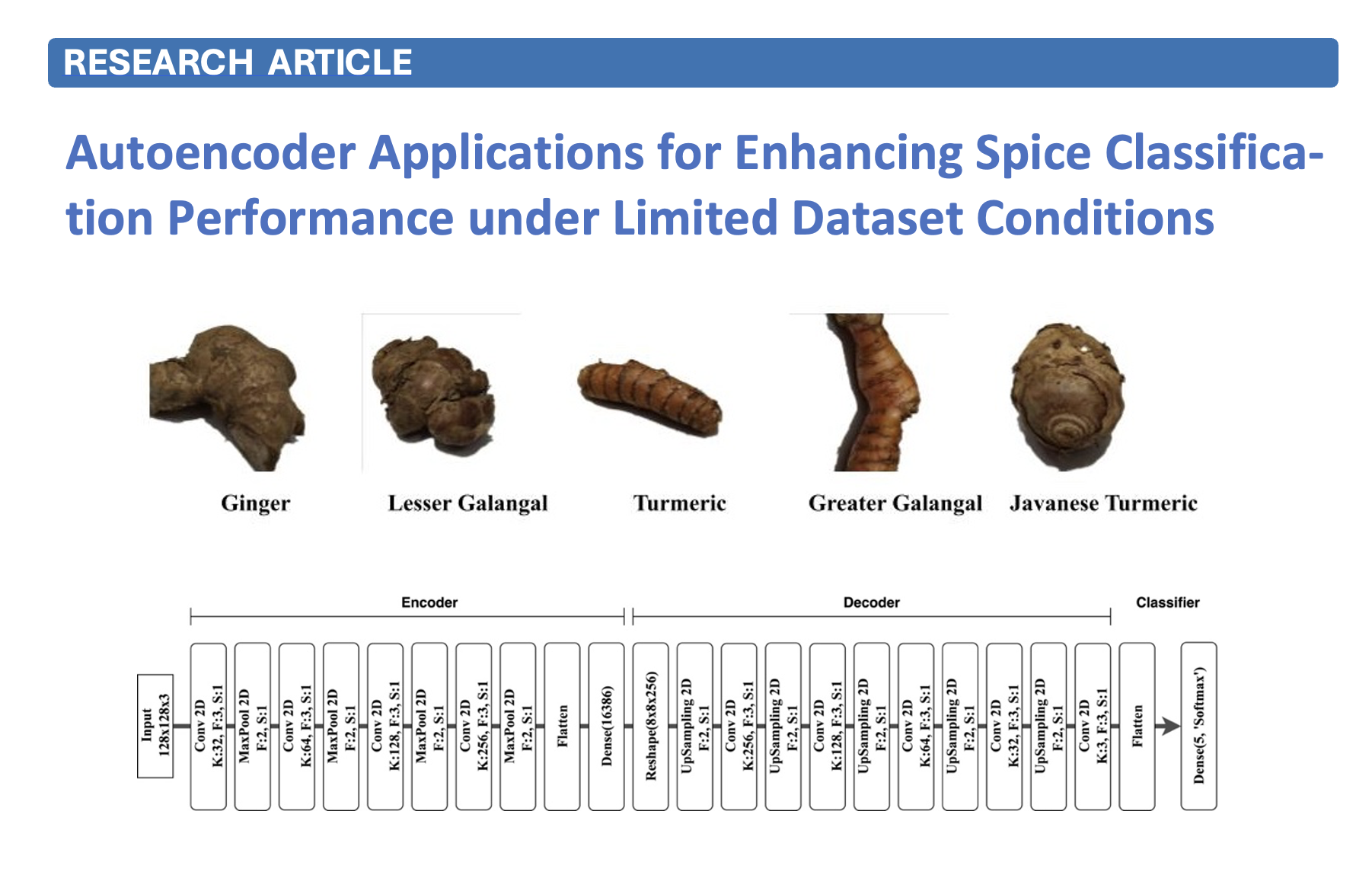
Indonesia's rich assortment of spices holds immense value for their health benefits and culinary applications, yet widespread understanding of these spices among the populace remains limited. This research proposes leveraging autoencoder technology to address the complexities arising from the intricate shapes and colors of spices, compounded by the constraints of a limited dataset. Through meticulous refinement of hyperparameters such as learning rate, optimization function, input size, and epochs, the autoencoder endeavors to extract unique features crucial for accurate spice classification. Comparative assessments against alternative CNN architectures employing transfer learning underscore the autoencoder's capacity to attain comparable accuracy levels. Notably, the model demonstrates consistent performance devoid of overfitting or underfitting, yielding validation precision and recall rates nearing 0.97. These outcomes accentuate the autoencoder's efficacy in compressing image data and discerning pivotal features, thereby facilitating precise spice classification despite constraints posed by dataset limitations.
Article Details

This work is licensed under a Creative Commons Attribution-NonCommercial-NoDerivatives 4.0 International License.
All authors need to complete copyright transfer to Journal of Applied Informatics and Technology prior to publication. For more details click this link: https://ph01.tci-thaijo.org/index.php/jait/copyrightlicense




References
Agrahar-Murugkar, D. (2020). Food to food fortification of breads and biscuits with herbs, spices, millets and oilseeds on bio-accessibility of calcium, iron and zinc and impact of proteins, fat and phenolics. LWT, 130:109703. DOI: 10.1016/j.lwt.2020.109703.
Ahmad, B., Sun, J., You, Q., Palade, V., and Mao, Z. (2022). Brain tumor classification using a combination of variational autoencoders and generative adversarial networks. Biomedicines, 10(2):223. DOI: 10.3390/biomedicines10020223.
Arrofiqoh, E. N. and Harintaka, H. (2018). Implementasi metode convolutional neural network untuk klasifikasi tanaman pada citra resolusi tinggi. GEOMATIKA, 24(2):61. DOI: 10.24895/jig.2018.24-2.810.
Atliha, V. and Sesok, D. (2020). Comparison of VGG and ResNet used as encoders for image captioning. In 2020 IEEE Open Conference of Electrical, Electronic and Information Sciences (eStream). IEEE. DOI: 10.1109/estream50540.2020.9108880.
Cardoso-Ugarte, G. A. and Sosa-Morales, M. E. (2021). Essential oils from herbs and spices as natural antioxidants: Diversity of promising
food applications in the past decade. Food Reviews International, 38(sup1):403–433. DOI: 10.1080/87559129.2021.1872084.
De-Montijo-Prieto, S., Razola-D´ıaz, M. d. C., G´omez-Caravaca, A. M., Guerra-Hernandez, E. J., Jim´enez-Valera, M., Garcia-Villanova, B., Ruiz-Bravo, A., and Verardo, V. (2021). Essential oils from fruit and vegetables, aromatic herbs, and spices: Composition, antioxidant, and antimicrobial activities. Biology, 10(11):1091. DOI: 10.3390/biology10111091.
Habaragamuwa, H., Oishi, Y., and Tanaka, K. (2024). Achieving explainability for plant disease classification with disentangled variational autoencoders. Engineering Applications of Artificial Intelligence, 133:107982. DOI: 10.1016/j.engappai.2024.107982.
Han, D., Tian, M., Gong, C., Zhang, S., Ji, Y., Du, X., Wei, Y., and Chen, L. (2022). Image classification of forage grasses on Etuoke banner using edge autoencoder network. PLOS ONE, 17(6):e0259783. DOI: 10.1371/journal.pone.0259783.
Jiang, T. A. (2019). Health benefits of culinary herbs and spices. Journal of AOAC International, 102(2):395–411. DOI: 10.5740/jaoacint.18-0418. Khrisne, D. C. and Suyadnya, I. M. A. (2018). Indonesian herbs and spices recognition using smaller VGGNet-like network. In 2018 International Conference on Smart Green Technology in Electrical and Information Systems (ICSGTEIS), page 221–224. IEEE. DOI: 10.1109/icsgteis.2018.8709135.
Li, T. (2006). The range of medicinal herbs and spices, page 113–125. Elsevier. DOI: 10.1533/9781845691717.2.113.
Liu, B., Tan, C., Li, S., He, J., and Wang, H. (2020). A data augmentation method based on generative adversarial networks for grape leaf disease identification. IEEE Access, 8:102188–102198. DOI: 10.1109/access.2020.2998839.
Liu, J. and Lin, T. H. (2023). A framework for the synthesis of X-ray security inspection images based on generative adversarial networks. IEEE Access, 11:63751–63760. DOI: 10.1109/access.2023.3288087.
Mandal, D., Sarkar, T., and Chakraborty, R. (2022). Critical review on nutritional, bioactive, and medicinal potential of spices and herbs and their application in food fortification and nanotechnology. Applied Biochemistry and Biotechnology, 195(2):1319–1513. DOI: 10.1007/s12010-022-04132-y.
Melisah, M. and Muhathir, M. (2023). A modification of the distance formula on the K-nearest neighbor method is examined in order to categorize spices from photo using the histogram of oriented gradient. In 2023 International Conference on Computer Science, Information Technology and Engineering (ICCoSITE), page 23–28. IEEE. DOI: 10.1109/iccosite57641.2023.10127780.
Nisa, C. and Candra, F. (2023). Klasifikasi jenis rempah-rempah menggunakan algoritma convolutional neural network: Classification of spice types using the convolutional neural network algorithm. MALCOM: Indonesian Journal of Machine Learning and Computer Science, 4(1):78–84. DOI: 10.57152/malcom.v4i1.1018.
Pratondo, A., Elfahmi, E., and Novianty, A. (2022). Classification of curcuma longa and curcuma zanthorrhiza using transfer learning. PeerJ Computer Science, 8:e1168. DOI: 10.7717/peerj-cs.1168.
Rismiyati, R. and Luthfiarta, A. (2021). VGG16 transfer learning architecture for Salak fruit quality classification. Telematika, 18(1):37. DOI:
31315/telematika.v18i1.4025.
Xia, H. and Xiao, M. (2020). 3D human pose estimation with generative adversarial networks. IEEE Access, 8:206198–206206. DOI: 10.1109/access.2020.3037829.
Zilvan, V., Ramdan, A., Heryana, A., Krisnandi, D., Suryawati, E., Yuwana, R. S., Kusumo, R. B. S., and Pardede, H. F. (2022). Convolutional variational autoencoder-based feature learning for automatic tea clone recognition. Journal of King Saud University - Computer and Information Sciences, 34(6):3332–3342. DOI: 10.1016/j.jksuci.2021.01.020.
