
The Development of Brand Equity Measurements for Competitiveness of Thai Seafood Industry in Consumers-Perspective
Article Sidebar
Main Article Content
Abstract
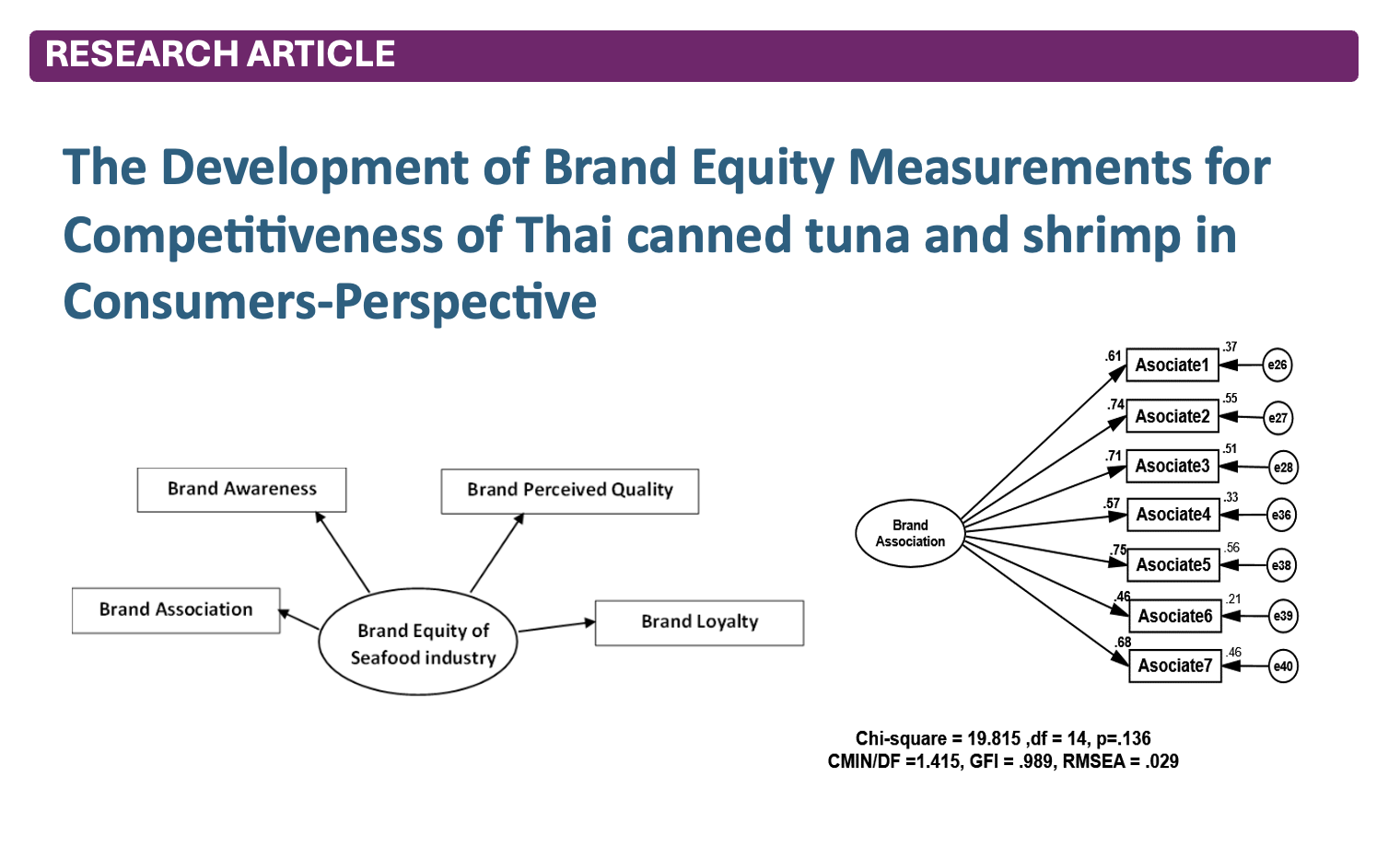
The study aimed to develop a precise measurement of brand equity for the Thai seafood industry, specifically focusing on canned tuna and shrimp products, from a consumer perspective. It utilized a comprehensive mixed-methods approach that combined qualitative interviews with experts and a quantitative survey of 500 consumers, following Churchill's recommendations. The structural validity of the research variable measurement was tested. Research Findings: The study revealed a consumer-oriented brand measurement model comprising four key components: brand loyalty, brand awareness, brand perceived quality, and brand association. This model provides valuable insights for assessing and generalizing brand equity within the Thai canned tuna and shrimp market. Theoretical Contribution/Originality: This research contributes significantly by offering a reliable measurement of brand equity for canned tuna and shrimp brands in Thailand. The comprehensive model, encompassing brand loyalty, awareness, perceived quality, and association, holds practical implications for marketers and practitioners aiming to enhance brand equity within the industry.
Article Details

This work is licensed under a Creative Commons Attribution-NonCommercial-NoDerivatives 4.0 International License.
All authors need to complete copyright transfer to Journal of Applied Informatics and Technology prior to publication. For more details click this link: https://ph01.tci-thaijo.org/index.php/jait/copyrightlicense




References
Aaker, D. A. (1996). Building Strong Brands. Simon and Schuster, New York, USA.
Arbuckle, J. L. (2016). IBM® SPSS® Amos™ User’s Guide. Amos Development Corporation, Chicago, IL, USA.
Barwise, P. (1993). Brand equity: Snark or boojum? International Journal of Research in Marketing, 10(1):93–104. DOI: 10.1016/0167-8116(93)90036-x.
Brochado, A. and Oliveira, F. (2018). Brand equity in the Portuguese vinho verde “green wine” market. International Journal of Wine Business Research, 30(1):2–18. DOI: 10.1108/ijwbr-07-2016-0023.
Chakraborty, U. and Bhat, S. (2017). The effects of credible online reviews on brand equity dimensions and its consequence on consumer behavior. Journal of Promotion Management, 24(1):57–82. DOI: 10.1080/10496491.2017.1346541.
Chanprasit, W. and Anantachart, S. (2016). Developing a conceptual model of customer-based brand equity for tourism destination (CBBETD). Journal of Public Relations and Advertising, 9(1):35–57.
Churchill, G. A. (1979). A paradigm for developing better measures of marketing constructs. Journal of Marketing Research, 16(1):64. DOI: 10.2307/3150876.
Comrey, A. L. and Lee, H. B. (2013). A First Course in Factor Analysis. Psychology Press, New York, USA, 2nd edition.
de Chernatony, L. and McDonald, M. (2012). Creating Powerful Brands. Routledge.
Department of International Trade Promotion (2022). Seafood product. Technical report, Department of International Trade Promotion, Thailand. Retrieved February 2024, from https://www.ditp.go.th.
Gartner, W. C. and Ruzzier, M. K. (2010). Tourism destination brand equity dimensions: Renewal versus repeat market. Journal of Travel Research, 50(5):471–481. DOI: 10.1177/0047287510379157.
Girard, T., Trapp, P., Pinar, M., Gulsoy, T., and Boyt, T. E. (2016). Consumer-based brand equity of a private-label brand: Measuring and examining determinants. Journal of Marketing Theory and Practice, 25(1):39–56. DOI: 10.1080/10696679.2016.1236662.
Hanna, R., Rohm, A., and Crittenden, V. L. (2011). We’re all connected: The power of the social media ecosystem. Business Horizons, 54(3):265–273. DOI: 10.1016/j.bushor.2011.01.007.
Jafari Drabjerdi, J., Arabi, M., and Haghighikhah, M. (2016). Identifying the effective factors on brand equity from consumers perspective using Aaker model: A case of tehran dairy products. International Journal of Business and Management, 11(4):265. DOI: 10.5539/ijbm.v11n4p265.
Jitprapai, N., Techakana, J., and Wattanakomol, S. (2022). Guidelines to create opportunities for upgrading of the original equipment manufacturer to the original brand manufacturer. Res Militaris, 12(3):3451–3468.
Jr., J. F. H., Matthews, L. M., Matthews, R. L., and Sarstedt, M. (2017). PLS-SEM or CB-SEM: Updated guidelines on which method to use. International Journal of Multivariate Data Analysis, 1(2):107. DOI: 10.1504/ijmda.2017.087624.
Kannasuit, A. and Anantachart, S. (2017). The levels of consumer-based brand equity in service business. Journal of Public Relations and Advertising, 10(1):25–48.
Kashif, M., Samsi, S. Z. M., and Sarifuddin, S. (2015). Brand equity of lahore fort as a tourism destination brand. Revista de Administra¸c˜ao de Empresas, 55(4):432–443. DOI: 10.1590/s0034-759020150407.
Keller, K. L. (1993). Conceptualizing, measuring, and managing customer-based brand equity. Journal of Marketing, 57(1):1–22. DOI: 10.1177/002224299305700101.
Keller, K. L. (2002). Branding and brand equity. In Weitz, B. A. and Wensley, R., editors, Handbook of Marketing, pages 151–178. Sage Publications, Thousand Oaks, CA, USA.
Keller, K. L. and Brexendorf, T. O. (2017). Measuring Brand Equity, page 1–32. Springer Fachmedien Wiesbaden. DOI: 10.1007/978-3-658-13361-0 72-1.
Khoshtaria, T., Datuashvili, D., and Matin, A. (2020). The impact of brand equity dimensions on university reputation: an empirical study of Georgian higher education. Journal of Marketing for Higher Education, 30(2):239–255. DOI: 10.1080/08841241.2020.1725955.
Kim, H.-K. and Lee, T. (2018). Brand equity of a tourist destination. Sustainability, 10(2):431. DOI: 10.3390/su10020431.
Kim, W. G. and Kim, H. B. (2004). Measuring customer-based restaurant brand equity. Cornell Hotel and Restaurant Administration Quarterly, 45(2):115–131. DOI: 10.1177/0010880404264507.
Konecnik, M. and Gartner, W. C. (2007). Customer-based brand equity for a destination. Annals of Tourism Research, 34(2):400–421. DOI: 10.1016/j.annals.2006.10.005.
Lee, G. and Leh, F. (2011). Dimensions of customer- based brand equity: A study on Malaysian brands. Journal of Marketing Research and Case Studies, page 1–10. DOI: 10.5171/2011.821981.
Molinillo, S., Ekinci, Y., and Japutra, A. (2018). A consumer-based brand performance model for assessing brand success. International Journal of Market Research, 61(1):93–110. DOI: 10.1177/1470785318762990.
Quan, N. H., Chi, N. T. K., Nhung, D. T. H., Ngan, N. T. K., and Phong, L. T. (2020). The influence of website brand equity, e-brand experience on e-loyalty: The mediating role of e-satisfaction. Management Science Letters, page 63–76. DOI: 10.5267/j.msl.2019.8.015.
SCB EIC (2023). SCB EIC, industry insight: Seafood industry.
Shaalan, A., Hegazy, A., Tourky, M., Elshaer, I., and Ashour, H. (2020). Understanding consumer-based brand equity and its antecedents in international and national banks in Egypt. Journal of Marketing Communications, 28(1):38–72. DOI: 10.1080/13527266.2020.1832137.
Silpchalu, T. (2020). Statistical Research and Analysis with SPSS and AMOS. Business R&D General Partnership, Bangkok, Thailand.
So, K. F. and King, C. (2010). When experience matters: Building and measuring hotel brand equity from the customers’ perspective. International Journal of Contemporary Hospitality Management, 22(5):589–608.
Tong, X. and Hawley, J. M. (2009). Measuring customer-based brand equity: Empirical evidence from the sportswear market in China. Journal of Product & Brand Management, 18(4):262–271. DOI: 10.1108/10610420910972783.
Tritama, H. B. and Tarigan, R. E. (2016). The effect of social media to the brand awareness of a product of a company. Communication and Information Technology Journal, 10(1):9–14.
Tsordia, C., Papadimitriou, D., and Parganas, P. (2017). The influence of sport sponsorship on brand equity and purchase behavior. Journal of Strategic Marketing, 26(1):85–105. DOI: 10.1080/0965254x.2017.1374299.
Vadakkepatt, G. G., Winterich, K. P., Mittal, V., Zinn, W., Beitelspacher, L., Aloysius, J., Ginger, J., and Reilman, J. (2021). Sustainable retailing. Journal of Retailing, 97(1):62–80. DOI: 10.1016/j.jretai.2020.10.008.
Washburn, J. H. and Plank, R. E. (2002). Measuring brand equity: An evaluation of a consumer-based brand equity scale. Journal of Marketing Theory and Practice, 10(1):46–62. DOI: 10.1080/10696679.2002.11501909.
Yoo, B. and Donthu, N. (2001). Developing and validating a multidimensional consumer-based brand equity scale. Journal of Business Research, 52(1):1–14. DOI: 10.1016/s0148-2963(99)00098-3.
