
Transfer Learning-Based Segmentation of Pneumonia from Chest X-Rays Images
Article Sidebar
Main Article Content
Abstract
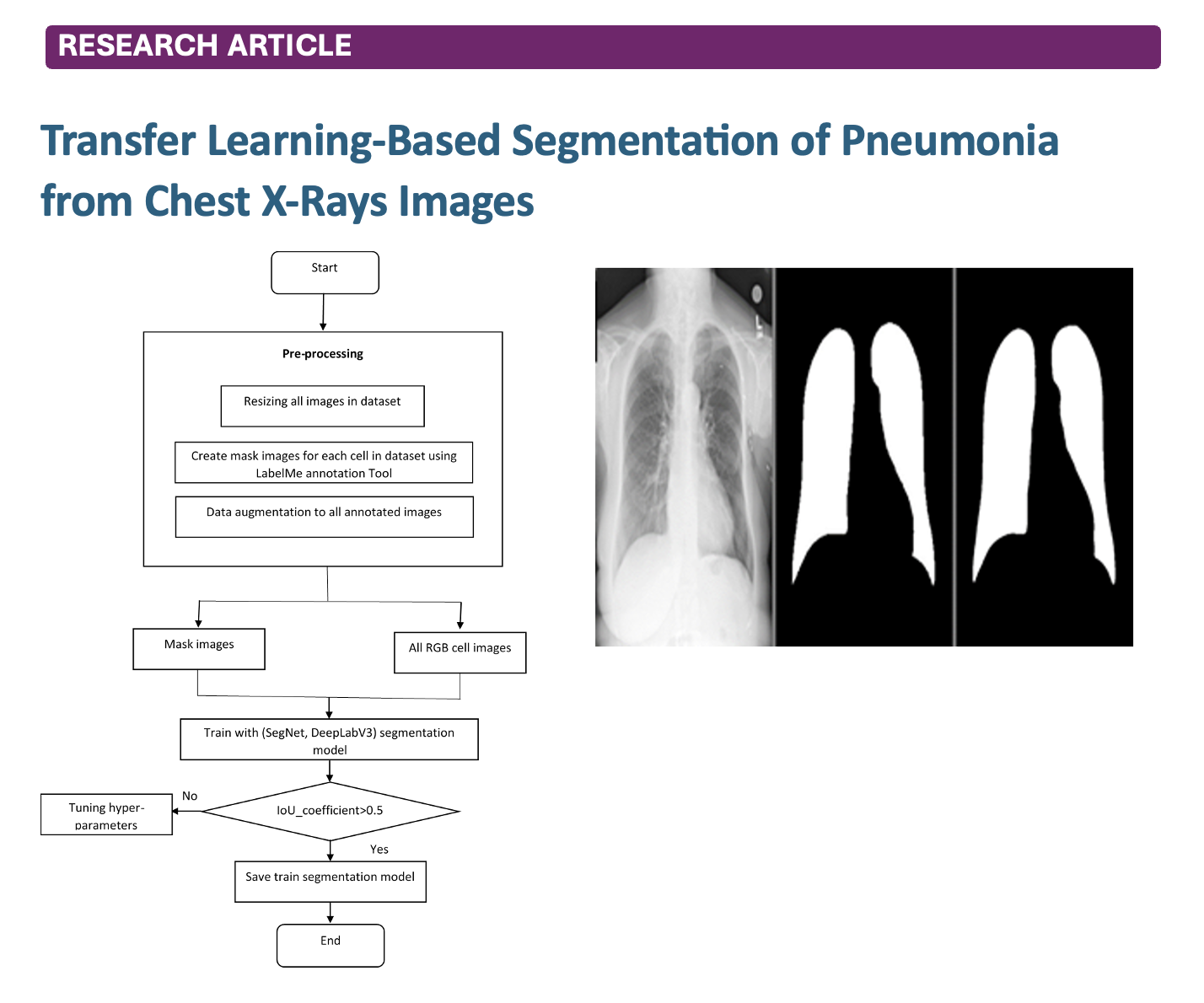
Pneumonia remains a significant global health concern, warranting precise and efficient diagnostic tools. This study introduces a comprehensive approach to pneumonia segmentation leveraging advanced deep learning techniques. The primary goal is to enhance the precision of pneumonia localization within medical images, specifically chest X-rays, through the utilization of state-of-the-art deep learning models. This study explores the application of advanced segmentation models, namely DeepLabv3 and SegNet, for the automated identification and delineation of pneumonia-affected regions within chest X-ray images. DeepLabv3, renowned for its semantic segmentation capabilities, and SegNet, featuring an encoder-decoder architecture, are selected as the segmentation models. The training process of the system leverages the widely acknowledged Kermany dataset, specifically composed of chest X-ray images depicting cases of pneumonia. This dataset is well-established and holds a prominent status within the field, recognized for its relevance and significance in the context of pneumonia detection and classification tasks. As per the evaluation findings, it is evident that the system attains enhanced accuracy when employing the DeepLabv3 architecture compared to the SegNet architecture.
Article Details

This work is licensed under a Creative Commons Attribution-NonCommercial-NoDerivatives 4.0 International License.
All authors need to complete copyright transfer to Journal of Applied Informatics and Technology prior to publication. For more details click this link: https://ph01.tci-thaijo.org/index.php/jait/copyrightlicense




References
Badrinarayanan, V., Kendall, A., and Cipolla, R. (2017). SegNet: A deep convolutional encoder-decoder architecture for image segmentation. IEEE Transactions on Pattern Analysis and Machine Intelligence, 39(12):2481–2495. DOI: 10.1109/tpami.2016.2644615.
Cao, F. and Zhao, H. (2021). Automatic lung segmentation algorithm on chest X-ray images based on fusion variational auto-encoder and three-terminal attention mechanism. Symmetry, 13(5):814. DOI: 10.3390/sym13050814.
Chen, L., Papandreou, G., Schroff, F., and Adam, H. (2017). Rethinking atrous convolution for semantic image segmentation. CoRR, abs/1706.05587.
De Silva, M. S., Narayanan, B. N., and Hardie, R. C. (2022). A patient-specific algorithm for lung segmentation in chest radiographs. AI, 3(4):931–947. DOI: 10.3390/ai3040055.
Dey, A. (2022). COV-XDCNN: Deep Learning Model with External Filter for Detecting COVID-19 on Chest X-rays, page 174–189. Springer International Publishing. DOI: 10.1007/978-3-031-11633-9_14.
Fernandes, V., Bras, G., d, L. F., Paiva, e., Junior, G. B., d, A. C., Paiva, e., and Rivero, L. (2023). Transfer learning-based lung segmentation
and pneumonia detection for paediatric chest X-ray images. International Journal of Innovative Computing and Applications, 14(1/2):56. DOI: 10.1504/ijica.2023.129358.
Gite, S., Mishra, A., and Kotecha, K. (2022). Enhanced lung image segmentation using deep learning. Neural Computing and Applications, 35(31):22839–22853. DOI: 10.1007/s00521-021-06719-8.
Kayalibay, B., Jensen, G., and van der Smagt, P. (2017). CNN-based segmentation of medical imaging data. CoRR, abs/1701.03056.
Kim, Y.-G., Kim, K., Wu, D., Ren, H., Tak, W. Y., Park, S. Y., Lee, Y. R., Kang, M. K., Park, J. G., Kim, B. S., Chung, W. J., Kalra, M. K., and Li,
Q. (2022). Deep learning-based four-region lung segmentation in chest radiography for COVID-19 diagnosis. Diagnostics, 12(1):101. DOI: 10.3390/diagnostics12010101.
Mooney, P. (2018). Chest X-ray images (pneumonia). https://www.kaggle.com/paultimothymooney/chest-xray-pneumonia. Accessed: 2024-01-25.
Rahman, M. F., Zhuang, Y., Tseng, T.-L. B., Pokojovy, M., McCaffrey, P., Walser, E., Moen, S., and Vo, A. (2022). Improving lung region segmentation accuracy in chest X-ray images using a two-model deep learning ensemble approach. Journal of Visual Communication and Image Representation, 85:103521. DOI: 10.1016/j.jvcir.2022.103521.
Victor Ikechukwu, A., Murali, S., Deepu, R., and Shivamurthy, R. (2021). ResNet-50 vs VGG-19 vs training from scratch: A comparative analysis of the segmentation and classification of pneumonia from chest X-ray images. Global Transitions Proceedings, 2(2):375–381. DOI: 10.1016/j.gltp.2021.08.027.
Wahyuningrum, R. T., Yunita, I., Siradjuddin, I. A., Satoto, B. D., Sari, A. K., and Sensusiati, A. D. (2023). Improvement of chest X-ray image segmentation accuracy based on FCA-Net. Cogent Engineering, 10(1). DOI: 10.1080/23311916.2023.2229571.
Zhang, Z., Ni, X., Huo, G., Li, Q., and Qi, F. (2021). Novel coronavirus pneumonia detection and segmentation based on the deep-learning method. Annals of Translational Medicine, 9(11):934–934. DOI: 10.21037/atm-21-1156.
Zhao, C., Xu, Y., He, Z., Tang, J., Zhang, Y., Han, J., Shi, Y., and Zhou, W. (2021). Lung segmentation and automatic detection of COVID-19 using radiomic features from chest CT images. Pattern Recognition, 119:108071. DOI: 10.1016/j.patcog.2021.108071.
