
Adaptive Hybrid Stacking Ensemble Learning for Real-Time Forest Fire Risk Prediction
Article Sidebar
Main Article Content
Abstract
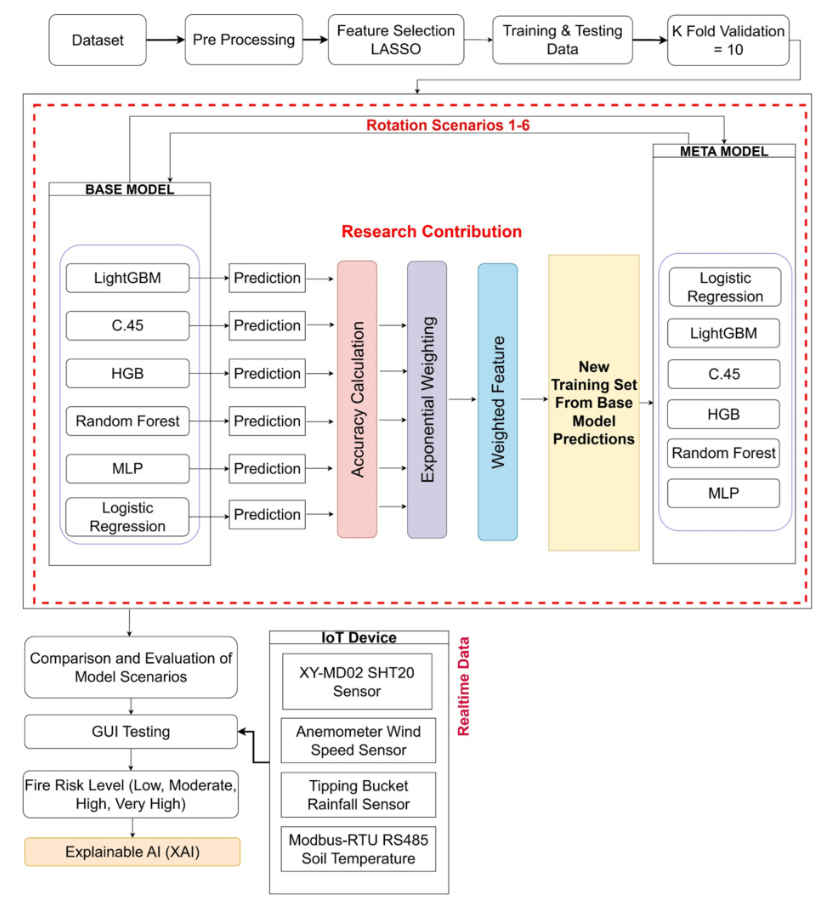
Forest and land fires remain a recurring environmental issue, particularly in regions with high climate variability such as Indonesia. This study proposes an Adaptive Hybrid Stacking Ensemble approach for real-time fire risk prediction by integrating meteorological data and IoT-based sensing systems. The model combines multiple base learners with a rotation strategy and an exponential accuracy weighting mechanism to optimize the contribution of each model. A dataset consisting of 4,931 meteorological records was used, including variables such as Average Temperature, Relative Humidity, Rainfall, Wind Speed, and Soil Surface Moisture. Experimental results show that the proposed model significantly outperforms conventional stacking, achieving an accuracy of up to 92.47%, compared to 86%87% in baseline stacking. The optimal performance was obtained at α= 5 in the weighting scheme, which effectively balances model contribution. Evaluation using confusion matrix, ROC curve, and K-fold cross-validation confirms the model's robustness, with AUC values reaching 0.981.00 and stable accuracy across folds. In addition, Explainable AI using SHAP reveals that Rainfall and Soil Surface Moisture are the most influential features in fire risk prediction. The integration with IoT enables real-time data processing and prediction, making the system applicable for early warning and disaster mitigation.
Article Details

This work is licensed under a Creative Commons Attribution-NonCommercial-NoDerivatives 4.0 International License.
References
S. Y. Ardiyanto and S. Andrikasmi, “Prevention, control and law enforcement forest and land burning in Riau Province,” in Proc. 2nd Riau Annu. Meeting Law Social Sci. (RAMLAS), pp. 90–94, 2022.
D. Sekarjati, W. Putklang and N. Wattanakij, “Identifying Peatland Fire Detection and Spatiotemporal Distribution: Implications for Land Use and land Cover Changes in Riau Province, Indonesia,” 2024 28th International Computer Science and Engineering Conference (ICSEC), Khon Kaen, Thailand, pp. 1-6, 2024.
A. Muhaimin, Edriyansyah, Wahyat, Y. Irawan, and R. Wahyuni, “Optimized IoT-Based Multimodal Fusion for Early Forest Fire Detection and Prediction,” ECTI-CIT Transactions, vol. 19, no. 4, pp. 569–582, Sep. 2025.
A. P. Selvam and S. N. S. Al-Humairi, “Environmental impact evaluation using smart real-time weather monitoring systems: A systematic review,” Innovative Infrastructure Solutions, vol. 10, no. 1, Art. no. 13, 2024.
D. R. Ramani, B. Ben Sujitha and S. Tangade, “Smart environmental monitoring systems,” in Environmental Monitoring Using Artificial Intelligence, pp. 45–60, 2025.
A. Morchid, Z. Oughannou, R. El Alami, H. Qjidaa, M. O. Jamil and H. M. Khalid, “Integrated Internet of Things (IoT) solutions for early fire detection in smart agriculture,” Results in Engineering, vol. 24, Art. no. 103392, 2024.
Y. Irawan et al., “Realtime monitoring and analysis based on cloud computing Internet of Things (CC-IoT) technology in detecting forest and land fires in Riau Province,” ILKOM Jurnal Ilmiah, vol. 15, no. 3, pp. 445–454, 2023.
T. L. Narayana et al., “Advances in real time smart monitoring of environmental parameters using IoT and sensors,” Heliyon, vol. 10, no. 7, Apr. 2024.
A. N. Mabdeh, A. Al-Fugara, L. Abualigah, K. Saleem and V. Snasel, “Enhanced forest fire susceptibility mapping by integrating feature selection genetic algorithm and bagging-based support vector machine with artificial neural networks,” Stochastic Environmental Research and Risk Assessment, vol. 38, no. 12, pp. 5039–5058, 2024.
K. Yazici and A. Taskin, “A comparative Bayesian optimization-based machine learning and artificial neural networks approach for burned area prediction in forest fires: An application in Turkey,” Natural Hazards, vol. 119, no. 3, pp. 1883–1912, 2023.
A. R. Uthappa, B. Das, A. Raizada, P. Kumar, P. Jha and P. V. V. Prasad, “Forest fire susceptibility mapping using multi-criteria decision making and machine learning models in the Western Ghats of India,” Journal of Environmental Management, vol. 379, Art. no. 124777, 2025.
L. Song et al., “Early detection of wheat powdery mildew: A multi-source in situ remote sensing approach enabled by stacked ensemble learning,” Artificial Intelligence in Agriculture, vol. 16, no. 1, pp. 124–138, 2026.
Y. Li, S. Guo, P. Chen, L. Chen and J. Mou, “A stacking-based ensemble learning model for intelligent ship trajectory interpolation,” Reliability Engineering & System Safety, vol. 265, Art. no. 111615, 2026.
Y. Irawan, S. Defit and R. Sovia, “Rotational stacking ensemble with accuracy-based weighting for real-time forest fire risk prediction,” International Journal of Robotics and Control Systems, vol. 6, no. 3, May 2026.
Y. Irawan, S. Defit and R. Sovia, “Optimizing stacking ensemble learning to enhance metamodel performance in forest fire risk level detection,” in Proc. 2025 1st International Conference on Emerging Trends in Information Systems and Informatics (ICETISI), pp. 1–6, 2025.
S. Reza, R. Amin, R. Yasmin, W. Kulsum and S. Ruhi, “Improving diabetes disease patients classification using stacking ensemble method with PIMA and local healthcare data,” Heliyon, vol. 10, no. 2, Art. no. e24536, 2024.
C. Li, B. Xu, Z. Chen, X. Huang, J. He and X. Xie, “A stacking model-based classification algorithm is used to predict social phobia,” Applied Sciences, vol. 14, no. 1, Art. no. 433, 2024.
H. Fonda, Y. Irawan, R. Melyanti, R. Wahyuni and A. Muhaimin, “A comprehensive stacking ensemble approach for stress level classification in higher education,” Journal of Applied Data Sciences, vol. 5, no. 4, pp. 1701–1714, 2024.
M. Garouani, A. Barhrhouj and O. Teste, “XStacking: An effective and inherently explainable framework for stacked ensemble learning,” Information Fusion, vol. 124, Art. no. 103358, 2025.
M. Lu et al., “A stacking ensemble model of various machine learning models for daily runoff forecasting,” Water, vol. 15, no. 7, Art. no. 1265, 2023.
A. Abdollahi and B. Pradhan, “Explainable artificial intelligence (XAI) for interpreting the contributing factors feed into the wildfire susceptibility prediction model,” Science of The Total Environment, vol. 879, Art. no. 163004, 2023.
A. A. Awan, A. Majid, R. Riaz, S. S. Rizvi and S. J. Kwon, “A Novel Deep Stacking-Based Ensemble Approach for Short-Term Traffic Speed Prediction,” in IEEE Access, vol. 12, pp. 1522215235, 2024.
N. Pramanick, S. Srivastava, J. Mathew and M. Agarwal, “Enhanced IDS using BBA and SMOTE-ENN for imbalanced data for cybersecurity,” SN Computer Science, vol. 5, no. 7, Art. no. 875, 2024.
Y. Devis, Muhamadiah, Yulanda, Y. Irawan and R. Wahyuni, “Optimization of machine learning models for risk prediction of DHF spread to support management strategies in urban areas,” Journal of Applied Data Sciences, vol. 6, no. 4, pp. 2407–2420, 2025.
A. K. Putri and H. Suparwito, “Uji algoritma stacking ensemble classifier pada kemampuan adaptasi mahasiswa baru dalam pembelajaran online,” Konstelasi: Konvergensi Teknologi dan Sistem Informasi, vol. 3, no. 1, pp. 1–12, 2023.
L. Stracqualursi, “A lightweight exponential weighted ensemble for crop recommendation,” Journal of Agricultural, Biological and Environmental Statistics, pp. 1–17, 2025.
A. Juna et al., “Water quality prediction using KNN imputer and multilayer perceptron,” Water, vol. 14, no. 17, Art. no. 2592, 2022.
I. Aruleba and Y. Sun, “Enhanced credit risk prediction using deep learning and SMOTEENN resampling,” Machine Learning with Applications, vol. 21, Art. no. 100692, 2025.
A. M. Salih et al., “A perspective on explainable artificial intelligence methods: SHAP and LIME,” Advanced Intelligent Systems, vol. 7, no. 1, Art. no. 2400304, Jan. 2025.
A. AlMohimeed et al., “Explainable Artificial Intelligence of Multi-Level Stacking Ensemble for Detection of Alzheimer’s Disease Based on Particle Swarm Optimization and the Sub-Scores of Cognitive Biomarkers,” in IEEE Access, vol. 11, pp. 123173-123193, 2023.
H. El-Sofany, S. A. El-Seoud, O. H. Karam, Y. M. Abd El-Latif and I. A. T. F. Taj-Eddin, “A proposed technique using machine learning for the prediction of diabetes disease through a mobile app,” International Journal of Intelligent Systems , vol. 2024, 2024.
T. G. P. Megouo and S. Pierre, “A Stacking Ensemble Machine Learning Model for Emergency Call Forecasting,” in IEEE Access, vol. 12, pp. 115820-115837, 2024.
A. Lubis, Y. Irawan, Junadhi and S. Defit, “Leveraging K-nearest neighbors with SMOTE and boosting techniques for data imbalance and accuracy improvement,” Journal of Applied Data Sciences, vol. 5, no. 4, pp. 1625–1638, 2024.
K. Hernandez and A. B. Hoskins, “Machine learning algorithms applied to wildfire data in California’s Central Valley,” Trees, Forests and People, vol. 15, Art. no. 100516, 2024.
A. B. Adeyemi and A. A. Komolafe, “Flood hazard zones prediction using machine-learning based geospatial approach in lower Niger River basin, Nigeria,” Natural Hazards Research, vol. 5, no. 2, pp. 399–412, 2025.
M. A. Rahim, M. A. Hossain, M. N. Hossain, J. Shin and K. S. Yun, “Stacked ensemble-based type-2 diabetes prediction using machine learning techniques,” Annals of Emerging Technologies in Computing, vol. 7, no. 1, pp. 30–39, 2023.
