
D-CAD: Decentralized Continual Anomaly Detection through Collaborative Knowledge Fusion in Wireless Sensor Networks
Article Sidebar
Main Article Content
Abstract
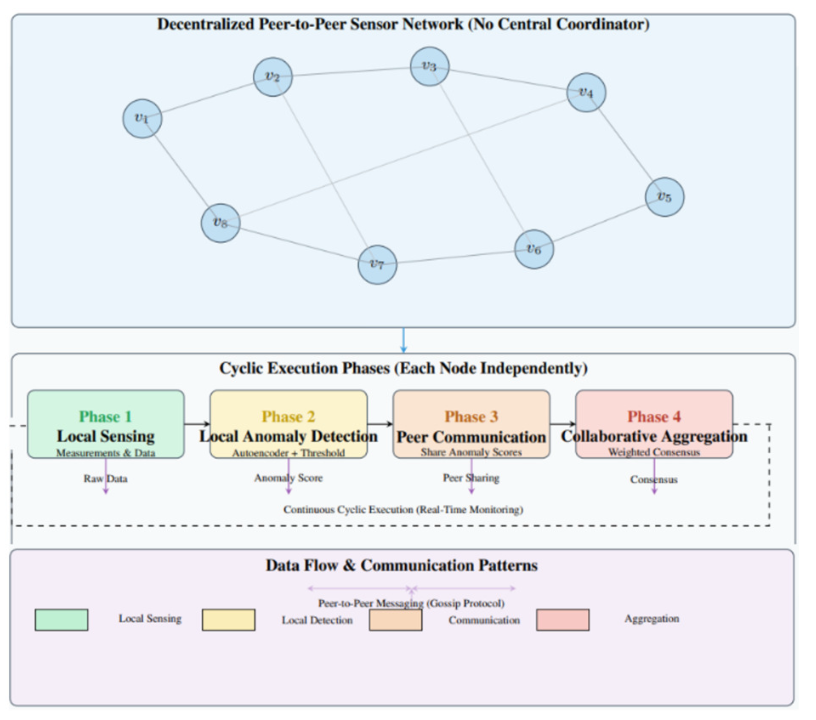
Wireless Sensor Networks (WSNs) are critical for real-time monitoring in industrial and environmental applications, where robust anomaly detection is essential for safety and efficiency. However, existing approaches face a trilemma: centralized methods create communication bottlenecks and single points of failure, isolated on-device learning cannot leverage collective knowledge, and static models degrade under real-world concept drifts. To overcome these limitations, we propose D-CAD, a novel framework for Decentralized Continual Anomaly Detection. D-CAD enables sensor nodes to collaboratively learn and adapt detection models over time using a lightweight, gossip-based knowledge fusion protocol, thereby eliminating the need for a central coordinator. Our method combines local lightweight autoencoders with a replay-based memory buffer to mitigate catastrophic forgetting and a dynamic weighting mechanism for effective peer-to-peer model fusion. Evaluated on the SWaT industrial dataset and a simulated non-IID WSN testbed, D-CAD achieved an average F1-score of 0.92, outperforming a centralized continual learner by 8% and isolated nodes by 23%. It maintains high accuracy while reducing the total network communication overhead by 65% compared with standard Federated Learning. Thus, D-CAD provides a scalable, robust, and communication-efficient paradigm for lifelong anomaly detection in distributed-sensing systems.
Article Details

This work is licensed under a Creative Commons Attribution-NonCommercial-NoDerivatives 4.0 International License.
References
V. Chandola, A. Banerjee and V. Kumar, “Anomaly detection: A survey,” ACM Computing Surveys, vol. 41, no. 3, pp. 1–58, Jul. 2009.
J. Goh, S. Adepu, M. Tan and A. Mathur, “A dataset to support research in the design of secure water treatment systems,” Critical Information Infrastructures Security, pp. 88-99, 2017.
H. Brendan McMahan, E. Moore, D. Ramage, S. Hampson and B. A. y. Arcas, “Communicationefficient learning of deep networks from decentralized data,” in Proceedings of the 20 th International Conference on Artificial Intelligence and Statistics (AISTATS) 2017, vol. 54, 2017.
X. Lian, C. Zhang, H. Zhang, C.-J. Hsieh, W. Zhang and J. Liu, “Can decentralized algorithms outperform centralized algorithms? A case study for decentralized parallel stochastic gradient descent,” in Advances in Neural Information Processing Systems (NeurIPS), pp. 5330–5340, 2017.
J. Kirkpatrick et al., “Overcoming catastrophic forgetting in neural networks,” Proc. Nat. Acad. Sci. USA, vol. 114, no. 13, pp. 3521–3526, Mar. 2017.
D. Lopez-Paz and M. A. Ranzato, “Gradient episodic memory for continual learning,” in Advances in Neural Information Processing Systems (NeurIPS), pp. 6467–6476, 2017.
M. R. Sprague et al., “Asynchronous federated learning for geospatial applications,” DMLE/IOTSTREAMING@PKDD/ECML, 2018.
D. E. Rumelhart, G. E. Hinton and R. J. Williams, “Learning representations by backpropagating errors,” Nature, vol. 323, no. 6088, pp. 533–536, Oct. 1986.
S. Hochreiter and J. Schmidhuber, “Long shortterm memory,” Neural Computation, vol. 9, no. 8, pp. 1735–1780, Nov. 1997.
Y. Bengio, A. Courville and P. Vincent, “Representation Learning: A Review and New Perspectives,” in IEEE Transactions on Pattern Analysis and Machine Intelligence, vol. 35, no. 8, pp. 1798-1828, Aug. 2013.
I. Goodfellow, Y. Bengio and A. Courville, Deep Learning. Cambridge, MA, USA: MIT Press, 2016.
T. H. Morris, Z. Thornton and I. P. Turnipseed, “Industrial control system simulation and data logging for intrusion detection system research,” 2015.
M. Ahmed, A. N. Mahmood and M. R. Islam, “A survey of anomaly detection techniques in financial domain,” Future Generation Computer Systems, vol. 55, pp. 278–288, Feb. 2016.
A. Zimek, E. Schubert, and H.-P. Kriegel, “A survey on unsupervised outlier detection in high-dimensional numerical data,” Statistical Analysis and Data Mining, vol. 5, no. 5, pp. 363–387, Oct. 2012.
Z. Wan, Y. Zhang and H. He, “Variational autoencoder based synthetic data generation for imbalanced learning,” 2017 IEEE Symposium Series on Computational Intelligence (SSCI), Honolulu, HI, USA, pp. 1-7, 2017.
P. Malhotra, L. Vig, G. Shroff, and P. Agarwal, “Long short term memory networks for anomaly detection in time series,” ESANN 2015 proceedings, European Symposium on Artificial Neural Networks, Computational Intelligence and Machine Learning, Bruges, Belgium, pp. 89–94, 2015.
M. Du, F. Li, G. Zheng, and V. Srikumar, “DeepLog: Anomaly detection and diagnosis from system logs through deep learning,” in Proc. ACM SIGSAC Conf. Comput. Commun. Security (CCS), Dallas, TX, USA, pp. 1285– 1298, 2017.
T. Kieu, B. Yang, C. Guo, and C. S. Jensen, “Outlier detection for time series with recurrent autoencoder ensembles,” in Proc. 28th Int. Joint Conf. Artificial Intelligence (IJCAI), Macao, China, pp. 2725–2732, 2019.
L. Bontemps, V. L. Cao, and J. McDermott, “Collective anomaly detection based on long short-term memory recurrent neural networks,” in Proc. Int. Conf. Future Internet Things Cloud (FiCloud), Vienna, Austria, pp. 141–146, 2016.
T. Ergen and S. S. Kozat, “Unsupervised Anomaly Detection With LSTM Neural Networks,” in IEEE Transactions on Neural Networks and Learning Systems, vol. 31, no. 8, pp. 3127-3141, Aug. 2020.
S. Boyd, N. Parikh, E. Chu, B. Peleato, and J. Eckstein, “Distributed optimization and statistical learning via the alternating direction method of multipliers,” Foundations and Trends in Machine Learning, vol. 3, no. 1, pp. 1–122, 2011.
A. Nedi´c and A. Olshevsky, “Distributed Optimization Over Time-Varying Directed Graphs,” in IEEE Transactions on Automatic Control, vol. 60, no. 3, pp. 601-615, March 2015.
J. Koneˇcn´y, H. B. McMahan, D. Ramage and P. Richt´arik, “Federated optimization: Distributed machine learning for on-device intelligence,” arXiv preprint arXiv:1610.02527, 2016.
Y. Nesterov and V. Spokoiny, “Random gradient-free minimization of convex functions,” Foundations of Computational Mathematics, vol. 17, no. 2, pp. 527–566, Apr. 2017.
A. A. Rusu et al., “Progressive neural networks,” arXiv preprint arXiv:1606.04671, 2016.
M. Ren, W. Zeng, B. Yang, and R. Urtasun, “Learning to reweight examples for robust deep learning,” in Proc. 35th Int. Conf. Machine Learning (ICML), Stockholm, Sweden, pp. 4334–4343, 2018.
J. S. Vitter, “Random sampling with a reservoir,” ACM Trans. Math. Softw., vol. 11, no. 1, pp. 37–57, Mar. 1985.
S. -A. Rebuffi, A. Kolesnikov, G. Sperl and C. H. Lampert, “iCaRL: Incremental Classifier and Representation Learning,” 2017 IEEE Conference on Computer Vision and Pattern Recognition (CVPR), Honolulu, HI, USA, pp. 55335542, 2017.
A. A. Rusu, M. Vecerik, T. Roth¨orl, N. Heess, R. Pascanu, and R. Hadsell, “Sim-to-real robot learning from pixels with progressive nets,” in Proc. Conf. Robot Learning (CoRL), New York, NY, USA, pp. 262–270, 2016.
K.-H. Li, “Reservoir-sampling algorithms of time complexity O(n(1+log(N/n))),” ACM Trans. Math. Softw., vol. 20, no. 4, pp. 481–493, Dec. 1994.
M. Castro and B. Liskov, “Practical Byzantine fault tolerance,” in Proc. 3rd USENIX Symp. Operating Systems Design and Implementation (OSDI), New Orleans, LA, USA, pp. 173–186, 1999.
