
Localized AI-Based Urban Hazard Detection for Defensive Driving Support
Article Sidebar
Main Article Content
Abstract
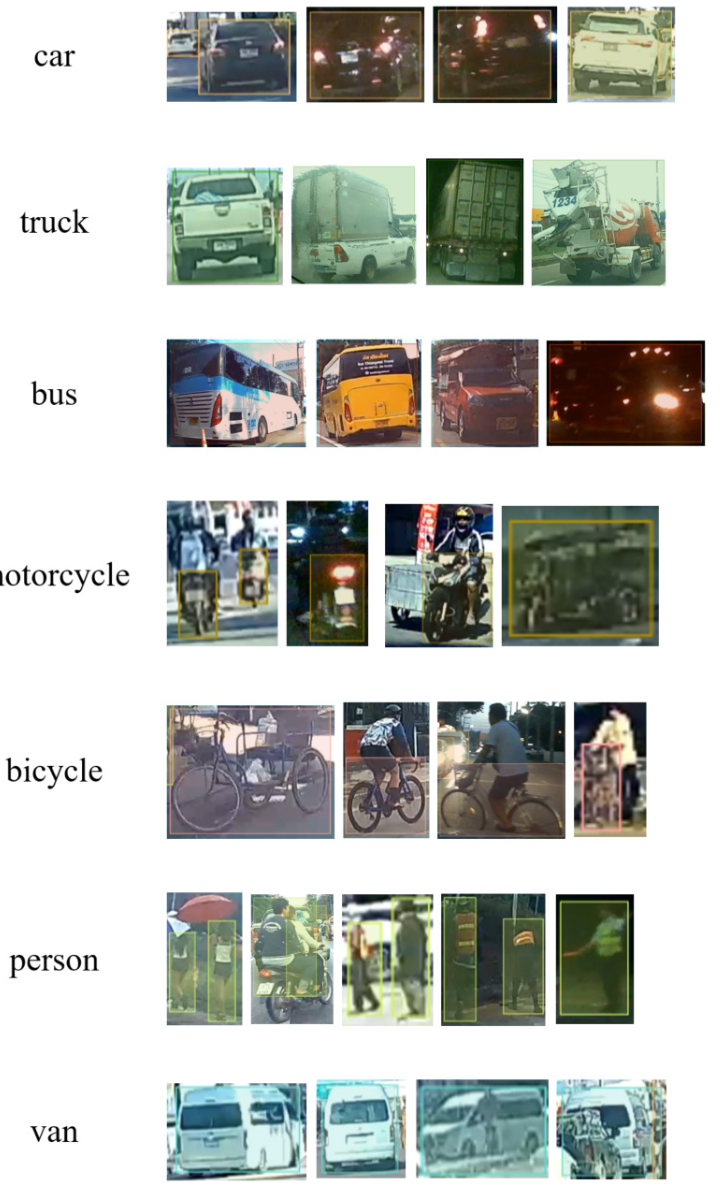
This research investigates the feasibility and effectiveness of implementing localized artificial intelligence-based system for enhancing defensive driving through automated urban hazard detection. For this purpose, a lightweight You Only Look Once version 11 nano (YOLOv11-nano) model containing 2.6 million parameters was fine-tuned on a localized dataset consisting of 18,132 images collected over 300 days in Chiang Mai, Thailand. These results reveal a mean Average Precision (mAP) of 0.96 when using an intersection over union (IoU) threshold of 0.5. Even if the precision rate is quite high in ideal conditions, there is an observed decrease of 13.1 percent in the Average Detection Confidence due to monsoon rain and night-time conditions. Thus, a safety margin has been established for the application of Advanced Driver Assistance Systems. The reliability test conducted across seven localized object categories reveals consistent detection performance for vulnerable objects, such as motorcycles and pedestrians. Furthermore, a cost-benefit analysis based on localized accident cost data confirmed the economic viability of implementation in commercial transporting services.
Article Details

This work is licensed under a Creative Commons Attribution-NonCommercial-NoDerivatives 4.0 International License.
References
T. T. Nguyen, P. Krishnakumari, S. C. Calvert, H. L. Vu and H. van Lint, “Feature extraction and clustering analysis of highway congestion,” Transportation Research Part C: Emerging Technologies, vol. 100, pp. 238–258, 2019.
Federal Motor Carrier Safety Administration (FMCSA), “A Return on Investment (ROI) Guide to Advanced Driver Assistance Systems (ADAS),” U.S. Department of Transportation, Tech-Celerate Now Program Office, Tech. Rep., 2022.
J. Zhong, Q. Cheng, X. Hu and Z. Liu, “YOLO Adaptive Developments in Complex Natural Environments for Tiny Object Detection,” Electronics, vol. 13, no. 13, Art. no. 2503, 2024.
G. Jocher and J. Qiu, “Ultralytics YOLO11,” ver. 11.0.0, [Computer software], 2024. [Online]. Available: https: //github.com/ultralytics/ultralytics
M. K. Bhowmik, Computer Vision: Object Detection in Adversarial Vision, 1st ed. Boca Raton, FL, USA: Chapman & Hall/CRC, 2024.
M. Aleksa, A. Schaub, I. Erdelean, S. Wittmann, A. Soteropoulos and A. F¨urd¨os, “Impact analysis of Advanced Driver Assistance Systems (ADAS) regarding road safety – computing reduction potentials,” European Transport Research Review, vol. 16, no. 1, 2024. ness on the Road,” in A Cognitive Approach to Situation Awareness: Theory and Application, S. Banbury and S. Tremblay, Eds. Aldershot, UK: Ashgate, pp. 155–175, 2004.
P. Thongchim, P. Taneerananon, P. Luathep and P. Prapongsena, “Traffic Accident Costing for Thailand,” Journal of the Eastern Asia Society for Transportation Studies, vol. 7, pp. 2891– 2906, 2007.
W. Liu, G. Ren, R. Yu, S. Guo, J. Zhu and L. Zhang, “Image-Adaptive YOLO for Object Detection in Adverse Weather Conditions,” in The Thirty-Sixth AAAI Conference on Artificial Intelligence (AAAI-22), vol. 36, no. 2, pp. 1792– 1800, 2022.
M. R. Endsley, “Toward a Theory of Situation Awareness in Dynamic Systems,” Human Factors: The Journal of the Human Factors and Ergonomics Society, vol. 37, no. 1, pp. 32–64, 1995.
M. Z. Shahzad, M. A. Hanif and M. Shafique, “Robust ADAS: Enhancing Robustness Of Machine Learning-Based Advanced Driver Assistance Systems For Adverse Weather,” 2024 IEEE International Conference on Image Processing Challenges and Workshops (ICIPCW), Abu Dhabi, United Arab Emirates, pp. 42404246, 2024.
Y. Rehman, H. Amanullah, D. M. Saqib Bhatti, W. T. Toor, M. Ahmad and M. Mazzara, “Detection of Small Size Traffic Signs Using Regressive Anchor Box Selection and DBL Layer Tweaking in YOLOv3,” Applied Sciences, vol. 11, no. 23, 2021.
Y. Zhong, J. Wang, J. Peng and L. Zhang, “Anchor Box Optimization for Object Detection,” 2020 IEEE Winter Conference on Applications of Computer Vision (WACV), Snowmass, CO, USA, pp. 1275-1283, 2020.
