Improving Course Recommendations: An RBM-Based Explainable Framework for Student Performance in E-Learning
Article Sidebar
Main Article Content
Abstract
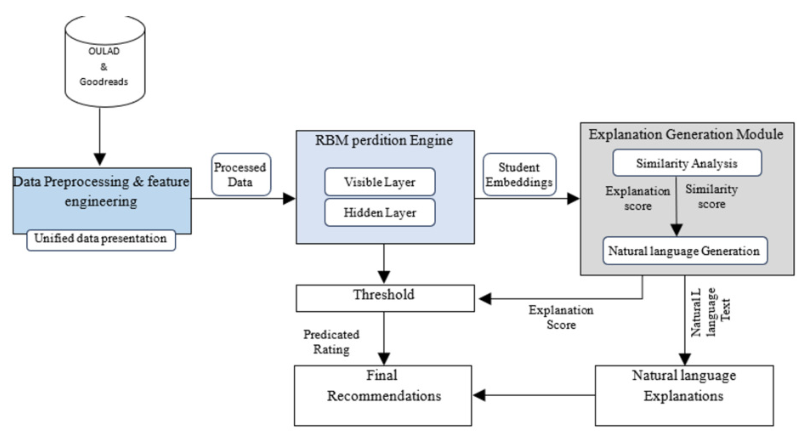
The vast expansion of online learning has increased the need for intelligent systems to guide learners toward suitable learning paths. Although educational recommender systems address this challenge by personalizing recommendations, many existing approaches focus primarily on accuracy and provide limited insight into why recommendations are made. This study proposes EduExplain, an explainable collaborative filtering framework based on a Restricted Boltzmann Machine (RBM) that combines strong predictive performance with neighbor-similarity explanations to generate interpretable recommendations. The framework integrates a prediction engine with an explanation module that produces natural-language justifications derived from the performance of similar learners. We evaluated the framework using a multi-domain experimental design on the OULAD educational dataset and the Goodreads dataset, comparing it against four established baselines. The results show that EduExplain achieves a 20% reduction in prediction error over traditional collaborative filtering (RMSE: 0.873 on OULAD) and delivers high-quality, interpretable explanations (coherence: 0.89), demonstrating that accuracy and explainability can coexist in e-learning systems. Unlike prior approaches that rely on external review data or treat explainability as a post-hoc step, EduExplain embeds explanation generation directly into the RBM pipeline using only interaction data. An ablation study confirmed each component's necessity for both accuracy and interpretability. These findings demonstrate that explainable recommender systems can enhance decision-making in e-learning environments.
Article Details

This work is licensed under a Creative Commons Attribution-NonCommercial-NoDerivatives 4.0 International License.
References
R. C. Levin, “Online learning and the transformation of global higher education,” Daedalus, vol. 153, no. 2, pp. 262–274, 2024.
J. Anghelo, M. C. Bedoya-Flores, E. F. ´ Mosquera-Qui˜nonez, A. E. Mes´ıas-Simisterra and J. V. Bautista-S´anchez, “Educational platforms: Digital tools for the teaching-learning process in education,” Ibero-American Journal of Education & Society Research, vol. 3, no. 1, pp. 259–263, 2023.
H. Ahmadian Yazdi, S. J. Seyyed Mahdavi and H. Ahmadian Yazdi, “Dynamic educational recommender system based on improved LSTM neural network,” Scientific Reports, vol. 14, no. 4381, 2024.
H. Khosravi et al., “Explainable artificial intelligence in education,” Computers and Education: Artificial Intelligence, vol. 3, p. 100074, 2022.
F. Ullah et al., “Deep Edu: A Deep Neural Collaborative Filtering for Educational Services Recommendation,” in IEEE Access, vol. 8, pp. 110915-110928, 2020. 409
N. Khaledian, A. Nazari and M. Barkhan, “CFCAI: Improving collaborative filtering for solving cold start issues with clustering technique in recommender systems,” Multimedia Tools and Applications, vol. 84, no. 28, pp. 34207–34228, 2025.
S. Natarajan, S. Vairavasundaram, S. Natarajan and A. H. Gandomi, “Resolving data sparsity and cold start problem in collaborative filtering recommender systems using linked open data,” Expert Systems with Applications, vol. 149, p. 113248, 2020.
J. Bobadilla, S. Alonso and A. Hernando, “Deep learning architecture for collaborative filtering recommender systems,” Applied Sciences, vol. 10, no. 7, p. 2441, 2020.
F. L. da Silva, B. K. Slodkowski, K. K. A. da Silva and S. C. Cazella, “A systematic literature review on educational recommender systems for teaching and learning: Research trends, limitations and opportunities,” Education and Information Technologies, vol. 28, no. 3, pp. 3289– 3328, 2022.
N. Fatima Muhammad, A. Aminu and M. K. Kabir Ibrahim, “Optimizing explainable recommender system using knowledge graph and LSTM-based deep learning,” International Journal of Science Research and Technology, vol. 7, no. 9, 2025.
A. Torkashvand, S. M. Jameii and A. Reza, “Deep learning-based collaborative filtering recommender systems: A comprehensive and systematic review,” Neural Computing and Applications, vol. 35, pp. 24783–24827, 2023.
R. Salakhutdinov, A. Mnih and G. Hinton, “Restricted Boltzmann machines for collaborative filtering,” in Proceedings of the 24th International Conference on Machine Learning (ICML), Corvalis, OR, USA, pp. 791–798, 2007.
Q. Liang, X. Zheng, Y. Wang and M. Zhu, “O3ERS: An explainable recommendation system with online learning, online recommendation, and online explanation,” Information Sciences, vol. 562, pp. 94–115, Jul. 2021.
D. F. Murad, R. Hassan, B. D. Wijanarko, R. Leandros and S. A. Murad, “Evaluation of Hybrid Collaborative Filtering Approach with ContextSensitive Recommendation System,” 2022 7th International Conference on Business and Industrial Research (ICBIR), Bangkok, Thailand, pp. 7-12, 2022.
H. Sun, C. Yin, H. Chen, L. Qiao, Y. Ouyang and B. David, “A student’s performance prediction method based on neural collaborative filtering,” 2019 IEEE International Conference on Engineering, Technology and Education (TALE), Yogyakarta, Indonesia, pp. 1-8, 2019.
H. Waheed, S.-U. Hassan, N. R. Aljohani, J. Hardman, S. Alelyani and R. Nawaz, “Predicting academic performance of students from VLE big data using deep learning models,” Computers in Human Behavior, vol. 104, p. 1006189, 2020.
K. K. Jena, S. K. Bhoi, T. K. Malik, K. S. Sahoo, N. Z. Jhanjhi, and S. Bhatia, “E-learning course recommender system using collaborative filtering models,” Electronics, vol. 12, no. 1, p. 157, 2023.
Z. Zhang, “Personalized resource recommendation method of student online learning platform based on LSTM and collaborative filtering,” Journal of Intelligent Systems, vol. 33, p. 20240017, 2024.
J. Bobadilla, F. Ortega, A. Hernando and A. Guti´errez, “Recommender systems survey,” Knowledge-Based Systems, vol. 46, pp. 109–132, 2013.
J. L. Rastrollo-Guerrero, J. A. G´omez-Pulido and A. Dur´an-Dom´ınguez, “Analyzing and predicting students’ performance by means of machine learning: A review,” Applied Sciences, vol. 10, no. 3, p. 1042, 2020.
J. A. G´omez-Pulido, A. Dur´an-Dom´ınguez and F. Pajuelo-Holguera, “Optimizing latent factors and collaborative filtering for students’ performance prediction,” Applied Sciences, vol. 10, no. 16, p. 5601, 2020.
F. A. Al-Azazi and M. Ghurab, “ANN-LSTM: A deep learning model for early student performance prediction in MOOC,” Heliyon, vol. 9, no. 4, p. e15382, 2023.
H. Cheng, S. Wang, W. Lu, W. Zhang, M. Zhou and K. Lu, “Explainable recommendation with personalized review retrieval and aspect learning,” arXiv preprint arXiv:2306.12657, 2023.
J. Mawane, A. Naji and M. Ramdani, “Unsupervised deep collaborative filtering recommender system for e-learning platforms,” in Advances in Intelligent Systems and Computing, pp. 146–161, 2020.
X. Chen and Y. Zhang, “Explainable recommendation: A survey and new perspectives,” Foundations and Trends in Information Retrieval, vol. 14, no. 1, pp. 1–101, 2020.
B. Abdollahi and O. Nasraoui, “Explainable restricted Boltzmann machines for collaborative filtering,” arXiv preprint arXiv:1606.07129, 2016.
Q. Ma, X. Ren and C. Huang, “Xrec: Large language models for explainable recommendation,” arXiv preprint arXiv:2406.02377, 2024.
E. Zangerle and C. Bauer, “Evaluating recommender systems: Survey and framework,” ACM Computing Surveys, vol. 55, no. 8, pp. 1–38, 2022.
A. Jadon and A. Patil, “A comprehensive survey of evaluation techniques for recommendation systems,”arXiv preprint arXiv:2312.16015, 2024.
C. Bauer, E. Zangerle and A. Said, “Exploring the landscape of recommender systems evaluation: Practices and perspectives,” ACM Transactions on Recommender Systems, vol. 2, no. 1, pp. 1–31, 2024.
