
A Causal-AI Framework for Preventive Maintenance in Industrial Time-Series Systems
Article Sidebar
Main Article Content
Abstract
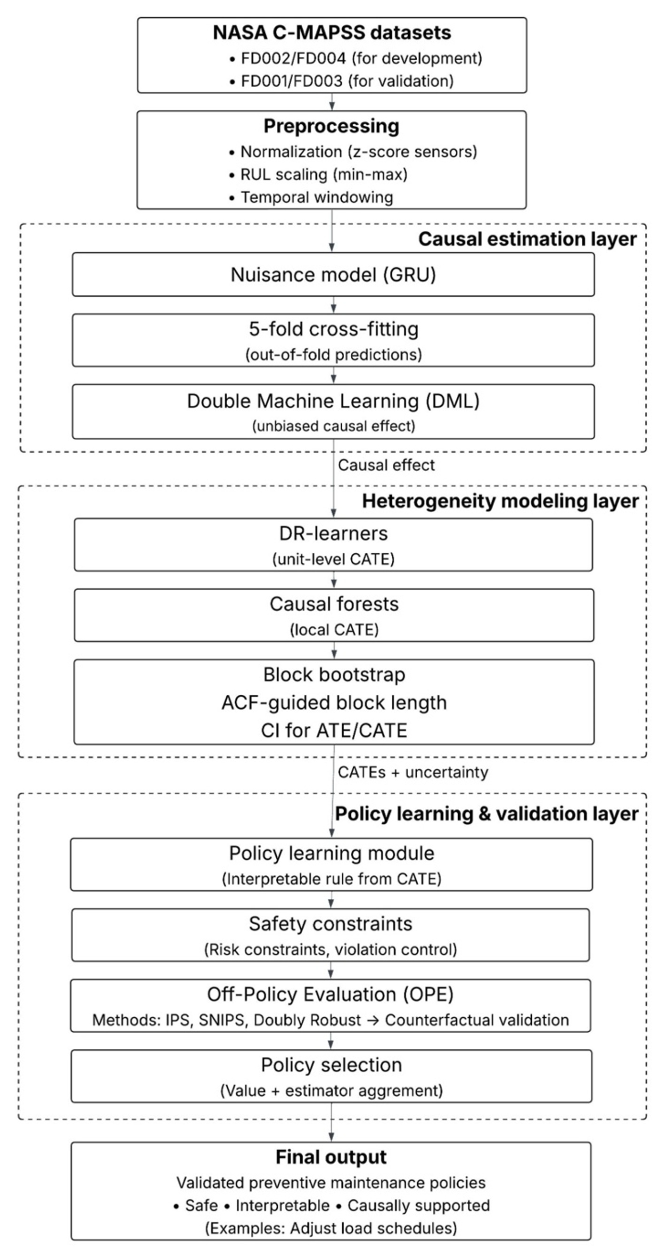
This study proposes a causal artificial intelligence framework for preventive maintenance analysis in industrial time-series systems, addressing confounding and heterogeneity in operating conditions. The framework combines Double Machine Learning (DML) with Gated Recurrent Unitbased nuisance models and employs Doubly Robust and Causal Forest learners for population-level and conditional effect estimation. Experiments on the NASA C-MAPSS turbofan datasets show that high-load operating regimes induce statistically significant reductions in remaining useful life, with Average Treatment Effects of -26.0 cycles for FD002 and -57.4 cycles for FD004, while effects are statistically detectable but operationally negligible under single-mode conditions. O-Policy Evaluation (OPE) shows that the Doubly Robust estimator yields stable incremental policy-value estimates with narrow confidence intervals. Uncertainty is quantified using block-bootstrap resampling to account for temporal dependence. The results support causal, regime-aware maintenance decision support while also identifying the need for hidden-confounder sensitivity analysis, streaming adaptation, and human validation before safety-critical deployment.
Article Details

This work is licensed under a Creative Commons Attribution-NonCommercial-NoDerivatives 4.0 International License.
References
S. Balamurugan, V. Prabakaran, S. Natarajan and B. Thangavel, “Predictive maintenance in industrial systems using data mining with fuzzy logic systems,” ICTACT Journal on Soft Computing, vol. 14, no. 4, pp. 3361–3367, 2024.
S. Nadaf, “AI for Predictive Maintenance in Industries,” International Journal for Research in Applied Science and Engineering Technology, vol. 12, no. 6, pp. 2013–2017, 2024.
A. Paleyes, R. Urma and N. D. Lawrence, “Challenges in Deploying Machine Learning: A Survey of Case Studies,” ACM Computing Surveys, vol. 55, no. 6, pp. 1–29, 2022.
F. T¨urko˘glu, E. G¨o¸cecek and Y. Yumrukuz, “Predictive Abilities of Machine Learning and Deep Learning Approaches for Exchange Rate Prediction,” BDDK Bankacılık ve Finansal Piyasalar Dergisi, pp. 186–210, 2024.
L. Jiao et al., “Causal Inference Meets Deep Learning: A Comprehensive Survey,” Research, vol. 7, 2024. 783
R. Paredes and M. S. Reis, “Causality in Process Systems Engineering: Fundamentals, Applications, and Emerging Trends,” Computers & Chemical Engineering, 2025.
H. Jeong, T. Fekete, A. Bashyal and H. Wicaksono, “From Theory to Practice: Implementing Causal AI in Manufacturing for Sustainability,” Procedia Computer Science, vol. 253, pp. 1495– 1504, 2025.
T. Vanderschueren et al., “Optimizing the Preventive Maintenance Frequency with Causal Machine Learning,” International Journal of Production Economics, vol. 258, p. 108798, 2023.
P. H¨unermund, J. Kaminski and C. Schmitt, “Causal Machine Learning and Business Decision Making,” SSRN Electronic Journal, 2021.
X. Xiao et al., “Bayesian Federated Causal Inference and Its Application in Manufacturing,” Journal of Intelligent Manufacturing, 2025.
E. H. Kennedy, “Towards Optimal Doubly Robust Estimation of Heterogeneous Causal Effects,” Electronic Journal of Statistics, vol. 17, no. 2, 2023.
R. Post, I. Heuvel, M. Petkovic and E. Heuvel, “Flexible Machine Learning Estimation of Conditional Average Treatment Effects: A Blessing and a Curse,” Epidemiology, vol. 35, no. 1, pp. 32–40, 2023.
Q. Li, T. Huang, J. Liu and S. Wang, “CausalityGuided Fault Diagnosis under Visual Interference in Fused Deposition Modeling,” Engineering Applications of Artificial Intelligence, vol. 143, p. 110027, 2025.
M. Abdar, A. Khosravi, S. M. S. Islam, U. R. Acharya and A. V. Vasilakos, “The need for quantification of uncertainty in artificial intelligence for clinical data analysis: increasing the level of trust in the decision-making process,” in IEEE Systems, Man, and Cybernetics Magazine, vol. 8, no. 3, pp. 28-40, July 2022.
M. A. Aghbolagh, “Ensuring Safety While Enhancing Performance: Encouraging Reinforcement Learning by Addressing Constraints and Uncertainty,” Bezopasnost Informacionnyh Tehnology, vol. 31, no. 2, pp. 90–110, 2024.
R. R. Ardeshiri and C. Ma, “Multivariate Gated Recurrent Unit for Battery Remaining Useful Life Prediction,” International Journal of Energy Research, vol. 45, no. 11, pp. 16633–16648, 2021.
K. ArunKumar et al., “Forecasting of COVID19 using deep layer Recurrent Neural Networks (RNNs) with Gated Recurrent Units (GRUs) and Long Short-Term Memory (LSTM) cells,” Chaos, Solitons & Fractals, vol. 146, p. 110861, 2021.
O. Asif, S. A. Haider, S. R. Naqvi, J. F. W. Zaki, K. -S. Kwak and S. M. R. Islam, “A Deep Learning Model for Remaining Useful Life Prediction of Aircraft Turbofan Engine on C-MAPSS Dataset,” in IEEE Access, vol. 10, pp. 9542595440, 2022.
H. S. Battey and N. Reid, “On Inference in High-Dimensional Regression,” Journal of the Royal Statistical Society Series B, vol. 85, no. 1, pp. 149–175, 2023.
R. Cai et al., “Long-Term Causal Effects Estimation via Latent Surrogates Representation Learning,” Neural Networks, vol. 176, p. 106336, 2024.
G. Chatziparaskevas, I. Mademlis and I. Pitas, “Generative Representation Learning in Recurrent Neural Networks for Causal Timeseries Forecasting,” in IEEE Transactions on Artificial Intelligence, vol. 5, no. 12, pp. 6412-6425, Dec. 2024.
H. Dewantoro, A. Smith and P. Daoutidis, “Causal Discovery for Topology Reconstruction in Industrial Chemical Processes,” Industrial & Engineering Chemistry Research, vol. 63, no. 26, pp. 11530–11543, 2024.
F. Dominici, F. J. Bargagli-Stoffi and F. Mealli , “From Controlled to Undisciplined Data: Estimating causal effects in the era of Data Science using a potential outcome framework,” Harvard Data Science Review, 2021.
J. Guo, D. Li and B. Du, “A stacked ensemble method based on TCN and convolutional bidirectional GRU with multiple time windows for remaining useful life estimation,” Applied Soft Computing, vol. 150, p. 111071, 2024.
L. Huang, J. Huang, P. Chen, H. Li and J. Cui, “Long-Term Sequence Dependency Capture for Spatiotemporal Graph Modeling,” KnowledgeBased Systems, vol. 278, p. 110818, 2023.
E. Igelstr¨om et al., “Causal Inference and Effect Estimation Using Observational Data,” Journal of Epidemiology & Community Health, vol. 76, no. 11, pp. 960–966, 2022.
N. Jawadekar et al., “Practical Guide to Honest Causal Forests for identifying Heterogeneous Treatment Effects,” American Journal of Epidemiology, vol. 192, no. 7, pp. 1155–1165, 2023.
D. Kabata and M. Shintani, “Variable selection in double/debiased machine learning for causal inference: an outcome-adaptive approach,” Communications in Statistics – Simulation and Computation, vol. 52, no. 12, pp. 5880– 5893, 2021.
B. J. Koch et al., “A Primer on Deep Learning for Causal Inference,” Sociological Methods & Research, 2024.
A. K¨ohn-Luque et al., “Phenotypic deconvolution in heterogeneous cancer cell populations using drug-screening data,” Cell Reports Methods, vol. 3, no. 3, p. 100417, 2023.
Y. Liu, Y. Liu, and Y. Yang, “Prediction of Contact Fatigue Performance Degradation Trends Based on Multi-Domain Features and Temporal Convolutional Networks,” Entropy, vol. 25, no. 9, p. 1316, 2023.
R. Moraffah, M. Karami, R. Guo, A. Raglin, and H. Liu, “Causal Interpretability for Machine Learning: Problems, Methods and Evaluation,” ACM SIGKDD Explorations Newsletter, vol. 22, no. 1, pp. 18–33, 2020.
M. Prosperi, Y. Guo, M. Sperrin, J. S. Koopman, J. S. Min, X. He, S. Rich, M. Wang, I. E. Buchan, and J. Bian, “Causal Inference and Counterfactual Prediction in Machine Learning for Actionable Healthcare,” Nature Machine Intelligence, vol. 2, no. 1, pp. 369–375, 2020.