
Explainable Deep Fusion for Breast Cancer Classification in Histopathology Images
Article Sidebar
Main Article Content
Abstract
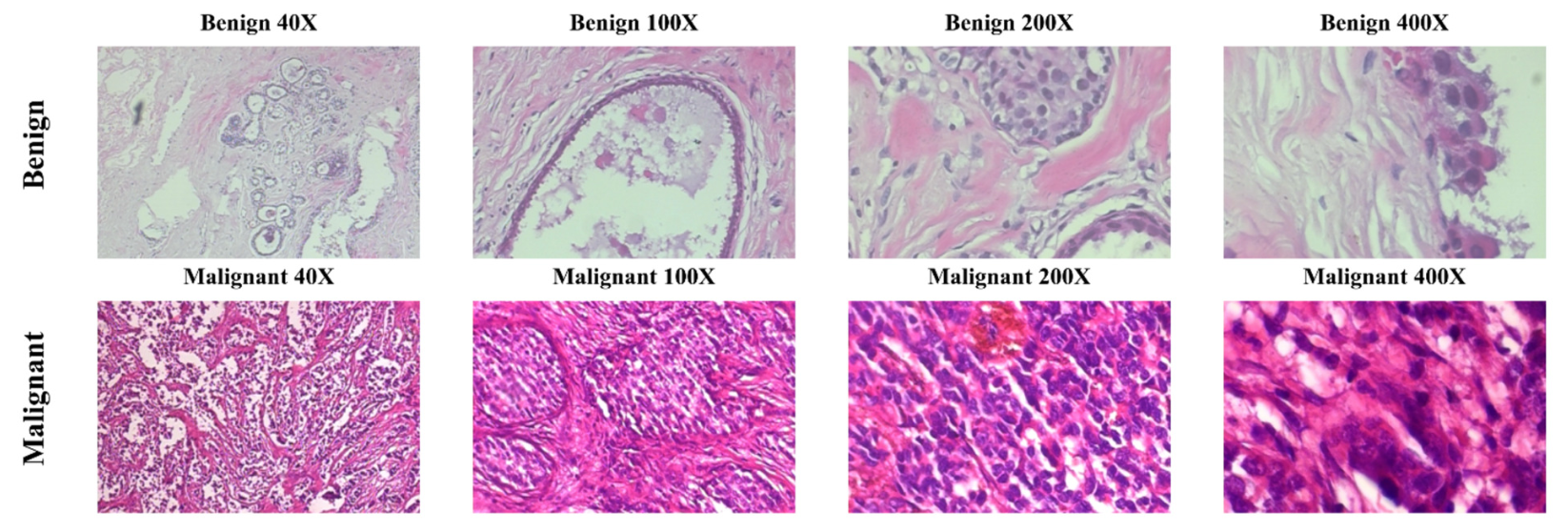
Breast cancer diagnosis from histopathology images is accurate but labor-intensive and subject to interobserver variability. Deep learning has shown strong performance on digital pathology benchmarks; however, limited transparency, magnification variability, and patient-level data leakage can reduce clinical trust and robustness. This paper proposes an explainable deep fusion framework for magnification-robust breast histopathology classification on the BreakHis dataset. In the experiments, all folds are generated at the patient level, and model selection is performed in two stages: first, single backbones and backbone-pair fusion models are compared without attention; second, attention modules are evaluated on the selected fusion pair. The results identify VGG16ResNet18 fusion without attention as the nal configuration, achieving an accuracy of 0.8890, an F1-score of 0.8888, and an AUC of 0.9326 under mixed-magnication, patient-level 5-fold cross-validation. Although the improvement over the strongest single-backbone baseline is modest and not statistically significant in the fold-level Wilcoxon test, an image-level discordant-case analysis shows that the proposed fusion model corrects more EfficientNetV2 errors than it introduces. To support transparency, Grad-CAM-based case analysis is used to examine corrected, newly misclassified, and persistently misclassified examples, with LIME and SHAP retained as complementary explanation tools when generated for selected cases. These results suggest that feature-level fusion can provide useful gains for some difficult histopathology images while highlighting remaining limitations caused by ambiguous tissue morphology, staining variation, magnification-dependent texture changes, and attention to non-diagnostic regions.
Article Details

This work is licensed under a Creative Commons Attribution-NonCommercial-NoDerivatives 4.0 International License.
References
K. Damkliang, T. Wongsirichot, C. Khongrak, and P. Suwannarat, “An optimal deep learning approach to BCA tissue detection using case studies,” ECTI Transactions on Computer and Information Technology (ECTI-CIT) , vol. 17, no. 1, pp. 60–72, Feb. 2023.
J. Kim et al., “Global patterns and trends in breast cancer incidence and mortality across 185 countries,” Nature Medicine, vol. 31, no. 4, pp. 1154–1162, 2025.
F. Bray et al., “Global cancer statistics 2022: GLOBOCAN estimates of incidence and mortality worldwide for 36 cancers in 185 countries,” CA: A Cancer Journal for Clinicians, vol. 74, no. 3, pp. 229–263, 2024.
S. K. Singh and K. S. Patnaik, “Patho-AI: A perceptive breast cancer identification and classification using deep learning methods integrated with explainable AI,” SN Computer Science, vol. 6, no. 6, Art. no. 619, 2025.
J. S. Ahn et al., “Artificial intelligence in breast cancer diagnosis and personalized medicine,” Journal of Breast Cancer, vol. 26, no. 5, pp. 405– 435, 2023.
A. Ibrahim, P. Gamble, R. Jaroensri, M. M. Abdelsamea, C. H. Mermel, P.-H. C. Chen and E. A. Rakha, “Artificial intelligence in digital breast pathology: Techniques and applications,” Breast, vol. 49, pp. 267–273, 2020.
C. McGenity et al., “Artificial intelligence in digital pathology: A systematic review and metaanalysis of diagnostic test accuracy,” npj Digital Medicine, vol. 7, no. 1, Art. no. 114, 2024.
P. S. Ginter et al., “Histologic grading of breast carcinoma: A multi-institution study of interobserver variation using virtual microscopy,” Modern Pathology, vol. 34, no. 4, pp. 701–709, 2021.
S. Datwani, H. Khan, M. K. K. Niazi, A. V. Parwani, and Z. Li, “Artificial intelligence in breast pathology: Overview and recent updates,” Human Pathology , vol. 162, Art. no. 105819, 2025.
C. Rudin, “Stop explaining black box machine learning models for high stakes decisions and use interpretable models instead,” Nature Machine Intelligence, vol. 1, no. 5, pp. 206–215, 2019.
R. Shad, J. P. Cunningham, E. A. Ashley, C. P. Langlotz and W. Hiesinger, “Designing clinically translatable artificial intelligence systems for high-dimensional medical imaging,” Nature Machine Intelligence, vol. 3, no. 11, pp. 929–935, 2021.
M. Plass et al., “Explainability and causability in digital pathology,” The Journal of Pathology: Clinical Research, vol. 9, no. 4, pp. 251–260, 2023.
N. Bienefeld et al., “Solving the explainable AI conundrum by bridging clinicians’ needs and developers’ goals,” npj Digital Medicine, vol. 6, no. 1, Art. no. 94, 2023.
A. Nicolson, E. Bradburn, Y. Gal, A. T. Papageorghiou and J. A. Noble, “The human factor in explainable artificial intelligence: Clinician variability in trust, reliance, and performance,” npj Digital Medicine, vol. 8, no. 1, Art. no. 658, 2025.
F. A. Spanhol, L. S. Oliveira, C. Petitjean and L. Heutte, “A Dataset for Breast Cancer Histopathological Image Classification,” in IEEE Transactions on Biomedical Engineering, vol. 63, no. 7, pp. 1455-1462, July 2016.
N. Bayramoglu, J. Kannala and J. Heikkil¨a, “Deep learning for magnification independent breast cancer histopathology image classification,” 2016 23rd International Conference on Pattern Recognition (ICPR), Cancun, Mexico, pp. 2440-2445, 2016.
S. Alkassar, B. A. Jebur, M. A. M. Abdullah, J. H. Al-Khalidy and J. A. Chambers, “Going deeper: Magnification-invariant approach for breast cancer classification using histopathological images,” IET Computer Vision, vol. 15, no. 2, pp. 151–164, 2021.
S. Taheri et al., “A comprehensive study on classification of breast cancer histopathological images: Binary versus multi-category and magnification-specific versus magnification independent,” in IEEE Access, vol. 12, pp. 50431– 50443, 2024.
G. Aresta et al., “BACH: Grand challenge on breast cancer histology images,” Medical Image Analysis, vol. 56, pp. 122–139, 2019.
P. B´andi et al., “From detection of individual metastases to classification of lymph node status at the patient level: The CAMELYON17 challenge,” IEEE Transactions on Medical Imaging, vol. 38, no. 2, pp. 550–560, 2019.
M. Veta et al., “Predicting breast tumor proliferation from whole-slide images: The TUPAC16 challenge,” Medical Image Analysis , vol. 54, pp. 111–121, 2019.
D. Bardou, K. Zhang and S. M. Ahmad, “Classification of breast cancer based on histology images using convolutional neural networks,” in IEEE Access, vol. 6, pp. 24680–24693, 2018.
M. Gour, S. Jain and T. Sunil Kumar, “Residual learning based CNN for breast cancer histopathological image classification,” International Journal of Imaging Systems and Technology, vol. 30, no. 3, pp. 621–635, 2020.
Y. Zheng et al. “Application of transfer learning and ensemble learning in image-level classification for breast histopathology,” Intelligent Medicine, vol. 3, no. 2, pp. 115–128, 2023.
M. Azmoodeh-Kalati, H. Shabani, M. S. Maghareh, Z. Barzegar and R. Lashgari, “Leveraging an ensemble of EfficientNetV1 and EfficientNetV2 models for classification and interpretation of breast cancer histopathology images,” Scientific Reports, vol. 15, no. 1, Art. no. 21541, 2025.
S. Chattopadhyay, A. Dey, P. K. Singh, D. Oliva, E. Cuevas and R. Sarkar, “MTRRE-Net: A deep learning model for detection of breast cancer from histopathological images,” Computers in Biology and Medicine, vol. 150, Art. no. 106155, 2022.
M. M. Rahman, M. S. I. Khan and H. M. H. Babu, “BreastMultiNet: A multi-scale feature fusion method using deep neural network to detect breast cancer,” Array, vol. 16, Art. no. 100256, 2022.
M. I. Rahman, “Fusion of vision transformer and convolutional neural network for explainable and efficient histopathological image classification in cyber-physical healthcare systems,” Journal of Transformative Technologies and Sustainable Development Publishing model, vol. 9, no. 1, Art. no. 8, 2025.
S. Boumaraf, X. Liu, Z. Zheng, X. Ma, and C. Ferkous, “A new transfer learning based approach to magnification dependent and independent classification of breast cancer in histopathological images,” Biomedical Signal Processing and Control, vol. 63, Art. no. 102192, 2021.
V. Kumari and R. Ghosh, “A magnification-independent method for breast cancer classification using transfer learning,” Healthcare Analytics, vol. 3, Art. no. 100207, 2023.
J. Hu, L. Shen, S. Albanie, G. Sun and E. Wu, “Squeeze-and-Excitation Networks,” in IEEE Transactions on Pattern Analysis and Machine Intelligence, vol. 42, no. 8, pp. 2011-2023, 1 Aug. 2020.
S. Woo, J. Park, J.-Y. Lee and I. S. Kweon, “CBAM: Convolutional block attention module,” in Computer Vision–ECCV 2018, V. Ferrari, M. Hebert, C. Sminchisescu, and Y. Weiss, Eds. Cham, Switzerland: Springer, pp. 3–19, 2018.
X. Wang, R. Girshick, A. Gupta and K. He, “Non-local Neural Networks,” 2018 IEEE/CVF Conference on Computer Vision and Pattern Recognition, Salt Lake City, UT, USA, pp. 77947803, 2018.
R. Maurya, N. N. Pandey, M. K. Dutta and M. Karnati, “FCCS-Net: Breast cancer classification using multi-level fully convolutional channel and spatial attention-based transfer learning approach,” Biomedical Signal Processing and Control, vol. 94, Art. no. 106258, 2024.
J. Peta and S. Koppu, “Explainable soft attentive EfficientNet for breast cancer classification in histopathological images,” Biomedical Signal Processing and Control, vol. 90, Art. no. 105828, 2024.
R. R. Selvaraju, M. Cogswell, A. Das, R. Vedantam, D. Parikh and D. Batra, “GradCAM: Visual Explanations from Deep Networks via Gradient-Based Localization,” 2017 IEEE International Conference on Computer Vision (ICCV), Venice, Italy, pp. 618-626, 2017.
M. T. Ribeiro, S. Singh and C. Guestrin, “Why should I trust you?: Explaining the predictions of any classifier,” in Proc. 22nd ACM SIGKDD Int. Conf. Knowl. Discovery Data Mining (KDD), pp. 1135–1144, 2016.
S. M. Lundberg and S.-I. Lee, “A unified approach to interpreting model predictions,” in Advances in Neural Information Processing Systems 30 (NeurIPS), pp. 4765–4774, 2017.
