
Machine Learning-based Estimation of Foot Parameters for Custom Insole Production: A Comprehensive Analysis of Structural Measurements
Article Sidebar
Main Article Content
Abstract
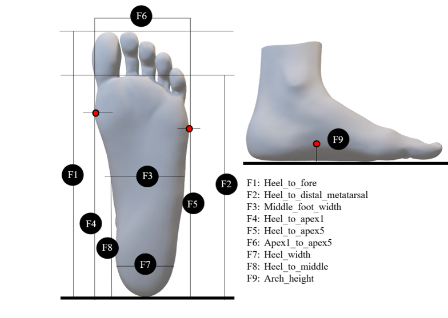
Precise quantification of foot morphology is critical for clinical diagnostics, biomechanics, and personalized orthotic design. Conventional anthropometric methods often remain labor-intensive or dependent on specialized hardware, necessitating more efficient predictive frameworks. This study develops and validates a series of machine learning (ML) models to predict nine essential foot anthropometric parameters. Leveraging a dataset of 544 independent foot samples from 272 participants, encompassing high, normal, and flat arch types. The models were evaluated using a 10-fold cross-validation strategy to ensure robust generalizability. Our pipeline integrates correlation-based feature selection with hyperparameter-optimized regression algorithms, including XGBoost, Random Forest, Support Vector Regressors, Neural Networks, and Linear Regression. The results demonstrate high predictive fidelity, with Mean Absolute Errors (MAE) consistently remaining below 0.5 cm. This level of precision meets the 0.5 cm clinical tolerance threshold established through expert consultation for in-sole production, while simultaneously aligning with international footwear sizing increments, thereby confirming the framework's practical utility in real-world manufacturing. Although parameters such as the length from heel to midfoot area and the length from heel to distal metatarsal head achieved exceptional precision (MAE of 0.012 cm and 0.026 cm, respectively), predicting arch height remains a notable challenge. This research underscores the necessity of optimal feature engineering and algorithm selection in automating foot morphometric assessment.
Article Details

This work is licensed under a Creative Commons Attribution-NonCommercial-NoDerivatives 4.0 International License.
References
R.L. Kirby, N.A. Price, and D.A. MacLeod, “The influence of foot position on standing balance,” Journal of Biomechanics, vol. 20, no. 4, pp. 423–427, 1987.
R. Wo´zniacka, L. Oleksy, A. Jankowicz Szyma´nska, A. Mika, R. Kielnar and A. Stolarczyk, “The association between high-arched feet, plantar pressure distribution and body posture in young women,” Scientific reports, vol. 9, no. 1, p. 17187, 2019.
V. Prakotmongkol et al., “Comparison of effectiveness, patient satisfaction, and durability between 3d-printed customized insoles and conventional custom-made insoles for flat feet: A randomized controlled trial,” The ASEAN Journal of Rehabilitation Medicine, vol. 33, pp. 2–9, 2023.
Y. Jiang, J. Yang, H. Tian, C. Jiang and H. Wang, “Comparative study of the effects of custom-made insole and ordinary insole in adults with flexible flatfoot on different slopes,” Technology and Health Care, vol. 32, no. 6, pp. 4063– 4075, 2024.
P. Panphattarasap et al., “Utilizing image processing to measure foot parameters for insole production,” Computer-Aided Design and Applications, vol. 21, no. 6, pp. 904–921, 2024.
C. Veltro, J. J. Branca, A. Vacca and F. Paternostro, “The foot: anatomy notes,” Infermieristica Journal, vol. 1, no. 1, pp. 30–37, 2022.
R. W. Schuster, A. G. Cresswell and L. A. Kelly, “Human foot form and function: variable and versatile, yet sufficiently related to predict function from form,” Proceedings of the Royal Society B, vol. 291, no. 2014, p. 20232543, 2024.
P.-C. Sun, S.-L. Shih, Y.-L. Chen, Y.-C. Hsu, R.C. Yang and C.-S. Chen, “Biomechanical analysis of foot with different foot arch heights: a finite element analysis,” Computer methods in biomechanics and biomedical engineering, vol. 15, no. 6, pp. 563–569, 2012.
S. N. K. Arachchige, H. Chander and A. Knight, “Flatfeet: Biomechanical implications, assessment and management,” The Foot, vol. 38, pp. 81–85, 2019.
F. Danckaers, K. Stankovi´c, T. Huysmans, B. G. Booth and J. Sijbers, “Foot shape assessment techniques for orthotic and footwear applications: a methodological literature review,” Frontiers in Bioengineering and Biotechnology, vol. 12, p. 1416499, 2024.
P. Cavanagh, J. Ulbrecht, T. Hurley and H. Zhang, “Method for design and manufacture of insoles,” 7 2007. Filing date: 2007-03-30; Assignee: Diapedia LLC.
S. Jandova and R. Mendricky, “Benefits of 3d printed and customized anatomical footwear insoles for plantar pressure distribution,” 3D printing and additive manufacturing, vol. 9, no. 6, pp. 547–556, 2022.
H. Li, T. Zhou, X. Li, and Y. Ma, “A feature-based shoe-last design and its automatic model construction method in cad systems,” Computer-Aided Design & Applications, vol. 22, no. 4, pp. 600–615, 2025.
V. P. Wickramasinghe et al., “Anthropometric prediction models of body composition in 3 to 24month old infants: a multicenter international study,” European Journal of Clinical Nutrition, vol. 78, no. 11, pp. 943–951, 2024.
L. Guti´errez-Vilah´u and M. Guerra-Balic, “Footprint measurement methods for the assessment and classification of foot types in subjects with down syndrome: a systematic review,” Journal of Orthopaedic Surgery and Research, vol. 16, no. 1, p. 537, 2021.
K.-R. Mun, S. Chun, J. Hong and J. Kim, “The relationship between foot feature parameters and postural stability in healthy subjects,” Human Factors, vol. 61, no. 7, pp. 1077–1085, 2019.
S. Paecharoen, M. Arunakul and N. Tantivangphaisal, “Diagnostic accuracy of harris imprint index, chippaux-smirak index, staheli index compared with talar-first metatarsal angle for screening arch of foot,” Annals of Rehabilitation Medicine, vol. 47, no. 3, p. 222, 2023.
S. Resch, J. Schauer, V. Schwind, D. V¨olz, and D. Sanchez-Morillo, “Improving social acceptance of orthopedic foot orthoses through image-generative ai in product design,” Applied Sciences, vol. 15, no. 8, p. 4132, 2025.
H. P. Khaing, S. Chaiprapat, T. Na-Rungsri, C. Yuangyai, S. Jirastitsin and S. Chaiprapat, “Automated design of affordable modular custom insoles by multi-classification algorithms,” Management Systems in Production Engineering, vol. 29, no. 2, pp. 151-161, 2021.
A. B. Yadav, A. D. Kale, D. R. Mane, S. K. Yadav and S. Hallikerimath, “Stature estimation from regression analysis of facial anthropometry in indian population,” Journal of Oral and Maxillofacial Pathology, vol. 23, no. 2, p. 311, 2019.
E. Brolin, L. Hanson, D. H¨ogberg and R. ¨ Ortengren, “Conditional regression model for prediction of anthropometric variables,” in 2nd International Digital Human Modeling Symposium, DHM 2013, Ann Arbor, June 11-13, 2013, 2013.
A. Luximon, Y. Luximon and H. Chao, “A human surface prediction model based on linear anthropometry,” International Journal On Advances in Intelligent Systems, vol. 6, no. 3, pp. 213–22, 2013.
T. Probst, A. Fossati, M. Salzmann and L. Van Gool, “Efficient Model-Free Anthropometry from Depth Data,” 2017 International Conference on 3D Vision (3DV), Qingdao, China, pp. 486-495, 2017.
M. G. Hossain, A. Saw, R. Alam, F. Ohtsuki and T. Kamarul, “Multiple regression analysis of anthropometric measurements influencing the cephalic index of male japanese university students,” Singapore Med J., vol. 54, no. 9, pp. 516–520, 2013.
L. T. Staheli, D. E. Chew, M. Corbett, “The longitudinal arch,” J Bone Joint Surg Am., vol. 69, no. 3, pp. 426–428, 1987.
F. Forriol and J. Pascual, “Footprint analysis between three and seventeen years of age,” Foot & ankle, vol. 11, no. 2, pp. 101–104, 1990.
Z. Xu et al., “Foot arch morphology and lowerlimb biomechanical characteristics in university students: a crosssectional multifactorial analysis of 1,078 participants,” Scientific Reports,vol. 6, p. 7329, 2026.
F. T. Liu, K. M. Ting and Z. -H. Zhou, “Isolation Forest,” 2008 Eighth IEEE International Conference on Data Mining, Pisa, Italy, pp. 413422, 2008.
S. Jomthanachai, W. P. Wong and K. W. Khaw, “An application of machine learning regression to feature selection: a study of logistics performance and economic attribute,” Neural Computing and Applications, vol. 34, no. 18, pp. 15781– 15805, 2022.
G. Manohar, K. A. Francy and C. S. Rao, “A framework for prediction of extrusion responses using machine learning algorithm,” International Journal on Interactive Design and Manufacturing (IJIDeM), pp. 1–14, 2024.
W. Thongpeth, A. Lim, A. Wongpairin, T. Thongpeth and S. Chaimontree, “Comparison of linear, penalized linear and machine learning models predicting hospital visit costs from chronic disease in thailand,” Informatics in Medicine Unlocked, vol. 26, p. 100769, 2021.
N. R. Draper and H. Smith, Applied regression analysis, vol. 326. John Wiley & Sons, 1998.
L. Breiman, J. Friedman, R. A. Olshen and C. J. Stone, Classification and regression trees. Routledge, 2017.
R. Tibshirani, “Regression shrinkage and selection via the lasso,” Journal of the Royal Statistical Society Series B: Statistical Methodology, vol. 58, no. 1, pp. 267–288, 1996.
A. E. Hoerl and R. W. Kennard, “Ridge regression: Biased estimation for nonorthogonal problems,” Technometrics, vol. 12, no. 1, pp. 55–67, 1970.
H. Zou and T. Hastie, “Regularization and variable selection via the elastic net,” Journal of the Royal Statistical Society Series B: Statistical Methodology, vol. 67, no. 2, pp. 301–320, 2005.
V. Vapnik, S. Golowich, and A. Smola, “Support vector method for function approximation, regression estimation and signal processing,” Advances in neural information processing systems, vol. 9, 1996.
D. F. Specht, “A general regression neural network,” in IEEE Transactions on Neural Networks, vol. 2, no. 6, pp. 568-576, Nov. 1991.
T. Chen and C. Guestrin, “Xgboost: A scalable tree boosting system,” in Proceedings of the 22nd acm sigkdd international conference on knowledge discovery and data mining, pp. 785–794, 2016.
L. Breiman, “Random forests,” Machine learning, vol. 45, pp. 5–32, 2001.
M. A. Hall, Correlation-based feature selection for machine learning. PhD thesis, The University of Waikato, 1999.
M. M. Mukaka, “A guide to appropriate use of correlation coefficient in medical research,” Malawi medical journal: the journal of Medical Association of Malawi, vol. 24, no. 3, p. 69, 2012.
S. M. Lundberg and S.-I. Lee, “A unified approach to interpreting model predictions,” Advances in neural information processing systems, vol. 30, 2017.
Y.-C. Lee, G. Lin, and M.-J. J. Wang, “Comparing 3d foot scanning with conventional measurement methods,” Journal of foot and ankle research, vol. 7, no. 1, p. 44, 2014.
L. Chertenko, D. Kaptiurova, and O. Bondar, “Practical aspects of 3d scanning results application in shoe last design,” in 3D Body Scanning and Processing Technologies, 2023.
L. Firtikiadis, A. Manavis, P. Kyratsis, and N. Efkolidis, “Product design trends within the footwear industry: A review,” Designs, vol. 8, no. 3, p. 49, 2024.
