
A Vision Transformer-Enhanced ResU-Net50 Model for Accurate MRI Brain Tumor Segmentation Using DBO Optimization
Article Sidebar
Main Article Content
Abstract
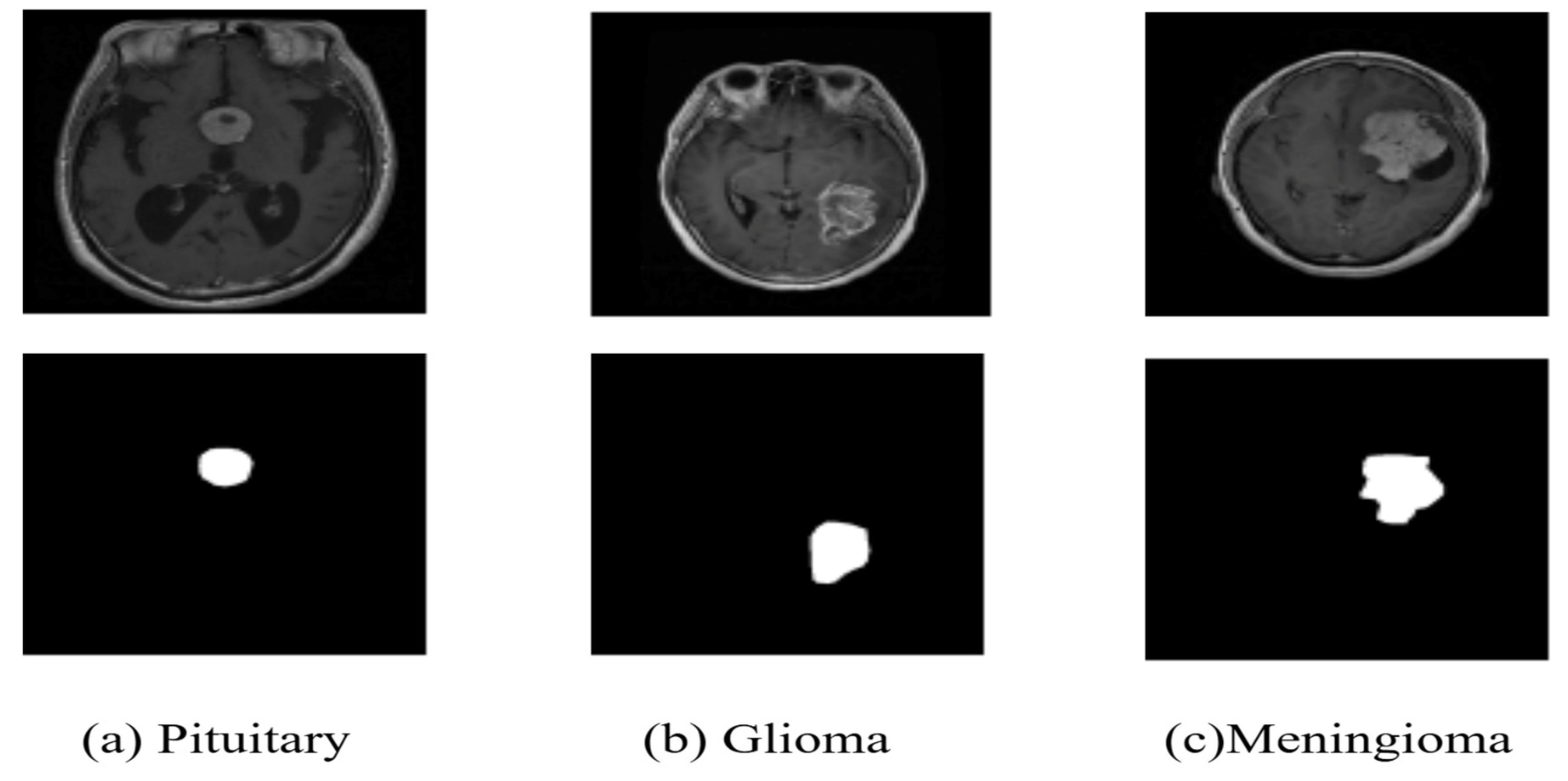
For precise evaluation and therapeutic planning, automatic brain cancer segmentation from MRI scans is essential. In this work, a hybrid deep learning framework for image segmentation comprising a Vision transformer and ResU-Net50 is proposed. It combines the strong local feature extraction capabilities of ResNet50 with the global representation learning capabilities of a Vision Transformer embedded in a U-Net framework. To improve mask quality and prediction stability, a preprocessing pipeline powered by Dung Beetle Optimization (DBO) is used to optimize thresholding, morphological enhancement, and test-time augmentation. Comparing DBO-based preprocessing to non-optimized preprocessing, experimental results on a T1-CE MRI dataset with 3064 annotated images show that the former greatly enhances segmentation performance, resulting in increases of 2.3% in precision, 1.9% in Dice Coefficient, and 3.2% in Jaccard Index. With Dice scores of 0.9630, 0.9873, and 0.9862 for pituitary, glioma, and meningioma tumors, respectively, the suggested Vision-ResU- Net50 model further achieves exceptional tumor-wise segmentation results, outperforming cutting-edge techniques like Edge U-Net, Improved U-Net, CNN, and deep learning models by margins of 417% in Dice and 515% in Jaccard Index, the suggested approach is a highly efficient and dependable for clinical brain tumor analysis.
Article Details

This work is licensed under a Creative Commons Attribution-NonCommercial-NoDerivatives 4.0 International License.
References
A. Abo-El-Rejal, S. A. Ayman and F. Aymen, “Advances in breast cancer segmentation: A comprehensive review,” Acadlore Transactions on AI and Machine Learning, vol. 3, no. 2, pp. 70–83, 2024.
S. Zahoor, I. U. Lali, M. A. Khan, K. Javed and W. Mehmood, “Breast cancer detection and classification using traditional computer vision techniques: A comprehensive review,” Current Medical Imaging Reviews, vol. 16, no. 10, pp. 1187–1200, 2020.
M. Moghbel, C. Y. Ooi, N. Ismail, Y. W. Hau and N. Memari, “A review of breast boundary and pectoral muscle segmentation methods in computer-aided detection/diagnosis of breast mammography,” Artificial Intelligence Review, vol. 53, pp. 1873–1918, 2020.
S. Vijh, M. Saraswat and S. Kumar, “Automatic multilevel image thresholding segmentation using hybrid bio-inspired algorithm and artificial neural network for histopathology images,” Multimedia Tools and Applications, vol. 82, pp. 4979–5010, 2023.
A. Ashurov et al., “Improved breast cancer classification through combining transfer learning and attention mechanism,” Life, vol. 13, no. 9, p. 1945, 2023.
X. Zhang et al., “HiViT: A Simpler and More Efficient Design of Hierarchical Vision Transformer,” in Proceedings International Conference on Learning Representations (ICLR), 2023.
J. Ruan, J. Li and S. Xiang,“VM-UNet: Vision Mamba UNet for medical image segmentation,” ACM Transactions on Multimedia Computing, Communications and Applications, 2024.
X. Ma, Y. Du and D. Sui, “A U-shaped architecture based on hybrid CNN and Mamba for medical image segmentation,” Applied Sciences, vol. 15, no. 14, p. 7821, 2025.
H. Yang, Y. Liu and T. Xia, “Defect detection scheme of pins for aviation connectors based on image segmentation and improved ResNet-50,” International Journal of Image and Graphics, vol. 24, no. 1, p. 2450011, 2024.
J. Shedbalkar, K. Prabhushetty, and R. H. Havaldar, “UNet and transformer-based model for multi-modality brain tumor segmentation,” International Journal of Electronics and Communication Engineering, vol. 10, no. 8, pp. 22– 35, 2023.
G. Huang et al., “Channel-Attention U-Net: Channel Attention Mechanism for Semantic Segmentation of Esophagus and Esophageal Cancer,” in IEEE Access, vol. 8, pp. 122798-122810, 2020.
K. Avazov, S. Mirzakhalilov, S. Umirzakova, A. Abdusalomov and Y. I. Cho, “Dynamic focus on 447 tumor boundaries: A lightweight U-Net for MRI brain tumor segmentation,” Bioengineering, vol. 11, no. 12, p. 1302, 2024.
A. H. Nizamani, Z. Chen, A. A. Nizamani and U. A. Bhatti, “Advance brain tumor segmentation using feature fusion methods with deep UNet model with CNN for MRI data,” Journal of King Saud University–Computer and Information Sciences, vol. 35, no. 9, p. 101793, 2023.
K. Swaraja, K. Meenakshi, H. B. Valiveti and G. Karuna, “Segmentation and detection of brain tumor through optimal selection of integrated features using transfer learning,” Multimedia Tools and Applications, vol. 81, pp. 27363–27395, 2022.
T. A. Soomro et al., “Image Segmentation for MR Brain Tumor Detection Using Machine Learning: A Review,” in IEEE Reviews in Biomedical Engineering, vol. 16, pp. 70-90, 2023.
M. G. Allah Ahmed, A. M. Sarhan and N. M. Elshennawy, “Edge U-Net: Brain tumor segmentation using MRI based on deep U-Net model with boundary information,” Expert Systems with Applications: An International Journal, vol. 213, no. PA, 2023.
Y. Chang, Z. Zheng, Y. Sun, M. Zhao, Y. Lu and Y. Zhang, “DPAFNet: A residual dualpath attention-fusion convolutional neural network for multimodal brain tumor segmentation,” Biomedical Signal Processing and Control, vol. 79, p. 104037, 2023.
J. Cheng et al., “Enhanced performance of brain tumor classification via tumor region augmentation and partition,” PLOS ONE, vol. 10, no. 12, p. e0144479, 2015.
D. Shah and J. Sen, “Pituitary macroadenoma: A comprehensive case study of surgical intervention and postoperative management,” Cureus, vol. 16, no. 4, p. e59387, 2024.
N. Rasool and J. I. Bhat, “A critical review on segmentation of glioma brain tumor and prediction of overall survival,” Archives of Computational Methods in Engineering, vol. 32, pp. 1525– 1569, 2025.
L. Rogers et al., “Meningiomas: Knowledge base, treatment outcomes, and uncertainties. A RANO review,” Journal of Neurosurgery, vol. 122, no. 1, pp. 4–23, 2015.
Z. Li, W. Liu, H. Zhao and W. Pu, “Dung beetle optimization with composite population initialization and multi-strategy learning for multilevel threshold image segmentation,” Signal, Image and Video Processing, vol. 19, no. 255, 2025.
W. Fang, Z. Yu, Y. Chen, T. Huang, T. Masquelier and Y. Tian, “Deep residual learning in spiking neural networks,” Advances in Neural Information Processing Systems, vol. 34, pp. 21056– 21069, 2021. ¨
S. H. H. Abdalgadir and M. Ozt¨urk, “Image enhancement and U-Net based brain tumor segmentation using MRI,” European Journal of Engineering and Applied Sciences, vol. 8, no. 1, pp. 31–38, 2025.
S. Kumar and D. Kumar, “Human brain tumor classification and segmentation using CNN,” Multimedia Tools and Applications, vol. 82, pp. 7599–7620, 2023.
K. T. Islam, S. Wijewickrema and S. O’Leary, “A deep learning framework for segmenting brain tumors using MRI and synthetically generated CT images,” Sensors, vol. 22, no. 2, p. 523, 2022.
P. Zheng, X. Zhu and W. Guo, “Brain tumour segmentation based on an improved U-Net,” BMC Medical Imaging, vol. 22, no. 199, 2022.
