
Horned Lizard Optimization-Driven CA-InceptionResNet Framework for Enhanced Dementia Diagnosis
Article Sidebar
Main Article Content
Abstract
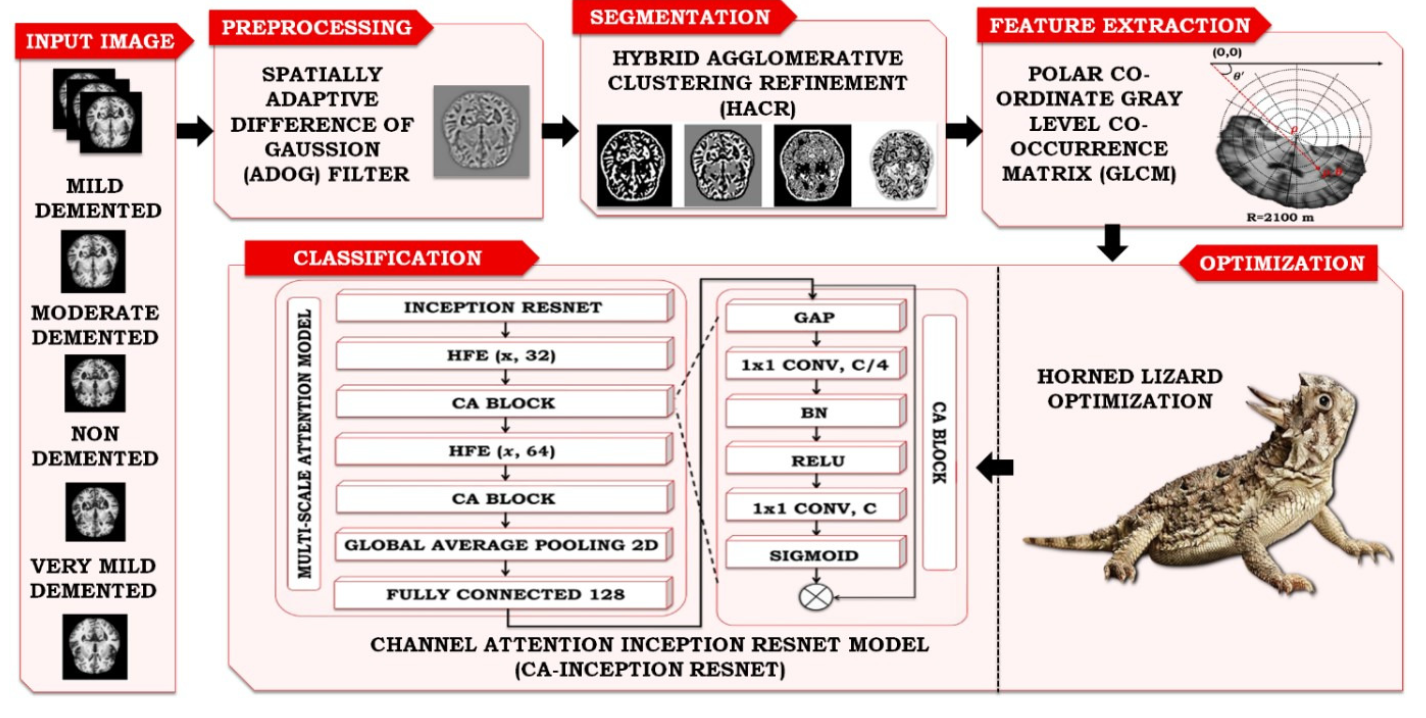
Dementia is a progressive neurological disorder affecting millions worldwide. It places a tremendous burden on global healthcare systems and research. Early detection and accurate diagnosis are essential for effective disease management. The purpose of this paper is to present an integrated framework using Deep Learning (DL) to help improve dementia diagnosis. The framework uses an Adaptive Difference of Gaussian (ADoG) filter to sharpen important edges on neuroimaging scans while reducing background noise, producing sharper (more focused) data in neuroimaging scans that contain significant amounts of data. To segment brain tissue into anatomical regions affected by neurodegenerative disorders using the Hybrid Agglomerative Clustering Refinement (HACR) technique. The segmented anatomical regions are analyzed using a polar-coordinate-based Gray-Level Co-Occurrence Matrix (GLCM) to extract rotation-invariant texture features, ensuring robust and orientation-independent characterization of tissue patterns. For a classification stage, proposed framework utilizes a Channel-Attention Inception-ResNet (CA-InceptionResNet) model. By integrating feature extraction stength of InceptionResNet architecture with channel-attention mechanism, proposed model effectively captures discriminative features and improves classification of dimentia sublevels. For classifier performance optimization, the Horned Lizard Optimization (HLO) algorithm is employed to optimize the model's hyperparameters. The proposed model is implemented in Python and achieved an accuracy of 98.98%,precision of 99.12%, recall of 98.96%, F-score of 99.04% and specificity of 99.58%, demonstrating its effectiveness in accurate and reliable classification.
Article Details

This work is licensed under a Creative Commons Attribution-NonCommercial-NoDerivatives 4.0 International License.
References
U. Anwar, T. Arslan, A. Hussain, T. C. Russ and P. Lomax, “Design and Evaluation of Wearable Multimodal RF Sensing System for Vascular Dementia Detection,” in IEEE Transactions on Biomedical Circuits and Systems, vol. 17, no. 5, pp. 928-940, Oct. 2023.
K. Aishwaryameenakshi, S. H. Banu, A. K. Priya, and S. Chitrakala, “Image Indexing using Edgel Index for Sketch-based Image Search and Retrieval,” International Journal of Wisdom Based Computing, vol. 1, no. 3, pp. 134–138, 2011.
V. Jain, O. Nankar, D. J. Jerrish, S. Gite, S. Patil and K. Kotecha, “A Novel AI-Based System for Detection and Severity Prediction of Dementia Using MRI,” in IEEE Access, vol. 9, pp. 154324-154346, 2021.
M. M. Hussain, D. Weslin, S. Kumari, S. Umamaheswari, and K. Kamalakannan, “Enhancing Parkinson’s disease identification using ensemble classifier and data augmentation techniques in machine learning,” Clinical eHealth, vol. 6, pp. 150–158, 2023.
J. Wei, B. Jiao, H. Lin, X. Tian, L. Shen, and J. Liu, “Multi-Scale Adaptive Graph Learning Based on Multi-Wave EEG Data for Dementia Diagnosis,” Big Data Mining and Analytics, vol. 8, no. 5, pp. 1023–1043, 2025.
S. Hong, J. H. Park, W. Cho, H. Choe, and J. H. Cheon, “Secure tumor classification by shallow neural network using homomorphic encryption,” BMC Genomics, vol. 23, no. 1, p. 284, 2022.
T. G. Devi, N. Patil, S. Rai, and C. S. Philipose, “Gaussian blurring technique for detecting and classifying acute lymphoblastic leukemia cancer cells from microscopic biopsy images,” Life, vol. 13, no. 2, p. 348, 2023.
M. S. Priyadharsini and J. G. R. Sathiaseelan, “The new robust adaptive median filter for denoising cancer images using image processing techniques,” Indian Journal of Science and Technology, vol. 16, no. 35, pp. 2813–2821, 2023.
O. Ali, H. Ali, S. A. A. Shah and A. Shahzad, “Implementation of a Modified U-Net for Medical Image Segmentation on Edge Devices,” in IEEE Transactions on Circuits and Systems II: Express Briefs, vol. 69, no. 11, pp. 4593-4597, Nov. 2022.
Y. Du, H. Yuan, K. Jia, and F. Li, “Research on threshold segmentation method of two-dimensional Otsu image based on improved sparrow search algorithm,” in IEEE Access, vol. 11, pp. 70459–70469, 2023.
I. Hussain and J. Muhammad, “Efficient convex region-based segmentation for noising and inhomogeneous patterns,” Inverse Problems and Imaging, vol. 17, no. 3, pp. 708–725, 2023.
S. M. Jihad, A. Aalsaud, F. H. Almukhtar, S. Kareem, and R. Z. Yousif, “Investigating feature extraction by SIFT methods for prostate cancer early detection,” Egyptian Informatics Journal, vol. 29, p. 100607, 2025.
M. G¨ul, “A novel local binary patterns-based approach and proposed CNN model to diagnose breast cancer by analyzing histopathology images,” in IEEE Access, vol. 13, pp. 165688– 165703, 2025.
A. Sharma, S. Kaur, N. Memon, A. J. Fathima, S. Ray, and M. W. Bhatt, “Alzheimer’s patients detection using support vector machine (SVM) with quantitative analysis,” Neuroscience Informatics, vol. 1, no. 3, p. 100012, 2021.
S. J. Ben, M. D¨orner, M. P. G¨unther, R. von K¨anel, and S. Euler, “Proof of concept: Predicting distress in cancer patients using back propagation neural network (BPNN),” Heliyon, vol. 9, no. 8, p. e18648, 2023.
A. Hashmi and O. Barukab, “Dementia classification using deep reinforcement learning for early diagnosis,” Applied Sciences, vol. 13, no. 3, p. 1464, 2023.
W. Al Shehri, “Alzheimer’s disease diagnosis and classification using deep learning techniques,” PeerJ Computer Science, vol. 8, p. e1177, 2022.
H. Tufail, A. Ahad, M. H. Naqvi, R. Maqsood, and I. M. Pires, “Classification of vascular dementia on magnetic resonance imaging using deep learning architectures,” Intelligent Systems with Applications, vol. 22, p. 200388, 2024.
M. R. Kumar, S. Vekkot, S. Lalitha, D. Gupta, V. J. Govindraj, K. Shaukat, Y. A. Alotaibi, and M. Zakariah, “Dementia detection from speech using machine learning and deep learning architectures,” Sensors, vol. 22, no. 23, p. 9311, 2022.
A. Marab and A. Bhadrashetty, “A novel approach using deep convolutional neural networks for automated dementia detection and classification,” Edraak, vol. 2023, pp. 16–20, 2023.
A. A. Soladoye, N. Aderinto, B. A. Omodunbi, A. O. Esan, I. A. Adeyanju, and D. B. Olawade, “Applications of artificial intelligence in dementia diagnosis and management: A systematic review,” Current Research in Translational Medicine, vol. 72, no. 4, p. 103460, 2024.
C. James, J. M. Ranson, R. Everson, and D. J. Llewellyn, “Performance of machine learning algorithms for predicting progression to dementia in memory clinic patients,” JAMA Network Open, vol. 4, no. 12, p. e2136553, 2021.
S. Bharati, P. Podder, D. N. H. Thanh, and V. S. Prasath, “Dementia classification using MR imaging and clinical data with voting based machine learning models,” Multimedia Tools and Applications, vol. 81, no. 18, pp. 25971–25992, 2022.
S. Murugan, C. Venkatesan, M. G. Sumithra, X. Z. Gao, B. Elakkiya, M. Akila, and S. Manoharan, “DEMNET: A deep learning model for early diagnosis of Alzheimer diseases and dementia from MR images,” in IEEE Access, vol. 9, pp. 90319–90329, 2021.
F. M. Talaat and M. R. Ibraheem, “Dementia diagnosis in young adults: A machine learning and optimization approach,” Neural Computing and Applications, vol. 36, no. 34, pp. 21451–21464, 2024.
G. Anuradha, H. Davu, and M. Karri, “Genetic algorithm-based decision tree optimization for detection of dementia through MRI analysis,” Informatyka, Automatyka, Pomiary w Gospo´ darce i Ochronie Srodowiska, vol. 14, no. 1, pp. 83–89, 2024.
H. Wang, L. Sheng, S. Xu, Y. Jin, X. Jin, S. Qiao, Q. Chen, W. Xing, Z. Zhao, J. Yan, and G. Mao, “Develop a diagnostic tool for dementia using machine learning and non-imaging features,” Frontiers in Aging Neuroscience, vol. 14, p. 945274, 2022.
E. Cho, S. Kim, S. J. Heo, J. Shin, S. Hwang, E. Kwon, S. Lee, S. Kim, and B. Kang, “Machine learning-based predictive models for the occurrence of behavioral and psychological symptoms of dementia: Model development and validation,” Scientific Reports, vol. 13, no. 1, p. 8073, 2023.
