
Mining User Mobility Insights from Public Wi-Fi Data Using Association Rules in Urban Riverfront Areas
Article Sidebar
Main Article Content
Abstract
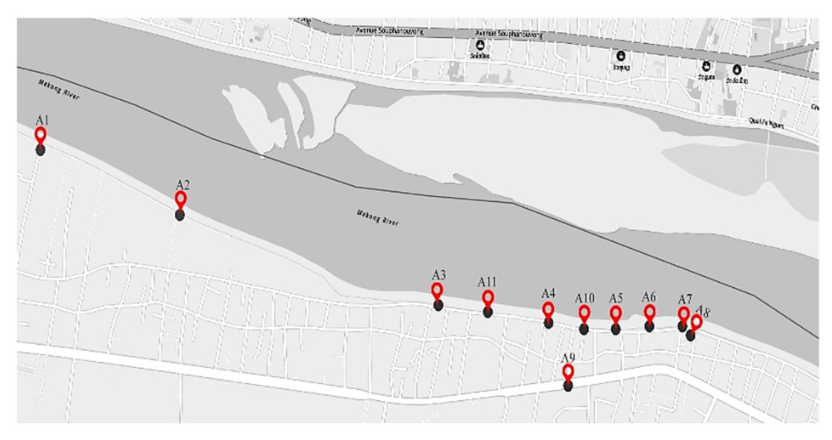
Understanding user mobility patterns is essential for effective urban planning and resource management. This study employs Association Rule Mining to analyze public Wi-Fi data collected from 11 access points along the Mekong River in Sri Chiang Mai, Thailand, from May 2022 to December 2023. By examining co-occurring movement patterns in over 73.7 million connection records, the research uncovers key insights into human behavior in the area. The findings highlight the area in front of the Fresh Market as a central destination, with confidence values exceeding 0.99 for related movement rules. The results reveal pronounced temporal variations in movement patterns, with transitions from commercial areas in the mornings to leisure spaces in the afternoons and evenings. Weekday patterns differ notably from weekend behaviors, reflecting how time influences urban space utilization. These insights provide urban planners and policymakers with data-driven evidence to optimize infrastructure development, enhance public spaces, and improve resource allocation. Although this study is limited to Wi-Fi data, it provides significant contributions to the development of smart cities that are more responsive and sustainable, paving the way for improved urban living experiences and more efficient resource management. Future work could integrate multiple data sources to enable more comprehensive mobility analysis and advance sustainable urban development goals.
Article Details

This work is licensed under a Creative Commons Attribution-NonCommercial-NoDerivatives 4.0 International License.
References
Y. Yang, A. Pentland and E. Moro, “Identifying latent activity behaviors and lifestyles using mobility data to describe urban dynamics,” EPJ Data Science, vol. 12, no. 15, 2023.
A. Memon, J. Kilby, J. Bre˜nosa, J. C. Espinosa and I. Ashraf, “Analysis and Implementation of Human Mobility Behavior Using Similarity Analysis Based on Co-Occurrence Matrix,” Sensors, vol. 22, no. 24, p. 9898, 2022.
R. De Vincentis, F. Karagulian, C. Liberto, M. Nigro, V. Rosati and G. Valenti, “A Data-Driven Approach to Analyze Mobility Patterns and the Built Environment: Evidence from Brescia, Catania, and Salerno (Italy),” Sustainability, vol. 14, no. 21, p. 14378, 2022. ´
A. Gonz´alez-Lorence, A. C. Navarrete-Fern´andez, R. Ayala-Landeros, J. E. Soto-Osornio and J. G. Ayala-Landeros, “Intelligent mobility system for improving the blind pedestrian independent behavior in unknown outdoor environments,” Human Behavior and Emerging Technologies, vol. 2022, no. 1, p. 4943457, 2022.
S. Ballı and E. A. Saˇgba¸s, “Diagnosis of transportation modes on mobile phone using logistic regression classification,” IET Software, vol. 12, no. 2, pp. 142–151, 2018.
B.-C. Lin and T.-C. Chan, “Visualizing population mobility from spatiotemporally aggregated mobile phone data via a 3D gradient approach,” Transactions in GIS, vol. 27, no. 1, pp. 40–56, 2023.
G. Michalk´o, M. Prorok, A. C. Kondor, N. Ily´es and T. Szab´o, “Mobility patterns of satellite travellers based on mobile phone cellular data,” Hungarian Geographical Bulletin, vol. 72, no. 2, pp. 163–178, 2023.
C. Heredia, S. Moreno and W. F. Yushimito, “Characterization of Mobility Patterns With a Hierarchical Clustering of Origin-Destination GPS Taxi Data,” in IEEE Transactions on Intelligent Transportation Systems, vol. 23, no. 8, pp. 12700-12710, Aug. 2022.
F. Liu, D. Wang and Z. Xu, “Privacy-Preserving Travel Time Prediction With Uncertainty Using GPS Trace Data,” in IEEE Transactions on Mobile Computing, vol. 22, no. 1, pp. 417-428, 1 Jan. 2023.
Q. Yang, F. Ji and F. Liu, “An efficient and differential privacy-based scheme for aggregating mobility datasets,” Journal of Advanced Transportation, vol. 2024, no. 1, p. 5374764, 2024.
M. K. Savi et al., “A standardised differential privacy framework for epidemiological modeling with mobile phone data,” PLOS Digital Health, vol. 2, no. 10, p. e0000233, 2023.
F. Kreuter, S. Presser and R. Tourangeau, “Social desirability bias in CATI, IVR, and web surveys: The effects of mode and question sensitivity,” Public Opinion Quarterly, vol. 72, no. 5, pp. 847–865, 2008.
L. Chen, X. Chen, L. Ni, Y. Peng and D. Fang, “Human Behavior Recognition Using Wi-Fi CSI: Challenges and Opportunities,” in IEEE Communications Magazine, vol. 55, no. 10, pp. 112117, Oct. 2017.
A. Sassi, A. Bachir and W. Bechkit, “Evaluating regression models for temporal prediction of WiFi device mobility,” Wireless Personal Communications, vol. 116, no. 3, pp. 2169–2186, 2021.
H. Ji and X. Wu, “Resource and mobility management in hybrid LiFi and WiFi networks: A user-centric learning approach,” arXiv preprint arXiv:2403.16823, 2024.
G. Poucin, B. Farooq and Z. Patterson, “Activity patterns mining in Wi-Fi access point logs,” Computers, Environment and Urban Systems, vol. 67, pp. 55–67, 2018.
F. Talavera, I. Lera and C. Guerrero, “Analysis of wireless network access logs for a hierarchical characterization of user mobility,” Journal of King Saud University-Computer and Information Sciences, vol. 34, no. 6, pp. 2471–2487, 2022.
L. Li, Z. Pei, Q. Li, F. Hao, X. Chen and J. Chen, “Identifying tourism attractiveness based on intra-destination tourist behaviour: evidence from Wi-Fi data,” Current Issues in Tourism, vol. 17, no.19, pp. 3131-3149, 2023.
B. Alorda-Ladaria, M. Ruiz-P´erez and V. Ramos, “A near real-time monitoring system using public WI-FI data to evaluate COVID-19 social distance measures,” Electronics, vol. 11, no. 18, p. 2897, 2022.
T. Wiangwiset et al., “Design and implementation of a real-time crowd monitoring system based on public wi-fi infrastructure: A case study on the sri chiang mai smart city,” Smart Cities, vol. 6, no. 2, pp. 987–1008, 2023.
G. Retscher, “Fundamental concepts and evolution of Wi-Fi user localization: An overview based on different case studies,” Sensors, vol. 20, no. 18, p. 5121, 2020.
P. Salas, V. Ramos, M. Ruiz-P´erez and B. Alorda-Ladaria, “Methodological proposal for the analysis of urban mobility using Wi-Fi data and artificial intelligence techniques: The case of Palma,” Electronics, vol. 12, no. 3, p. 504, 2023.
S. Zhang, Z. Yang and C. Wang, “The border 497 tourism hotspots network based on travelogues,” Heliyon, vol. 10, no. 13, p. e33260, 2024.
T. Arreeras, M. Arimura, T. Asada and S. Arreeras, “Association rule mining touristattractive destinations for the sustainable development of a large tourism area in Hokkaido using Wi-Fi tracking data,” Sustainability, vol. 11, no. 14, p. 3967, 2019.
A. Brauer, V. M¨akinen and J. Oksanen, “Human mobility tracks as FAIR data: Designing a privacy-preserving repository for GNSS-based activity tracking data,” AGILE: GIScience Series, vol. 4, no. 21, 2023.
D. Surian, V. Kim, R. Menon, A. G. Dunn, V. Sintchenko, and E. Coiera, “Tracking a moving user in indoor environments using Bluetooth low energy beacons,” Journal of Biomedical Informatics, vol. 98, p. 103288, 2019.
Y. Cui, X. Xie, and Y. Liu, “Social media and mobility landscape: Uncovering spatial patterns of urban human mobility with multi source data,” Frontiers of Environmental Science & Engineering, vol. 12, pp. 1–14, 2018.
Y. Zhou, B. P. L. Lau, Z. Koh, C. Yuen and B. K. K. Ng, “Understanding Crowd Behaviors in a Social Event by Passive WiFi Sensing and Data Mining,” in IEEE Internet of Things Journal, vol. 7, no. 5, pp. 4442-4454, May 2020.
P. Bellini, D. Cenni, P. Nesi and I. Paoli, “WiFi based city users’ behaviour analysis for smart city,” Journal of Visual Languages & Computing, vol. 42, pp. 31–45, 2017.
K. A. Cagney, E. York Cornwell, A. W. Goldman and L. Cai, “Urban mobility and activity space,” Annual Review of Sociology, vol. 46, no. 1, pp. 623–648, 2020.
S. Ding, Z. Li, K. Zhang and F. Mao, “A comparative study of frequent pattern mining with trajectory data,” Sensors, vol. 22, no. 19, p. 7608, 2022.
M. Versichele, L. De Groote, M. C. Bouuaert, T. Neutens, I. Moerman and N. Van de Weghe, “Pattern mining in tourist attraction visits through association rule learning on Bluetooth tracking data: A case study of Ghent, Belgium,” Tourism Management, vol. 44, pp. 67–81, 2014.
A. A. Hashad, K. W. Khaw, A. Alnoor and X. Y. Chew, “Exploratory analysis with association rule mining algorithms in the retail industry,” Malaysian Journal of Computing (MJoC), vol. 9, no. 1, pp. 1746–1758, 2024.
M. H. Chandwani, “Market basket analysis using association rule,” International Journal of Advance Research, Ideas and Innovations in Technology, vol. 4, pp. 744–747, 2018.
L. Zeng, B. Wang, L. Fan and J. Wu, “Analyzing sustainability of Chinese mining cities using an association rule mining approach,” Resources Policy, vol. 49, pp. 394–404, 2016.
M. Gebresselassie and T. W. Sanchez, “Smart” tools for socially sustainable transport: a review of mobility apps,” Urban Science, vol. 2, no. 2, p. 45, 2018.
R. A. Raslan, “Enhancing urban spaces through crowd behavior analysis: A case study of Arafat to Muzdalifah Road during Hajj time,” Engineering Research Journal, vol. 179, pp. 100–115, 2023.
T. Wiangwiset et al., “Development of a tourist behavior analysis system using public Wi-Fi data to enhance smart tourism management: A case study of Sri Chiang Mai Smart City,” Engineering and Applied Science Research, vol. 52, no. 1, pp. 42–56, 2025.
P.-N. Tan, V. Kumar, and J. Srivastava, “Selecting the right objective measure for association analysis,” Information Systems, vol. 29, no. 4, pp. 293–313, 2004.
T. Boonchoo, “Capturing Spatial Relationship Mapping Patterns between GPS Coordinates and Road Network Using Machine Learning and Partitioning Techniques,” ECTI-CIT Transactions, vol. 16, no. 3, pp. 277–288, 2022.
O. Sooknit, J. Suksawatchon, and U. Suksawatchon, “Awareness of Check-In Patterns for an Adaptive Framework in Next POI Recommendation,” ECTI-CIT Transactions, vol. 19, no. 4, pp. 645–655, 2025.
