
An AI-based Mixture-of-Experts Framework for Multi-Type Iatrogenic Drug Interaction Prediction
Article Sidebar
Main Article Content
Abstract
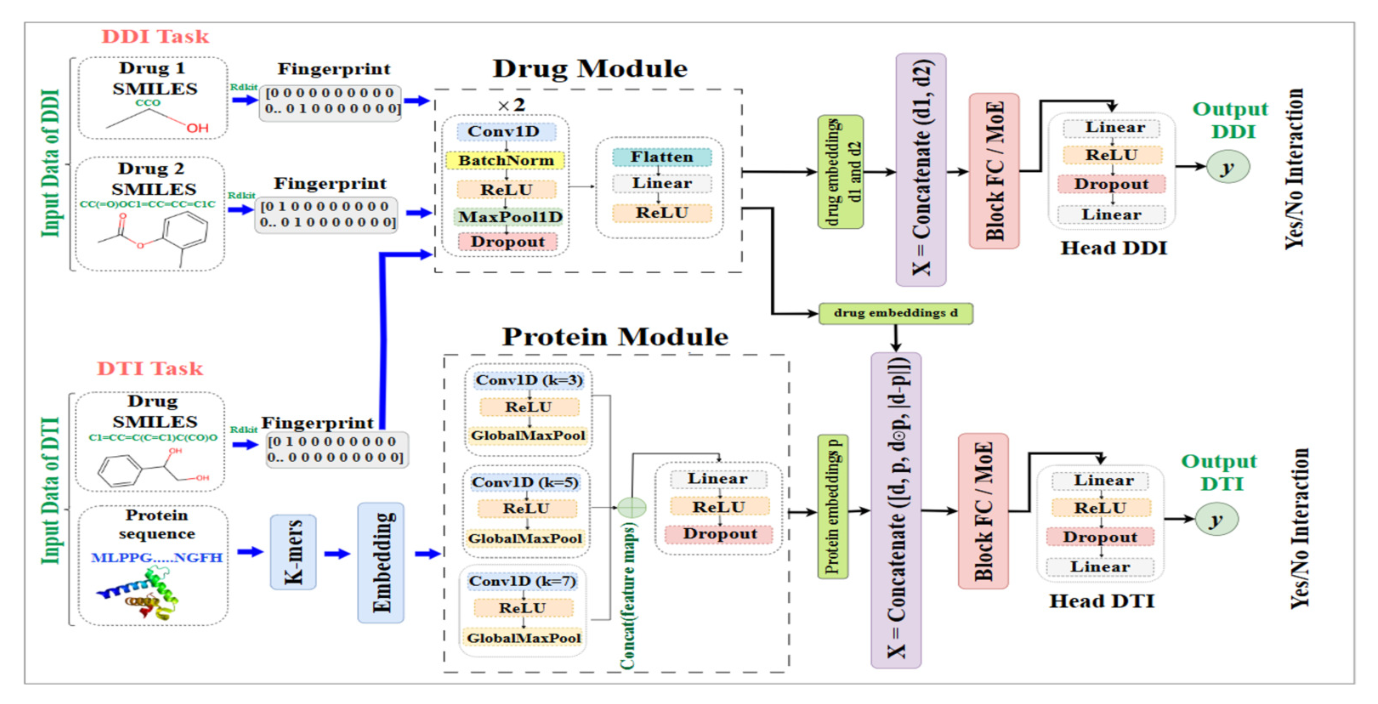
Pharmacovigilance involves preventing adverse effects in patients through the prevention, detection, and evaluation of these effects. Prescription errors, incorrect dosages, and drug interactions cause iatrogenic drug effects. There are two main types of drug interactions: between two drugs (DDI) and between a protein and a drug (DTI). The multitude of molecules and treatments available today makes it difficult to prevent their effects. Deep learning (DL) appears to be a solution to this problem. Current work in DL focuses on a single type of interaction and does not generalize to other types. We propose a multitask model that predicts both types of interactions (DDI and DTI). It deploys two mixture-of-experts (MoE) blocks for each task. This mechanism avoids interference between representation spaces. One module for drugs uses convolutional neural networks (CNNs). A second module for proteins learns multi-granularity patterns. The model test yields the following results for the DTI task: accuracy (0.952), precision (0.959), F1 (0.952), recall (0.944), AUC (0.987), and AUPR (0.987). The DDI task yields accuracy (0.980), precision (0.966), F1 (0.980), recall (0.995), AUC (0.997), and AUPR (0.995).
Article Details

This work is licensed under a Creative Commons Attribution-NonCommercial-NoDerivatives 4.0 International License.
References
G. Jeetu and G. Anusha, “Pharmacovigilance: A Worldwide Master Key for Drug Safety Monitoring,” Journal of Young Pharmacists, vol. 2, no. 3, pp. 315–320, 2010.
D. Hamdadou, H. Toumi, F. Zemri, Y. Omari and A. Bengueddach, “Intelligent Clinical Decision Support System for Monitoring and Preventing Adverse Effects of Drug-Drug Interaction,” in Intelligent and Fuzzy Systems, Springer, pp. 250–257, 2024.
K. Makhlouf, S. Madouri, D. Hamdadou and K. Bouamrane, “An Intelligent Clinical Decision Support System for Managing Iatrogenic Drug Risks Using Electronic Medical Records,” in Intelligent and Fuzzy Systems, Springer, pp. 368–376, 2025.
T. Perumal, N. Mustapha, R. Mohamed and F. M. Shiri, “A Comprehensive Overview and Comparative Analysis on Deep Learning Models,” Journal on Artificial Intelligence, vol. 6, no. 1, pp. 301–360, 2024.
Q. Zhao, H. Zhao, K. Zheng and J. Wang, “HyperAttentionDTI: improving drug–protein interaction prediction by sequence-based deep learning with attention mechanism,” Bioinformatics, vol. 38, no. 3, pp. 655–662, 2022.
C. Zhang, Y. Lu and T. Zang, “CNN-DDI: a learning-based method for predicting drug–drug interactions using convolution neural networks,” BMC Bioinformatics, vol. 23, no. S1, p. 88, 2022.
J. Zhou et al., “Graph neural networks: A review of methods and applications,” AI Open, vol. 1, pp. 57–81, 2020.
Y. Pan, Y. Zhang, J. Zhang and M. Lu, “CSDTI: an interpretable cross-attention network with GNN-based drug molecule aggregation for drug-target interaction prediction,” Applied Intelligence, vol. 53, no. 22, pp. 27177–27190, 2023.
S. Gupta, S. Laghuvarapu and U. D. Priyakumar, “GraphDDI: Graph Neural Network for Prediction of Drug-Drug Interaction,” in Artificial Intelligence in Healthcare, Springer, pp. 17–30, 2024.
M. Zhao, M. Yuan, Y. Yang and S. X. Xu, “CPGL: Prediction of Compound-Protein Interaction by Integrating Graph Attention Network With Long Short-Term Memory Neural Network,” in IEEE/ACM Transactions on Computational Biology and Bioinformatics, vol. 20, no. 3, pp. 1935-1942, 1 May-June 2023.
F. Liu, H. Xu, P. Cui, S. Li, H. Wang and Z. Wu, “NFSA-DTI: A Novel Drug–Target Interaction Prediction Model Using Neural Fingerprint and Self-Attention Mechanism,” International Journal of Molecular Sciences, vol. 25, no. 21, p. 11818, 2024.
X. Ouyang, Y. Feng, C. Cui, Y. Li, L. Zhang and H. Wang, “Improving generalizability of drug–target binding prediction by pre-trained multi-view molecular representations,” Bioinformatics, vol. 41, no. 1, p. btaf002, 2024.
J. Qiu et al., “PTB-DDI: An Accurate and Simple Framework for Drug–Drug Interaction Prediction Based on Pre-Trained Tokenizer and BiLSTM Model,” International Journal of Molecular Sciences, vol. 25, no. 21, p. 11385, 2024.
X. Zeng, W. Chen and B. Lei, “CAT-DTI: crossattention and Transformer network with domain adaptation for drug-target interaction prediction,” BMC Bioinformatics, vol. 25, no. 1, p. 141, 2024.
X. Gong, Q. Liu, J. He, Y. Guo and G. Wang, “MultiGranDTI: an explainable multigranularity representation framework for drugtarget interaction prediction,” Applied Intelligence, vol. 55, no. 2, p. 107, 2025.
K. Makhlouf, D. Hamdadou, Y. Omari, K. Bouamrane and F. A. Zemri, “Drug-Target Interaction Prediction Based on GCN and BiLSTM with a Cross-Attention Mechanism,” in Proc. 2024 International Conference of the African Federation of Operational Research Societies (AFROS), Tlemcen, Algeria, pp. 1–5, 2024.
S. Liu, Y. Liu, H. Xu, J. Xia and S. Z. Li, “SP-DTI: subpocket-informed transformer for drug–target interaction prediction,” Bioinformatics, vol. 41, no. 3, p. btaf011, 2025.
Y. Zhang, Q. Wang, C. Zhang, B. Feng, J. Shang and L. Zhang, “IHDFN-DTI: Interpretable Hybrid Deep Feature Fusion Network for Drug–Target Interaction Prediction,” Interdisciplinary Sciences: Computational Life Sciences, 2025.
D. Gao and F. Zhu, “GraphCF: Drug–target interaction prediction via multi-feature fusion with contrastive graph neural network,” Artificial Intelligence in Medicine, vol. 167, p. 103196, 2025.
P. Gupta, A. Majumdar, E. Chouzenoux and G. Chierchia, “DeConDFFuse: Predicting drug–drug interaction using joint deep convolutional transform learning and decision forest fusion framework,” Expert Systems with Applications, vol. 227, p. 120238, 2023.
Z. Jiang, P. Ding, C. Shen and X. Dai, “Geometric Molecular Graph Representation Learning Model for Drug-Drug Interactions Prediction,” IEEE Journal of Biomedical and Health Informatics, vol. 28, no. 12, pp. 7623–7632, 2024.
D. Niu, L. Zhang, B. Zhang, Q. Zhang and Z. Li, “DAS-DDI: A dual-view framework with drug association and drug structure for drug–drug interaction prediction,” Journal of Biomedical Informatics, vol. 156, p. 104672, 2024.
Z. Jiang, Z. Gong, X. Dai, H. Zhang, P. Ding and C. Shen, “Deep graph contrastive learning model for drug-drug interaction prediction,” PLoS ONE, vol. 19, no. 6, p. e0304798, 2024.
L. Wang, Y. Li, Y. Zhou, L. Guo and C. Chen, “MFE-DDI: A multi-view feature encoding framework for drug-drug interaction prediction,” Computational and Structural Biotechnology Journal, vol. 27, pp. 2473–2480, 2025.
D. Weininger, “SMILES, a chemical language and information system. 1. Introduction to methodology and encoding rules,” Journal of Chemical Information and Computer Sciences, vol. 28, no. 1, pp. 31–36, 1988.
J. L. Ba, J. R. Kiros and G. E. Hinton, “Layer Normalization,” arXiv preprint arXiv:1607.06450, 2016.
N. Srivastava, G. Hinton, A. Krizhevsky, I. Sutskever and R. Salakhutdinov, “Dropout: A Simple Way to Prevent Neural Networks from Overfitting,” The Journal of Machine Learning Research, vol. 15, no. 1, pp. 1929–1958, 2014.
C. Moeckel et al., “A survey of k-mer methods and applications in bioinformatics,” Computational and Structural Biotechnology Journal, vol. 23, pp. 2289–2303, 2024.
S. Kılı¸carslan, K. Adem, and M. C¸ elik, “An overview of the activation functions used in deep learning algorithms,” Journal of New Results in Science, vol. 10, no. 3, pp. 75–88, 2021.
H. Liu, J. Sun, J. Guan, J. Zheng and S. Zhou, “Improving compound–protein interaction prediction by building up highly credible negative samples,” Bioinformatics, vol. 31, no. 12, pp. i221–i229, 2015.
M. Zitnik, S. R. Sosic and J. Leskovec, “BioSNAP Datasets: Stanford Biomedical Network Dataset Collection,” 2018. [Online]. Available: https://snap.stanford.edu/biodata/
M. Tsubaki, K. Tomii and J. Sese, “Compound–protein interaction prediction with endto-end learning of neural networks for graphs and sequences,” Bioinformatics, vol. 35, no. 2, pp. 309–318, 2019.
K. Huang, C. Xiao, T. Hoang, L. Glass and J. Sun, “CASTER: Predicting Drug Interactions with Chemical Substructure Representation,” in Proc. AAAI Conference on Artificial Intelligence, vol. 34, no. 01, pp. 702–709, 2020.
D. Berrar, “Cross-Validation,” in Encyclopedia of Bioinformatics and Computational Biology, Elsevier, pp. 542–545, 2019.
M. Sokolova and G. Lapalme, “A systematic analysis of performance measures for classification tasks,” Information Processing & Management, vol. 45, no. 4, pp. 427–437, 2009.
C. Nadeau and Y. Bengio, “Inference for the generalization error,” Advances in Neural Information Processing Systems, vol. 12, 1999.
T. Nguyen, H. Le, T. P. Quinn, T. Nguyen, T. D. Le and S. Venkatesh, “GraphDTA: predicting drug–target binding affinity with graph neural networks,” Bioinformatics, vol. 37, no. 8, pp. 1140–1147, 2021.
A. K. Nyamabo, H. Yu and J.-Y. Shi, “SSI–DDI: substructure–substructure interactions for drug–drug interaction prediction,” Briefings in Bioinformatics, vol. 22, no. 6, p. bbab133, 2021.
S. Abnar, H. Shah, D. Busbridge, A. M. E. Ali, J. Susskind and V. Thilak, “Parameters vs FLOPs: Scaling Laws for Optimal Sparsity for Mixtureof-Experts Language Models,” arXiv preprint arXiv:2501.12370, 2025.
