
Enhancing the PI Distribution Network Performance with Hybrid ML Forecasting Techniques Applied to a Case Study of Electronic Products in Thailand
Article Sidebar
Main Article Content
Abstract
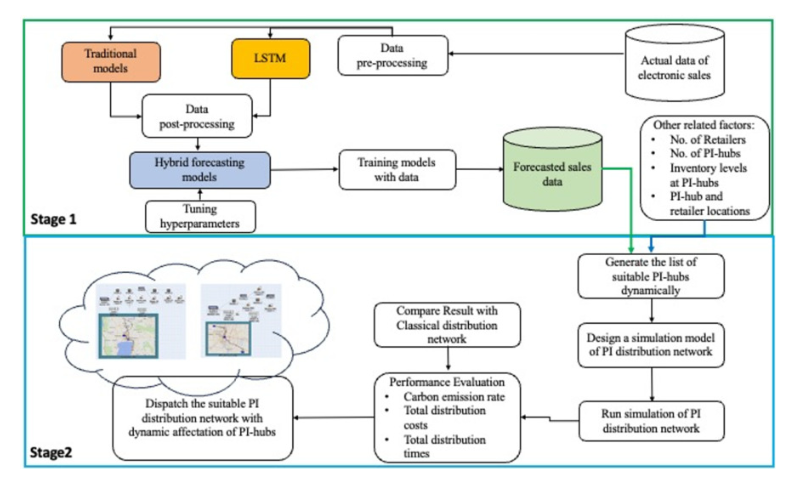
The consumption rate of different products such as electronic devices has drastically increased since the onset of COVID-19 in 2020. This shift in behavior has significantly impacted on the efficiency performance of supply chain in many countries. Using Physical Internet (PI) paradigm as an open global logistics system for increased efficiency and sustainability has been proved in different studies in the literature. Different forecasting models have been developed to predict demand fluctuations that have also been explored. However, in this work, we focus on designing different hybrid forecasting models in a dynamic way based on data analysis. Single and hybrid forecasting models, utilizing traditional and neural network techniques, have been used to design our models. The experimental data is drawn from a real case study of an electronic company in Thailand. These forecast outputs are then used to manage resources within a PI distribution network dynamically. The results indicate that hybrid forecasting models outperform other techniques in predicting the sales of three electronic Stock Keeping Units (SKUs), while only one SKU performs well with a single LSTM model. The appropriate hybrid combination model is dynamically chosen based on the forecasting performance of each SKU item. The forecast results also prove that the distribution distance, time, and cost in the PI distribution network are reduced by approximately 41%, 26%, and 49% for Bangkok and its metropolitan area, and these parameters decrease by around 14%, 11%, and 34% in the Central-Eastern regions.
Article Details

This work is licensed under a Creative Commons Attribution-NonCommercial-NoDerivatives 4.0 International License.
References
B. Montreuil, E. Ballot and F. Fontane, “An open logistics interconnection model for the physical internet,” IFAC Proceedings Volumes, vol. 45, no. 6, pp. 327–332, 2012.
T. G. Crainic and B. Montreuil, “Physical Internet enabled hyperconnected city logistics,” Transportation Research Procedia, vol. 12, pp. 383–398, 2016.
L. Faug`ere and B. Montreuil, “Smart locker bank design optimization for urban omnichannel logistics: Assessing monolithic vs. modular configurations,” Computers & Industrial Engineering, vol. 139, p. 105544, 2020.
E. Ballot, B. Montreuil and Z. G. Zacharia, “Physical Internet: First results and next challenges,” Journal of Business Logistics, vol. 42, no. 1, pp. 101–107, 2021.
H. S. Sternberg and M. Denizel, “Toward the Physical Internet—Logistics service modularity and design implications,” Journal of Business Logistics, vol. 42, no. 1, pp. 144–166, 2021.
R. Oger, B. Montreuil, M. Lauras and B. F. Oger, “Towards hyperconnected supply chain capability planning: Conceptual framework proposal,” in Proc. 5th International Physical Internet Conference (IPIC), pp. 72–82, 2018.
A. Kantasa-ard, M. Nouiri, A. Bekrar, A. Ait El Cadi and Y. Sallez, “Machine learning in forecasting in the Physical Internet: A case study of agricultural products in Thailand,” International Journal of Production Research , vol. 59, no. 24, pp. 7491–7515, 2021.
R. Carbonneau, K. Laframboise and R. Vahidov, “Application of machine learning techniques for supply chain demand forecasting,” European Journal of Operational Research, vol. 184, no. 3, pp. 1140–1154, 2008.
Thompson, “Online–Physical Shop–D2C,” 2021. [Online]. Available: https://www. brandbuffet.in.th/2021/06/thailand -future-shopper-2021-onlinephysical-shop -d2c-trends/
ETDA, “Value of e-Commerce survey in Thailand 2021,” 2021. [Online]. Available: https://www.etda.or.th/ th/Useful-Resource/publications/ Value-of-e-Commerce-Survey-in-Thailand -2021-Slides.aspx
G. Cardoza, “Thailand premium smartphone market grew 22% YoY in Q2 2022,” Counterpoint Smartphone Quarterly Global Edition (Q3 2022), 2022. [Online]. Available: https://www.counterpointresearch. com/wp-content/uploads/2017/06/ Counterpoint-Global-Smartphone-Quarterly -Q3-2022.pdf
Statista, “Production volume of household refrigerators in Thailand,” 2023. [Online]. Available: https://www.statista.com/ statistics/1242480/thailand-monthly -production-volume-of-fridges/
A. Kantasa-ard and M. Nouiri, “Enhancing the Forecasting Performance with the Hybrid Machine Learning Techniques for Online Shopping Channels: A Case Study of Electronic Products in Thailand,” TENCON 2024 2024 IEEE Region 10 Conference (TENCON), Singapore, Singapore, pp. 703-706, 2024.
A. Kantasa-ard, T. Chargui, A. Bekrar, A. Ait El Cadi and Y. Sallez, “Dynamic sustainable multiple-depot vehicle routing problem with simultaneous pickup and delivery in the context of the Physical Internet,” Journal of International Logistics and Trade, vol. 21, no. 3, pp. 110–134, 2023.
E. S. O. Helmi, O. Emam and M. Abdel-Salam, “Deep learning framework for Physical Internet hubs inbound containers forecasting,” International Journal of Advanced Computer Science and Applications(IJACSA), vol. 13, no. 3, pp. 211–216, 2022.
G. E. P. Box and G. M. Jenkins, Time Series Analysis: Forecasting and Control, San Francisco, CA, USA: Holden-Day, 1970.
G. P. Zhang and M. Qi, “Neural network forecasting for seasonal and trend time series,” European Journal of Operational Research, vol. 160, no. 2, pp. 501–514, 2005.
L. Aburto and R. Weber, “Improved supply chain management based on hybrid demand forecasts,” Appl. Soft Comput., vol. 7, no. 1, pp. 136–144, 2007.
Y. Liu, “Prediction of structural damage trends based on the integration of LSTM and SVR,” Applied Sciences, vol. 13, no. 12, p. 7135, 2023.
G. Wang, “Demand forecasting of supply chain based on support vector regression method,” Procedia Engineering, vol. 29, pp. 280–284, 2012.
T. Thuy, H. Nguyen, M. Abed, T. M. Le and A. Kantasa-ard, “Toward a smart forecasting model in supply chain management: A case study of coffee in Vietnam,” Journal of Forecasting, vol. 44, no. 1, pp. 173-199, 2024.
A. Kantasa-ard et al., “Artificial intelligence for forecasting in supply chain management,” in Proc. IFAC MIM, 2019.
K. N. D. Quach et al., “Short-term traffic speed prediction using hybrid LSTM-SVR model,” : Lecture Notes in Networks and Systems, vol. 642, pp. 438–450, 2023.
R. J. Hyndman and A. V. Kostenko, “Minimum sample size requirements for seasonal forecasting models,” Foresight, no. 6, pp. 12–15, 2007.
A. Shahin, “Using multiple seasonal Holt–Winters exponential smoothing,” International Journal of Advanced Computer Science and Applications(IJACSA), vol. 7, no. 11, pp. 91–96, 2016.
J. W. Taylor, “Exponentially weighted methods for forecasting intraday time series,” International Journal of Forecasting, vol. 26, no. 4, pp. 627–646, 2010.
R. J. Hyndman et al., Forecasting with Exponential Smoothing: The State Space Approach, Springer, 2008.
K. Chen, Y. Zhou and F. Dai, “A LSTM-based method for stock returns prediction: A case study of China stock market,” 2015 IEEE International Conference on Big Data (Big Data), Santa Clara, CA, USA, pp. 2823-2824, 2015.
A. Sagheer and M. Kotb, “Time series forecasting of petroleum production using deep LSTM networks,” Neurocomputing, vol. 323, pp. 203–213, 2019.
K. Greff, R. K. Srivastava, J. Koutn´ık, B. R. Steunebrink and J. Schmidhuber, “LSTM: A Search Space Odyssey,” in IEEE Transactions on Neural Networks and Learning Systems, vol. 28, no. 10, pp. 2222-2232, Oct. 2017.
B. Qiao, S. Pan and E. Ballot, “Dynamic pricing for carriers in the Physical Internet,” IFACPapersOnLine, vol. 52, no. 13, pp. 1663–1668, 2019.
B. Qiao, S. Pan and E. Ballot, “Revenue optimization for less-than-truckload carriers in the Physical Internet,” Computers & Industrial Engineering, vol. 139, p. 105563, 2020.
A. Soy Tem¨ur, M. Akg¨un and G. Tem¨ur, “Predicting housing sales using ARIMA, LSTM and hybrid models,” Journal of Business Economics and Management, vol. 20, no. 5, pp. 920–938, 2019.
J. Guo, Z. Xie, Y. Qin, L. Jia and Y. Wang, “Short-Term Abnormal Passenger Flow Prediction Based on the Fusion of SVR and LSTM,” in IEEE Access, vol. 7, pp. 42946-42955, 2019.
V.-C. Pham and N.-C. Pham, “Developing hybrid forecasting models on short-term time series,” ICIC Express Letters, vol. 14, no. 10, pp. 1017–1024, 2020.
H. J. Kim and K. S. Shin, “A hybrid approach based on neural networks and genetic algorithms,” Applied Soft Computing, vol. 7, no. 2, pp. 569–576, 2007.
V. K. Ojha, A. Abraham and V. Sn´aˇsel, “Metaheuristic design of feedforward neural networks,” Engineering Applications of Artificial Intelligence, vol. 60, pp. 97–116, 2017.
P. Liashchynskyi and P. Liashchynskyi, “Grid search, random search, genetic algorithm,” arXiv preprint arXiv:1912.06059, 2019.
L. Zhao, Z. Li and L. Qu, “Forecasting PM2.5 with hybrid ARIMA,” Heliyon, vol. 8, no. 12, p. e12239, 2022.
K. Mulphala, “Appropriate forecasting methods for consumer product demand,” Journal of Business Administration The Association of Private Higher Education Institutions of Thailand, vol. 3, no. 1, pp. 12–21, 2014.
S. Zhou, L. Zhou, M. Mao, H. -M. Tai and Y. Wan, “Optimized heterogeneous LSTM network for electricity price forecasting,” in IEEE Access, vol. 7, pp. 108161–108173, 2019.
P. Sumranhun et al., “Reducing forecasting error for industrial products,” Journal of Marketing Management, vol. 10, no. 1, pp. 36–54, 2023.
R. Peterson and E. A. Silver, Decision Systems for Inventory Management and Production Planning, New York, NY, USA: Wiley, 1985.
C. Kasemset, Inventory Management: Theory and Applications, Chiang Mai Univ., 2020.
A. Kantasa-ard et al., “Dynamic multiple-depot vehicle routing in the Physical Internet context,” in Proc. 17th IFAC Symposium on Information Control Problems in Manufacturing INCOM 2021, Budapest, Hungary, 2021.
M. Nouiri et al., “A multi-agent model for Physical Internet supply chain networks,” International Workshop on Service Orientation in Holonic and Multi-Agent Manufacturing (SOHOMA), pp. 435–448, 2021.
M. Nouiri et al., “Physical Internet supply chain: A short literature review,” International Workshop on Service Orientation in Holonic and Multi-Agent Manufacturing (SOHOMA), pp. 222–230, 2023.
K. M. R. Hoen et al., “Effect of carbon emission regulations on transport mode selection,” Eindhoven University of Technology, 2010.
S. Pan, E. Ballot, G. Q. Huang and B. Montreuil, “Physical Internet and interconnected logistics services,” International Journal of Production Research, vol. 55, no. 9, pp. 2603–2609, 2017.
