
Fuzzy Inference Approach for PM₂.₅ Modelling with High Accuracy and Low Complexity
Article Sidebar
Main Article Content
Abstract
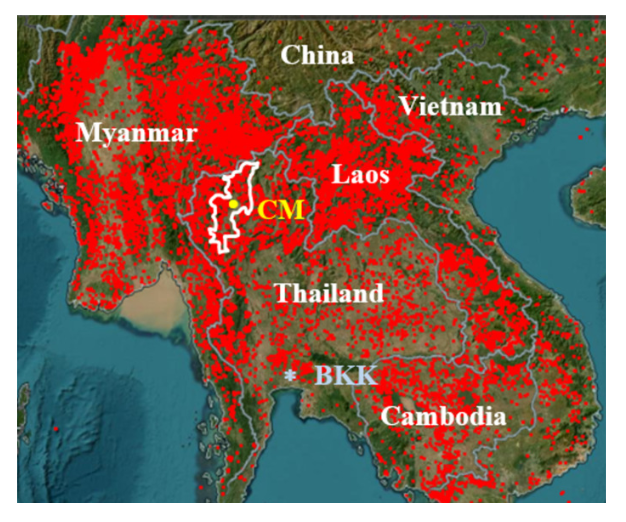
PM2.5 is a silent yet severe pollutant that accumulates in the human body, causing long-term health issues such as lung cancer. This study proposes a novel fuzzy inference system (FIS) for PM2.5 forecasting, addressing the nonlinear and dynamic nature of air pollution. Unlike complex, data-intensive black-box models, the proposed FIS is transparent, interpretable, and simple to implement. It uses only two lagged PM2.5 change rates and nine fuzzy rules for accurate prediction. The model requires no geographical or emission-source data, which are often costly and region-specific. Fuzzy rules are derived from natural PM2.5 rise-and-fall patterns, ensuring logical consistency and minimal inputs. Using data from Chiang Mai, Thailand —one of the most polluted cities —the model was benchmarked against MLR, MLP, LSTM, SVM, and Gradient Boosting. The FIS achieved up to 5% higher accuracy. Although the Diebold-Mariano test found no significant difference, FIS showed comparable robustness with 49% fewer parameters and 56% fewer FLOPs. Optimal performance occurred at three input lags and 27 fuzzy rules, balancing accuracy and complexity. Moreover, the Chiang Mai FIS generalized well to other PM2.5-affected cities —Bangkok, Jakarta, and Ho Chi Minh City—without modifications, and maintained reliability for both daily and extended hourly forecasts.
Article Details

This work is licensed under a Creative Commons Attribution-NonCommercial-NoDerivatives 4.0 International License.
References
H. Yin et al., “Global health costs of ambient PM2.5 from combustion sources: A modelling study supporting air pollution control strategies,” Lancet Planet. Health, vol. 8, no. 7, pp. e476–88, Jul. 2024.
T. Amnuaylojaroen and N. Parasin, “Perspective on Particulate Matter: From Biomass Burning to the Health Crisis in Mainland Southeast Asia,” Toxics, vol. 11, no. 7, pp. 1–14, Jul. 2023.
J. Murulitharan, “Assessing PM2.5 pollution and the role of transboundary pollution emissions across Greater Kuala Lumpur, Malaysia from 2018 to 2023,” M.S. thesis, Apollo Univ. Cambridge Repository, Cambridge, U.K., 2025. [Online]. Available: https://doi.org/10.17863/CAM.117887
K. Inlaung, C. Chotamonsak, R. Macatangay and V. Surapipith, “Assessment of Transboundary PM2.5 from Biomass Burning in Northern Thailand Using the WRF-Chem Model,” Toxics, vol. 12, no. 7, pp. 1–15, Jul. 2024.
Y. Luo, H. Wei and K. Yang, “The impact of biomass burning occurred in the Indo-China Peninsula on PM2.5 and its spatiotemporal characteristics over Yunnan Province,” Sci. Total Environ., vol. 908, pp. 168174, 2024.
J. Hong, F. Mao, Q. Min, Z. Pan, W. Wei, T. Zhang, and W. Gong, “Improved PM2.5 predictions of WRF-Chem via the integration of Himawari-8 satellite data and ground observations,” Environ. Pollut., vol. 263, p. 114451, 2020.
S. Raffuse, S. O’Neill and R. Schmidt, “A model for rapid PM. exposure estimates in wildfire conditions using routinely available data: Rapidfire v0.1.3,” Geosci. Model Dev., vol. 17, pp. 381–397, 2024.
B. T. Dinkelacker, P. G. Rivera, J. D. Marshall, P. J. Adams and S. N. Pandis, “High-resolution downscaling of source resolved PM2.5 predictions using machine learning models,” Atmos. Environ., vol. 310, p. 119967, 2023.
S. Gulati et al., “Estimating PM2.5 utilizing multiple linear regression and ANN techniques,” Sci. Rep., vol. 13, p. 22578, 2023.
H. Iftikhar, M. Qureshi, J. Zywiolek, J. L. L´opez Gonzales and O. Albalawi, “Short-term PM2.5 forecasting using a unique ensemble technique for proactive environmental management initiatives,” Front. Environ. Sci., vol. 12, p. 1442644, 2024.
T. N. T. Nguyen, T. D. Trinh, P. C. L. T. Vu and P. T. Bao, “Statistical and machine learning approaches for estimating pollution of fine particulate matter (PM2.5) in Vietnam,” J. Environ. Eng. Landsc. Manag., vol. 32, no. 4, pp. 292–304, 2024.
H. Hao, K. Wang, G. Wu, J. Liu, and J. Li, “PM2.5 concentrations based on near-surface visibility in the Northern Hemisphere from 1959 to 2022,” Earth Syst. Sci. Data, vol. 16, pp. 4051–4076, 2024.
Z. Liu, X. Huang and X. Wang, “PM2.5 prediction based on modified whale optimization algorithm and support vector regression,” Sci. Rep., vol. 14, p. 23296, 2024.
T. Istiana, B. Kurniawan, S. Soekirno, A. Wihono, D. E. Nuryanto, B. A. Pertala, and A. Sopaheluwakan, “Fine particulate matter concentration forecasting using long short-term memory network and meteorological inputs,” Glob. J. Environ. Sci. Manag., vol. 10, no. 4, pp. 1759–74, 2024.
X. Hu, J. Shi, C. He, and J. Fang, “Combined prediction model of PM2.5 concentration based on wavelet transform and LSTM,” J. Phys.: Conf. Ser., vol. 2555, p. 012009, 2023.
S. Sukprasert, H. Shimadera, S. Araki, T. Thongthammachart, P. Thanasutives, L. V. Mui, T. Matsuo, and A. Kondo, “Improving machine learning-based PM2.5 prediction by segregating biomass emission factor from chemical transport model,” E3S Web Conf., vol. 530, p. 01004, 2024.
H. M. Kim and J. M. Mendel, “Fuzzy basis functions: comparisons with other basis functions,” IEEE Trans. Fuzzy Syst., vol. 3, no. 2, pp. 158–168, May 1995.
E. Egrioglu, E. Bas, and M. Y. Chen, “A fuzzy Gaussian process regression function approach for forecasting problem,” Granul. Comput., vol. 9, p. 47, pp. 1–11, 2024.
M. Saleem, N. Shingari, M. S. Farooq, B. Mago, and M. A. Khan, “Real-time air quality monitoring model using fuzzy inference system,” Int. J. Adv. Comput. Sci. Appl., vol. 15, no. 6, pp. 838–846, Jun. 2024.
Z. N. Zulkiflee and A. Idris, “Fuzzy inference system model for air quality index prediction,” in Proc. Sci. Math., vol. 23, pp. 133–143, 2024.
F.-J. Moreno-Vazquez, F. Trujillo-Romero and A. E. Violante-Gavira, “Enhanced Fuzzy Inference System for PM10 Concentration Prediction Using Genetic Algorithms,” in Proc. 21st Int. Conf. Electr. Eng., Comput. Sci. Automat. Control (CCE), Mexico City, Mexico, pp. 1–6, 2024.
Z. S. Mousavi Fard, H. Asilian Mahabadi, F. Khajehnasiri and M. A. Rashidi, “Modeling the concentration of suspended particles by fuzzy inference system (FIS) and adaptive neuro-fuzzy inference system (ANFIS) techniques: A case study in the metro stations,” Environ. Health Eng. Manag. J., vol. 10, no. 3, pp. 311–319, Sep. 2023.
J. Saini, M. Dutta and G. Marques, “Modeling indoor PM. using Adaptive Dynamic Fuzzy Inference System Tree (ADFIST) on Internet of Things-based sensor network data,” Internet Things, vol. 20, pp. 1–13, 2022.
T. Supasri et al., “Association between ambient air particulate matter and human health impacts in northern Thailand,” Scientific Reports, vol. 13, p. 12753, pp. 1–15, 2023.
R. Wongsathan, I. Seedadan and M. Kavilkrue, “Prediction modeling of PM-10 in Chiangmai City Moat by using artificial neural networks,” Appl. Mech. Mater., vol. 781, pp. 628–631, 2015.
R. Wongsathan and I. Seedadan, “A hybrid ARIMA and neural networks model for PM-10 pollution estimation: The case of Chiang Mai City Moat area,” Procedia Comput. Sci., vol. 86, pp. 273–276, 2016.
R. Wongsathan, I. Seedadan and S. Wanasri, “Hybrid forecast models for PM-10 prediction: A case study of Chiang Mai city of Thailand during high season,” Eng. Appl. Sci. Res., vol. 43, pp. 203–206, 2016.
R. Wongsathan and S. Chankham, “Improvement on PM-10 forecast by using hybrid ARIMAX and neural networks model for the summer season in Chiang Mai,” Procedia Comput. Sci., vol. 86, pp. 277–280, 2016.
R. Wongsathan, “Improvement of PM-10 forecast using ANFIS model with an integrated hotspot,” Sci. Technol. Asia, vol. 23, no. 3, pp. 61–70, 2018.
R. Wongsathan, “PM-10 forecasting models using MLPNN with a hotspot predictor over the Upper Northern Thailand,” Sci. Technol. Asia, vol. 25, no. 4, pp. 93–105, 2020.
C. Chairungrueang and R. Wongsathan, “Forecasting the PM-10 using a deep neural network,” Songklanakarin J. Sci. Technol., vol. 43, no. 3, pp. 687–695, 2021.
R. Rakholia, Q. Le, B. Ho, K. Vu and R. Simon, “The Helthy Air Dataset: Outdoor Air Quality in Ho Chi Minh City, Vietnam,” Mendeley Data, vol. 1, 2022.
J. Chen, D. Li, G. Liu, Y. Li, A. Zhang, S. Lu and M. Zhou, “Development of a coal dust concentration sensor based on the electrostatic induction method,” ACS Omega, vol. 8, no. 13, pp. 13060–13067, 2023.
V. Rachnarong, “Performance evaluation of low cost particulate matter sensors for PM2.5 and PM10 measurement,” Engineering and Technology Horizons, vol. 40, no. 3, pp. 1–18, Sep. 2023.
F. X. Diebold and R. S. Mariano, “Comparing predictive accuracy,” J. Bus. Econ. Stat., vol. 13, no. 3, pp. 253–263, 1995.
