
AquaLink in HAB Detection: Integrating IoT and 3D-Printed PETG for Monitoring Aquaculture Conditions Conducive to HAB
Article Sidebar
Main Article Content
Abstract
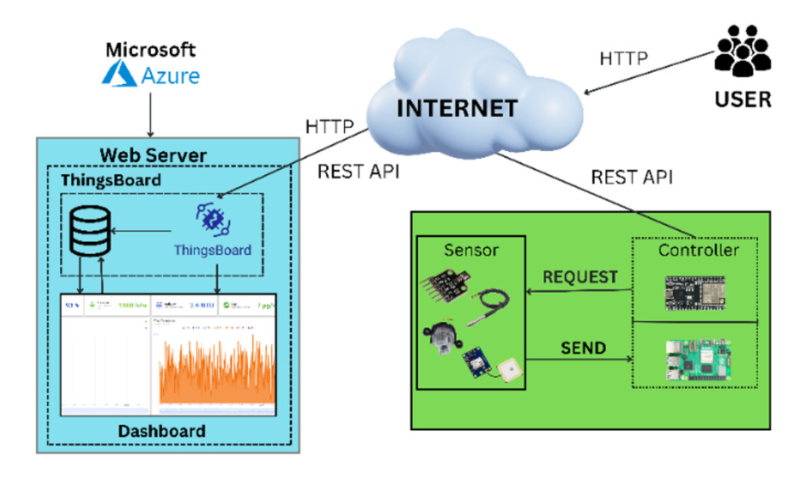
Harmful algal blooms (HABs) pose a serious threat to aquaculture and environmental health, often resulting in considerable ecological and economic impacts. Conventional water quality monitoring techniques, often manual and time-consuming, are inadequate for the timely detection of conditions that promote HAB formation. To overcome these limitations, the AquaLink system was developed by integrating the Internet of Things (IoT) technology with 3D-printed polyethylene terephthalate glycol (PETG) enclosures, enabling scalable, real-time, and cost-effective monitoring of water quality. The system employs sensors to measure essential parameters, including atmospheric pressure, temperature, and turbidity, with data transferred through Raspberry Pi and ESP32 controllers to an IoT dashboard for real-time analysis and visualisation. PETG-based casings were combined with IoT-enabled sensors to improve durability and reduce biofouling in aquatic environments. Prototypes were tested across different water bodies to validate performance under real-world conditions. The results demonstrated that the system effectively provided real-time monitoring of aquaculture environments, allowing the early identification of HAB risks through continuous tracking of water quality indicators. Beyond its technical contributions, AquaLink offers societal benefits by serving as a low-cost, efficient tool that reduces sh mortality, limits environmental degradation, and enhances food security. The flexibility and scalability of the system make it applicable to small-scale and industrial aquaculture operations, fostering sustainable practices through advanced environmental monitoring.
Article Details

This work is licensed under a Creative Commons Attribution-NonCommercial-NoDerivatives 4.0 International License.
References
C. E. Boyd, “General Relationship Between Water Quality and Aquaculture Performance in Ponds,” in Fish Diseases, Elsevier, pp. 147–166, 2017.
Md. M. Islam, M. A. Kashem and J. Uddin, “An internet of things framework for real-time aquatic environment monitoring using an Arduino and sensors,” Int. J. Electr. Comput. Eng. IJECE, vol. 12, no. 1, p. 826, Feb. 2022.
Y. Ahmed Alkhamis et al., “The Impact of Biofloc Technology on Water Quality in Aquaculture: A Systematic Meta-Analysis,” Aquac. Nutr., vol. 2023, pp. 1–20, Oct. 2023.
S.-Y. Zhang et al., “An integrated recirculating aquaculture system (RAS) for land-based fish farming: The effects on water quality and fish production,” Aquac. Eng., vol. 45, no. 3, pp. 93–102, Nov. 2011.
K. Karal Marx, A. Rathipriya, J. K. Sundaray and M. Muthu Abishag, “Water Quality Management in Aquaculture,” in Broodstock Management and Fish Seed Production, 1st ed., CRC Press, pp. 119–134, 2020.
P. M. Glibert et al., “Key Questions and Recent Research Advances on Harmful Algal Blooms in Relation to Nutrients and Eutrophication,” in Global Ecology and Oceanography of Harmful Algal Blooms, vol. 232, pp. 229–259, 2018.
T. I. McLean and G. A. Sinclair, “Harmful Algal Blooms,” in Environmental Toxicology, E. A. Laws, Ed., New York, NY: Springer New York, pp. 319–360, 2013.
V. H. Smith, G. D. Tilman and J. C. Nekola, “Eutrophication: impacts of excess nutrient inputs on freshwater, marine, and terrestrial ecosystems,” Environ. Pollut., vol. 100, no. 1–3, pp. 179–196, 1999.
D. H. Kwon et al., “Inland harmful algal blooms (HABs) modeling using internet of things (IoT) system and deep learning,” Environ. Eng. Res., vol. 28, no. 1, pp. 210280–0, Jan. 2022.
J. Gubbi, R. Buyya, S. Marusic and M. Palaniswami, “Internet of Things (IoT): A vision, architectural elements, and future directions,” Future Gener. Comput. Syst., vol. 29, no. 7, pp. 1645–1660, Sep. 2013.
Laird Plastics, PETG: For innovation in design and manufacturing. [Online]. Available: https://lairdplastics.com/resources/petg-for-innovation-in-design-and-manufacturing/. [Accessed: Sep. 25, 2024].
PrintaGuide, PETG filament: Everything you need to know. [Online]. Available: https://printaguide.com/petg-filament-everything-you-need-to-know/. [Accessed: Sep. 25, 2024].
A. H. Annas, A. A. Zainuddin, A. ‘. A. Hussin, N. N. M. S. N. M. Kamal, N. M. Noor and R. M. Razali, “Cloud-Based IoT System for RealTime Harmful Algal Bloom Monitoring: Seamless ThingsBoard Integration via MQTT and REST API,” 2024 IEEE 22nd Student Conference on Research and Development (SCOReD), Selangor, Malaysia, pp. 317-322, 2024.
Syazwan Izharuddin Mohamad Sabri, Norazlianie Sazali, Ahmad Shahir Jamaludin, Wan Sharuzi Wan Harun, Kumaran Kadirgama and Devarajan Ramasamy, “Investigation on Water Quality for Farmed Aquatic Species by IoT Monitoring System,” J. Adv. Res. Appl. Sci. Eng. Technol., vol. 31, no. 3, pp. 317–327, Aug. 2023.
G. Holcomb, E. B. Caldona, X. Cheng and R. C. Advincula, “On the optimized 3D printing and post-processing of PETG materials,” MRS Commun., vol. 12, no. 3, pp. 381–387, Jun. 2022.
A. Bachri, “Freshwater Monitoring System Design In Real-Time For Fish Cultivation,” Int. J. Multidiscip. Approach Res. Sci., vol. 2, no. 01, pp. 362–371, Dec. 2023.
M. K. Ch, M. S. K. Munaga, C. S. Kolli and S. K. Maddila, “Real-Time Water Quality Tracking and Alert System with IoT Integration,” 2023 3rd International Conference on Pervasive Computing and Social Networking (ICPCSN), Salem, India, pp. 1013-1018, 2023.
S. D. R. Pahri, A. F. Mohamed and A. Samat, “LCA for open systems: a review of the influence of natural and anthropogenic factors on aquaculture systems,” Int. J. Life Cycle Assess., vol. 20, no. 9, pp. 1324–1337, Sep. 2015.
A. R. Ives and S. R. Carpenter, “Stability and Diversity of Ecosystems,” Science, vol. 317, no. 5834, pp. 58–62, Jul. 2007.
A. Kalkal et al., “Recent advances in 3D printing technologies for wearable (bio)sensors,” Addit. Manuf., vol. 46, p. 102088, Oct. 2021.
J. Z. Gul, M. Khan, M. M. Rehman, Z. Mohy Ud Din and W. Y. Kim, “Preparation and Performance Analysis of 3D Thermoformed Fluidic Polymer Temperature Sensors for Aquatic and Terrestrial Applications,” Sensors, vol. 23, no. 20, p. 8506, Oct. 2023.
A. Delgado et al., “Assessment of biofouling on typical marine sensors materials,” OCEANS 2023 Limerick, Limerick, Ireland, pp. 1-8, 2023.
R. K. Upadhyay, A. K. Mishra and A. Kumar, “Mechanical Degradation of 3D Printed PLA in Simulated Marine Environment,” Surf. Interfaces, vol. 21, p. 100778, Dec. 2020.
J. R. Rocca-Smith et al., “Effect of the state of water and relative humidity on ageing of PLA films,” Food Chem., vol. 236, pp. 109–119, Dec. 2017.
S. Chopra et al., “Explication of mechanism governing atmospheric degradation of 3D-printed poly(lactic acid) (PLA) with different in-fill pattern and varying in-fill density,” RSC Adv., vol. 13, no. 11, pp. 7135–7152, 2023.
FacFox, What is PETG? (Everything you need to know). [Online]. Available: https://facfox.com/docs/kb/what-is-petg-everything-you-need-to-know. [Accessed: Sep. 25, 2024].
M. Davies, Is PETG UV (ultraviolet) resistant? (Solved!). 3D Print Beast. [Online]. Available:https://www.3dprintbeast.com/petg-uv-resistance/. [Accessed: Sep. 25, 2024].
TWI Global, What is PETG? (Everything you need to know). [Online]. Available: https:// www.twi-global.com/technical-knowledge/faqs/what-is-petg.aspx. [Accessed: Sep. 25, 2024].
3D Printing Spot, Is PETG food safe? What you must know about this material. [Online]. Available: https://www.3dprintingspot.com/post/is-petg-food-safe-what-you-must-know-about-this-material. [Accessed: Sep. 25, 2024].
