
Designing a Two-Stream Network Based Unsupervised Learning for Skin Cancer Recognition
Article Sidebar
Main Article Content
Abstract
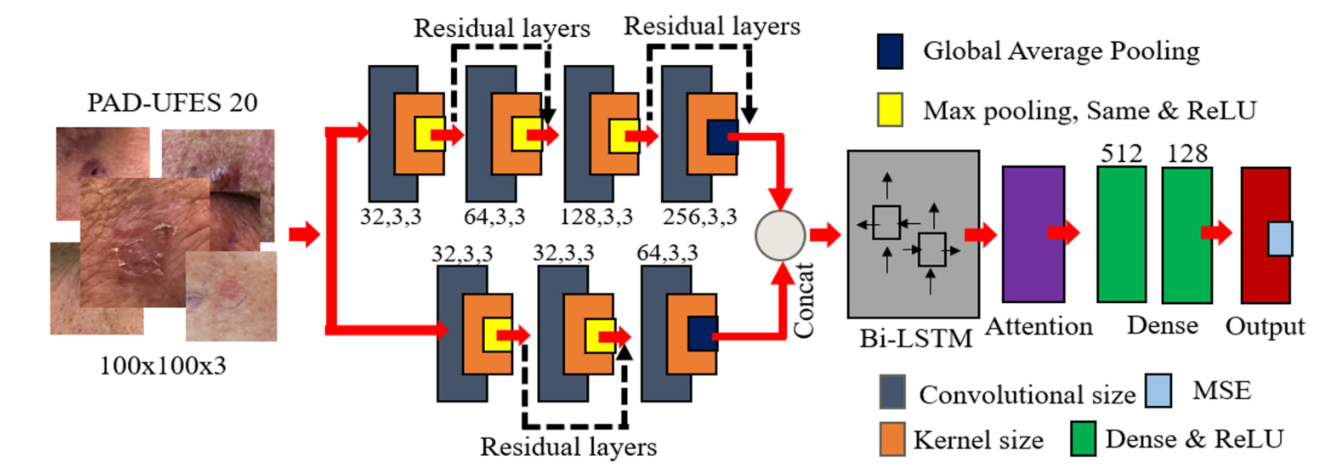
Computer vision is crucial in identifying and diagnosing diseases like skin cancer, which can become life-threatening if not detected early. Although numerous methods have been developed, these techniques often face challenges due to the varied nature of skin cancer, which frequently presents irregular shapes and ambiguous structures. In this study, we introduce the design of an unsupervised two-stream network capable of simultaneously learning from datasets of various sizes. The network parameters are organized from smallest to largest to improve the efficiency of feature extraction. Additionally, the network incorporates residual blocks, bidi- rectional long short-term memory, and an attention layer to help reduce training loss. The proposed method was tested using the PAD-UFES-20 dataset, using mean square error to measure training loss and accuracy to check how well it recognizes skin cancer. The results showed a loss of 0.0079 and a training time of only 0.53 minutes, performing better than other advanced methods in both loss and speed. Our approach showed better results than previous methods, accurately recognizing skin cancer and showing potential for use in a mobile app to help with early detection and diagnosis.
Article Details

This work is licensed under a Creative Commons Attribution-NonCommercial-NoDerivatives 4.0 International License.
References
O. Y. Carrasquillo, J. Lambert and B. G. Merritt, “Comment on ”Disparities in nonmelanoma skin cancer in Hispanic/Latino patients based on Mohs micrographic surgery defect size: A multicenter retrospective study,” Journal of the American Academy of Dermatology, vol. 87, no. 4, pp. e129-e130, 2022.
E. Rezk, M. Eltorki and W. El-Dakhakhni, “Human knowledge-based artificial intelligence methods for skin cancer management: Accuracy and interpretability study,” Smart Health, vol. 36, Art. no. 100540, 2025.
L. L. Locurcio, M. Breen and J. Haq, “Can a Single-Stage Approach Using a Dermal Regeneration Template Lead to Satisfactory Scalp Defect Reconstruction After Skin Cancer Excision?,” Journal of Oral and Maxillofacial Surger, vol. 82, no. 3, pp. 341-346, 2024. 465
A. Imran, A. Nasir, M. Bilal, G. Sun, A. Alzahrani, A. Almuhaimeed, “Skin Cancer Detection Using Combined Decision of Deep Learners,” in IEEE Access, vol.10, pp. 118198 – 118212, 2022.
W. K. Mridha, M. M. Uddin, J. Shin, S. Khadka and M. F. Mridha, “An Interpretable Skin Cancer Classification Using Optimized Convolutional Neural Network for a Smart Healthcare System,” in IEEE Access, vol. 11, pp. 41003 – 41018, 2023.
O. Akinrinade and C. Du, “Skin cancer detection using deep machine learning techniques,” Intelligence-Based Medicine, vol. 11, Art. no. 100191, 2025.
M. Subramanian, J. Cho, V. E. Sathishkumar and O. S. Naren, “Multiple Types of Cancer Classification Using CT/MRI Images Based on Learning Without Forgetting Powered Deep Learning Models,” in IEEE Access, vol. 31, pp. 10336 10354, 2023.
A. Strittmatter and F. G. Z¨ollner, “Multistep Networks for Deformable Multimodal Medical Image Registration,” in IEEE Access, vol. 12, pp. 82676 82692, 2024.
S. Pohtongkam and J. Srinonchat, “Object Recognition for Humanoid Robots Using Full Hand Tactile Sensor,” in IEEE Access, vol. 11, pp. 20284-20297, 2023.
T. Kaewrakmuk and J. Srinonchat, “MultiSensor Data Fusion and Time Series to Image Encoding for Hardness Recognition,” IEEE Sensors Journal, vol. 24, Issue: 16, pp. 26463 – 26471, 2024.
C. Chansri and J. Srinonchat, “Enhance Egocentric Grasp Recognition Based Flex Sensor Under Low Illumination,” Computers, Materials and Continua, vol. 71, No.3, pp. 4377-4389, 2022, DOI:10.32604/cmc.2022.024026
J. Chaki and A. U¸car, “An Efficient and Robust Approach Using Inductive Transfer-Based Ensemble Deep Neural Networks for Kidney Stone Detection,” IEEE Access, pp. 32894 32910, 2024.
S. M. M. Elkholy, A. Rezk and A. A. E. F. Saleh, “Early Prediction of Chronic Kidney Disease Using Deep Belief Network,” in IEEE Access, vol. 9, pp. 135542 – 135549, 2021.
S. D. Pande and R. Agarwal, “Multi-Class Kidney Abnormalities Detecting Novel System Through Computed Tomography,” in IEEE Access, vol. 12, pp. 21147 – 21155, 2024.
F. L. Tiro, V. Estrade, J. Hubert, D. F. Araiza, M. G. Mendoza and G. Ochoa, “On the In Vivo Recognition of Kidney Stones Using Machine Learning,” in IEEE Access, vol. 12, pp. 10736 – 10759, 2024.
R. Magherini, M. Servi, Y. Volpe, R. Campi and F. Buonamici, “Distinguishing Kidney Tumor Types Using Radiomics Features and Deep Features,” in IEEE Access, vol. 12, pp. 84241 – 84252, 2024.
R. Gaikar, A. Azad, N. Schieda and E. Ukwatta, “Fully Automated Deep Learning-Based Renal Mass Detection on Multi-Parametric MRI,” in IEEE Access, vol. 12, pp. 112714 – 112728, 2024.
A. Prommakhot and J. Srinonchat, “VGGNet Integration for Kidney Tumor Classification,” International Electrical Engineering Congress (iEECON), Pattaya, Thailand, Mar. 06-08, 2024.
M. I. Faizi and S. M. Adnan, “Improved Segmentation Model for Melanoma Lesion Detection Using Normalized Cross-Correlation-Based k-Means Clustering,” in IEEE Access, vol. 12, pp. 20753 – 20766, 2024.
Z. Lan, S. Cai, X. He and X. Wen, “FixCaps: An Improved Capsules Network for Diagnosis of Skin Cancer,” IEEE Access, vol. 10, pp. 76261 – 76267, 2022.
L. Wei, K. Ding and H. Hu, “Automatic Skin Cancer Detection in Dermoscopy Images Based on Ensemble Lightweight Deep Learning Network,” in IEEE Access, vol. 8, pp. 99633 – 99647, 2020.
N. Q. Nguyen and S. W. Lee, “Robust Boundary Segmentation in Medical Images Using a Consecutive Deep Encoder-Decoder Network,” in IEEE Access, vol. 7, pp. 33795 – 33808, 2019.
P. A. Lyakhov, U. A. Lyakhova and D. I. Kalita, “Multimodal Analysis of Unbalanced Dermatological Data for Skin Cancer Recognition,” in IEEE Access, vol. 11, pp. 131487 – 131507, 2023.
S. S. Zareen, G. Sun, M. Kundi, S. F. Qadri and S. Qadri, “Enhancing Skin Cancer Diagnosis with Deep Learning: A Hybrid CNN-RNN Approach,” Computers, Materials and Continua, vol. 79, no. 1, pp. 1497-1519, 2024.
C. Kavitha, S. Priyanka, M. Praveen Kumar and V. Kusuma, “Skin Cancer Detection and Classification using Deep Learning Techniques,” Procedia Computer Science, vol. 235, pp. 2793-2802, 2024.
J. S. T. Purni and R. Vedhapriyavadhana, “EOSA-Net: A deep learning framework for enhanced multi-class skin cancer classification using optimized convolutional neural networks,” Journal of King Saud University Computer and Information Sciences, vol. 36, no. 3, Art. No. 102007, 2024.
M. S. Ali, M. S. Miah, J. Haque, M. M. Rahman and M. K. Islam, “An enhanced technique of skin cancer classification using deep convolutional neural network with transfer learning models,” Machine Learning with Applications, vol. 5, Art. No. Art. No. 100036, 2021.
E. S. Rahayu, E. M. Yuniarno, I. K. E. Purnama and M. H. Purnomo, “A combination model of shifting joint angle changes with 3Ddeep convolutional neural network to recognize human activity,” IEEE Transactions on Neural Systems and Rehabilitation Engineering, vol. 32, pp. 1078–1089, 2024.
A. Prommakhot and J. Srinonchat, “Scaled Dilation of DropBlock Optimization in Convolutional Neural Network for Fungus Classification,” Computers, Materials and Continua, vol.72, No.2, pp. 3313-3329, 2022.
S. Yaemprayoon and J. Srinonchat, “Exploring CNN Model with Inrush Current Pattern for Non-Intrusive Load Monitoring,” Computers, Materials and Continua, vol.73, No.2, pp. 36673684, 2022.
A. Prommakhot and J. Srinonchat, “Combining Convolutional Neural Networks for Fungi Classification,” in IEEE Access, Vol. 12, pp. 5802158030, 2024.
C. Chansri and J. Srinonchat, “Utilizing Gramian Angular Fields and Convolution Neural Networks in Flex Sensors Glove for Human–Computer Interaction,” IEEE Transactions on Human-Machine Systems, Vol. 54, Issue: 4, pp. 475 – 483, 2024.
G. Xu, X. Wang, X. Wu, X. Leng and Y. Xu, “Development of residual learning in deep neural networks for computer vision: A survey,” Engineering Applications of Artificial Intelligence, vol. 142, Art. no. 109890, 2025.
J. Zhu, M. A. A. Al-qaness, D. AL-Alimi, H. Z. Tao and S. H. Alsamhi, “Multiple lung diseases detection using advanced deep learning model with attention mechanisms and upsampling features,” Engineering Applications of Artificial Intelligence, vol. 156, Art. no. 111038, 2025.
D. Haritha, N. Satyavani and A. Ramesh, “Generation of missing well log data with deep learning: CNN-Bi-LSTM approach,” Journal of Applied Geophysics, vol. 233, Art. no. 105628, 2025.
H. Ye, B. Cao, Z. Peng, T. Chen, Y. Wen and J. Liu, “Web Services Classification Based on Wide & Bi-LSTM Model,” in IEEE Access, vol. 7, pp. 43697-43706, 2019.
A. G. Pacheco et al., “PAD-UFES-20: A skin lesion dataset composed of patient data and clinical images collected from smartphones,” Data in Brief, vol. 32, Art. No. 106221, 2020. [online] https://www.kaggle.com/datasets/mahdavi1202/skin-cancer/data.
A. Barbadekar, V. Ashtekar and A. Chaudhari, “Skin Cancer Classification and Detection Using VGG-19 and DesNet,” International Conference on Computational Intelligence, Networks and Security (ICCINS), Mylavaram, India, 2023.
E. Firasari, N. Khasanah, F. L. D. Cahyanti, D. N. Kholifah, U. Khultsum and F. Sarasati, “Performance Evaluation of ResNet50 and MobileNetV2 in Skin Cancer Image Classification with Various Optimizers,” International Conference on Information Technology Research and Innovation (ICITRI), Jakarta, Indonesia, 2024.
S. S. Reka, H. L. Karthikeyan, A. J. Shakil, P. Venugopal and M. Muniraj, “Exploring Quantum Machine Learning for Enhanced Skin Lesion Classification: A Comparative Study of Implementation Methods,” in IEEE Access, vol. 12, pp. 104568 – 104584, 2024.
V. D. Hoang, X. T. Vo and K. H. Jo, “Categorical Weighting Domination for Imbalanced Classification With Skin Cancer in Intelligent Healthcare Systems,” in IEEE Access, vol. 12, pp. 105170 – 105181, 2023.
M. A. Rasel, U. H. Obaidellah and S. A. Kareem, “Convolutional Neural Network-Based Skin Lesion Classification With Variable Nonlinear Activation Functions,” in IEEE Access, vol. 10, pp. 83398-83414, 2022.
Q. -J. Lv, H. Y. Chen, W. B. Zhong, Y. Y. Wang, J. Y. Song and S. D. Guo, “A Multi-Task Group Bi-LSTM Networks Application on Electrocardiogram Classification,” in IEEE Journal of Translational Engineering in Health and Medicine, vol. 8, Art. No. 1900111, 2019.
H. Guo, H. Bai and W. Qin, “ClouDet: A Dilated Separable CNN-Based Cloud Detection Framework for Remote Sensing Imagery,” IEEE Journal of Selected Topics in Applied Earth Observations and Remote Sensing, vol. 14, pp. 9743 – 9755, 2021.
C. Aliferis and G. Simon, “Overfitting, Underfitting and General Model Overconfidence and Under-Performance: Pitfalls and Best Practices in Machine Learning and AI,” Artificial Intelligence and Machine Learning in Health Care and Medical Research, Springer, vol. 10, pp. 123-145, 2023.
J. Yeomans, S. Thwaites, W. S. P. Robertson, D. Booth, B. Ng and D. Thewlis, “Simulating Time-Series Data for Improved Deep Neural Network Performance,” in IEEE Access, vol. 7, pp. 131248-131255, 2019
