Quantum State Estimation of a Qubit Using Adaptive Measurements
Article Sidebar
Main Article Content
บทคัดย่อ
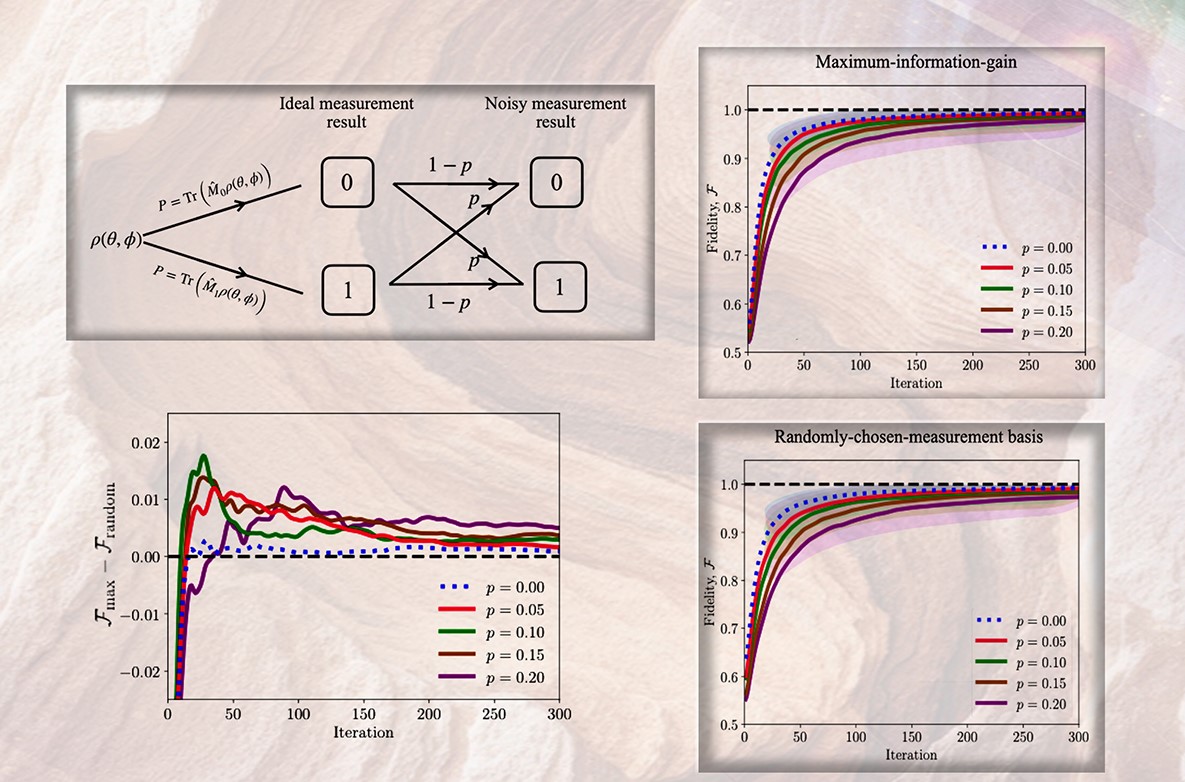
Quantum state estimation is one of the most extensively studied topics in the field of quantum theory and quantum information. This process is essential in quantum protocols to ensure that the estimated state matches the true state. Typically, the quantum state of identical systems can be estimated from the statistics of measurement outcomes across different measurement bases. In this research, we study adaptive-measurement strategies for quantum state estimation used to identify a pure state of two-level systems and compare the obtained estimated state to the state obtained when the measurement bases are chosen randomly. The adaptive measurements in this study include the maximum-information-gain strategy, and the confirmation strategy. In this work, we simulate the outcome of the measurement on a system and use the Bayesian estimation method to estimate the obtained state. We then adaptively change the basis of the next measurement in accordance with the estimated state and the used adaptive strategy. We find that the maximum-information-gain strategy provides the fastest convergence and the most accurate state estimation compared to the confirmation strategy and the randomly-chosen-measurement-basis strategy, especially in the presence of measurement noise.
Keywords: Quantum state estimation, State tomography, Adaptive measurements
