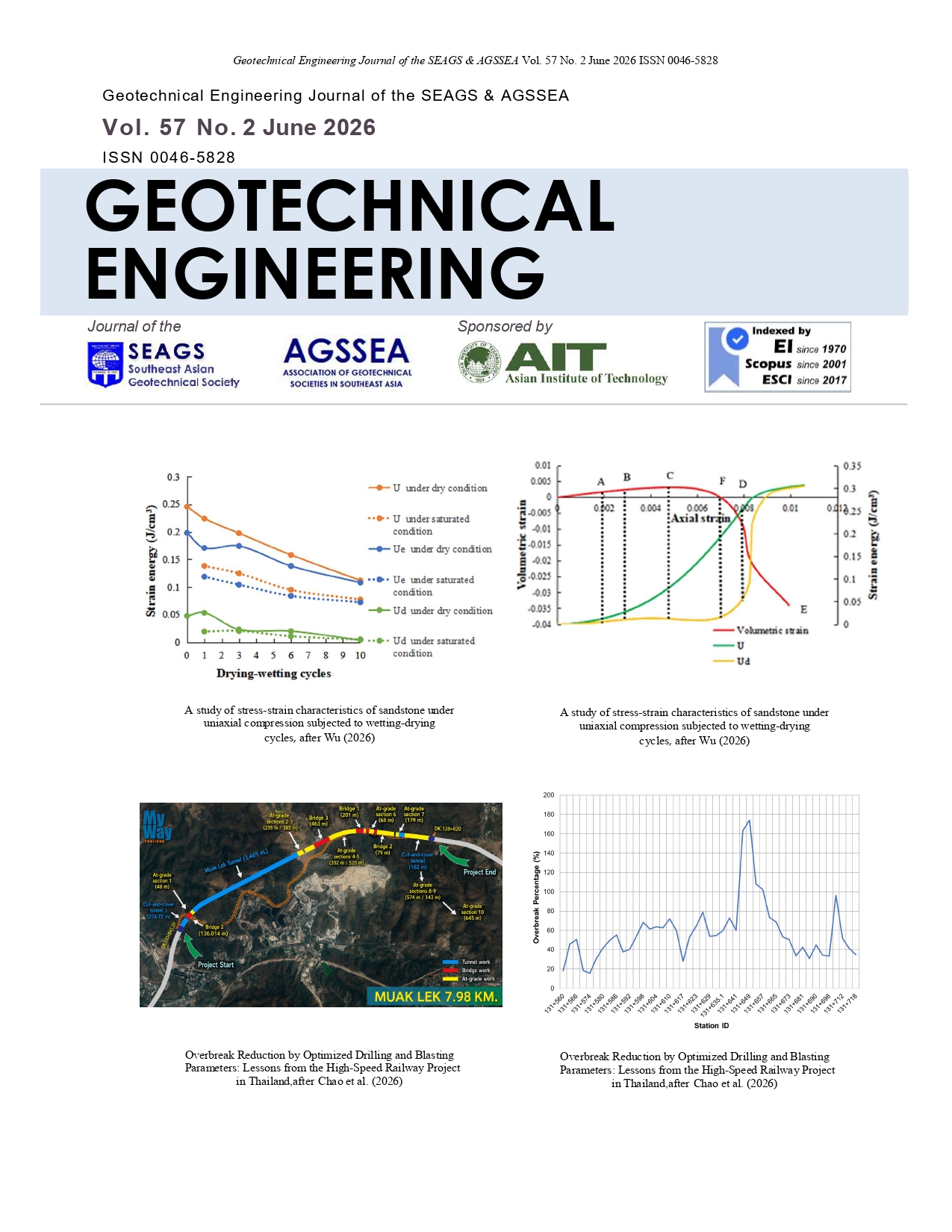
Overbreak Reduction by Optimized Drilling and Blasting Parameters: Lessons from the High-Speed Railway Project in Thailand
Article Sidebar
Main Article Content
Abstract
This study investigates practical measures to reduce overbreak in drill-and-blast tunnel excavation using the New Austrian Tunneling Method (NATM). The project data from the Muak Lek tunnel section of the High-Speed Railway Project in Thailand was collected and analyzed in the study. Initial field observations revealed that Class IV rock conditions in the study area exhibited an average overbreak of approximately 30%, which significantly exceeded the allowable limits. A nearby double-track railway tunnel with similar rock conditions recorded lower overbreak values (11.7 – 14.0% across rock classes II – IV). Based on these findings and the authors’ experience, an optimized blasting approach was developed involving reduced drill hole length, lowered powder factor, precise hole alignment, and smooth blasting with small emulsion charges and detonating cord. A field test was conducted to assess the effectiveness of the proposed approach in a selected Class IV rock section. In nearby sections at the test site, the percent overbreak values were 51.6% and 41.1%, while the improved section achieved a reduced overbreak of 9.3% after applying the proposed approach. The results confirm that adjusting drilling and blasting parameters to site and construction conditions can significantly improve excavation control, offering practical measures for similar NATM tunnel projects.
Article Details

This work is licensed under a Creative Commons Attribution-NonCommercial-NoDerivatives 4.0 International License.
Copyright © 2019 Association of Geotechnical Societies in Southeast Asia (AGSSEA) - Southeast Asian Geotechnical Society (SEAGS).
