A systematic Literature Review on Mobile Application Development for Children with Autism Spectrum Disorder (ASD)
Keywords:
Autism Spectrum Disorder (ASD), Mobile Applications Development, Early Intervention, Assistive Technology, User-Centered Design (UCD)Abstract
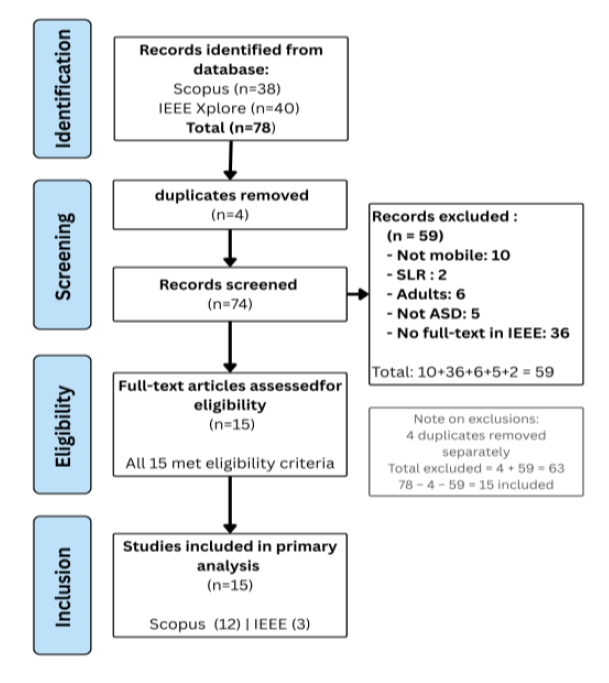
Mobile applications are increasingly used to support children with autism spectrum disorder (ASD). This systematic literature review analyzed studies published between 2018 and 2025 on mobile app development for children with ASD. Using PRISMA guidelines, 78 records were identified from Scopus and IEEE Xplore databases, and 15 met the inclusion criteria. Study quality was evaluated using the CASP checklist, with 47% (7/15) achieving high quality scores. The findings showed geographic diversity, with many studies conducted in Asia, and varied methodological quality. Several design approaches were used, including User-Centered Design, Applied Behavior Analysis, TEACCH, gamification, and artificial intelligence. Intervention-based studies reported positive outcomes in communication, emotional regulation, daily living skills, and user engagement. However, many studies relied on small sample sizes and short testing periods, limiting generalizability. Applications combining multiple therapeutic and design approaches demonstrated higher usability and effectiveness than single-method systems, with usability scores reaching up to 97/100. This review provides evidence-based guidance for researchers, developers, and clinicians working to advance mobile interventions for children with ASD.
References
American Psychiatric Association. (2013). Diagnostic and statistical manual of mental disorders, 5th ed., American Psychiatric Publishing.
Arbaoui, F. E. Z., Hari, K. E., & Saidi, R. (2024). Enhancing communication for people with autism through the design of a context-aware mobile application for PECS. Journal of ICT Standardization, 12(3), 243–270. https://doi.org/10.13052/jicts2245-800X.1231
Bir, V., Bhatt, A., Chauhan, S., Poonam, & Tanwar, (2023). Design and Development of Application for Children Suffering from Autism Spectrum Disorder using Machine Learning. In Proceedings of the 2023 International Conference on Advances in Computation, Communication and Information Technology. pp. 772-777. https://ieeexplore.ieee.org/document/10466085
Castellanos, A., Liu , C., & Shi, C. (2022). Deep mobile linguistic analysis for children with autism spectrum disorder. Int. J. Environ. Res. Public Health 2022, 19(19), 12857.
Chinchay, Y., Collazos, C. A., Gomez, J., & Montoro, G. (2024). Designing learning technologies: Assessing attention in children with autism through a single case study. IEEE Transactions on Learning Technologies, 17, 2118–2128. https://doi.org/10.1109/TLT.2024.3475741
Chistol, M., Turcu, C., & Danubianu, M. (2023). Autism Assistant: A platform for autism home-based therapeutic intervention. IEEE Access, 11, 94188–94204. https://doi.org/10.1109/ACCESS.2023.3310397
Concepción, D., Munoz, L., Villarreal, V., & Pardo, C. (2022). A systematic review of the use of mobile applications and augmented reality for the education of children with Autism Spectrum Disorder (ASD). In 2022 V Congreso Internacional en Inteligencia Ambiental, Ingeniería de Software y Salud Electrónica y Móvil (AmITIC). https://ieeexplore.ieee.org/document/9941308
Critical Appraisal Skills Programme. (2018). CASP Qualitative Studies Checklist. https://casp-uk.net/casp-tools-checklists/qualitative-studies-checklist/
Deeon, J. (2025). Kids on the autism spectrum in Thailand. Bangkok Mothers & Babies International. Retrieved October 9, 2025, from https://www.bambiweb.org/news/kids-autism-spectrum-thailand
Falagas, M. E., Pitsouni, E. I., Malietzis, G. A., & Pappas, G. (2008). Comparison of PubMed, Scopus, Web of Science, and Google Scholar: Strengths and weaknesses. FASEB Journal, 22(2), 338–342. https://doi.org/10.1096/fj.07-9492LSF
Hussain, S., Ullah, S., Khan, M. A., & Kim, H. (2023). A support system for autistic children using IoT technology. International Journal for Advanced Research in Science & Technology, 13(5), 145-148.https://www.ijarst.in/public/uploads/paper/150751684148831.pdf
Kalantarian, H., Jedoui, K., Washington, P., Tariq, Q., Dunlap, K., Schwartz, J., & Wall, D. P. (2019). Labeling images with facial emotion and the potential for pediatric healthcare. Artificial Intelligence in Medicine, 98, 77-86. https://doi.org/10.1016/j.artmed.2019.06.004
Laubscher, E., Light, J., & McNaughton, D. (2019). Effect of an application with video visual scene displays on communication during play: Pilot study of a child with autism spectrum disorder and a peer. Augmentative and Alternative Communication, 35(4), 299-309. https://doi.org/10.1080/07434618.2019.1699160
Liu, X., Zhao, W., Qi, Q., & Luo, X. (2023). A survey on autism care, diagnosis, and intervention based on mobile apps: Focusing on usability and software design. Sensors, 23(14), Article 6260. https://doi.org/10.3390/s23146260
Maenner, M. J., Warren, Z., Williams, A. R., Amoakohene, E., Bakian, A. V., Bilder, D. A., & Shaw, K. A. (2023). Prevalence and characteristics of autism spectrum disorder among children aged 8 years Autism and Developmental Disabilities Monitoring Network, 11 sites, United States, 2020. MMWR Surveillance Summaries, 72(2), 1–14. https://doi.org/10.15585/mmwr.ss7202a1
Mahmoudi, E., Yoo, P. Y., Chandra, A., Cardoso, R., Dos Santos, C. D., Majnemer, A., & Shikako, K. (2024). Gamification in mobile applications for children with disabilities: A scoping review. JMIR Serious Games, 12, Article e49029. https://doi.org/10.2196/49029
Moher, D., Liberati, A., Tetzlaff, J., Altman, D. G., & PRISMA Group. (2009). Preferred reporting items for systematic reviews and meta-analyses: The PRISMA statement. Annals of Internal Medicine, 151(4), 264-269. https://doi.org/10.7326/0003-4819-151-4-200908180-00135
Mongeon, P., & Paul-Hus, A. (2016). The journal coverage of Web of Science and Scopus: A comparative analysis. Scientometrics, 106(1), 213–228. https://doi.org/10.1007/s11192-015-1765-5
Mruzek, D. W., McAleavey, S., Loring, W., Butter, E., Smith, T., McDonnell, E., Levato, L., Aponte, C., Travis, R., Aiello, R., Taylor, C., Wilkins, J., Corbett-Dick, P., Finkelstein, D., York, A., & Zanibbi, K. (2019). A pilot investigation of an iOS-based app for toilet training children with autism spectrum disorder. Behavioral Interventions, 32(1), 19-30. https://doi.org/10.1177/
Purnama, Y., Herman, F., Hartono, J., Neilsen., Suryani, D. & Sanjaya, G. (2021). Educational software as assistive technologies for children with autism spectrum disorder. Procedia Computer Science, 179, 6-16. https://doi.org/10.1016/j.procs.2020.12.002
Rojas, G., & Chavarriaga, J. (2023). A mobile application to dynamically design activities to promote personal autonomy in children with autism spectrum disorder: A usability evaluation. In A. Coman & S. Vasilache (Eds.), Social computing and social media. pp. 269-282. https://doi.org/10.1007/978-3-031-35927-9_19
Shminan, A. S., Choi, L. J., & Sharif, S. (2020). AutiTEACCH: Mobile-based learning in a structured teaching approach for autistic children caregivers. In Proceedings of the 2020 International Conference on Informatics, Multimedia, Cyber and Information System (ICIMCIS). pp. 259-264. https://doi.org/10.1109/ICIMCIS51567.2020.9354288
The Place for Children with Autism. (n.d.). The 3 levels of autism: Diagnosing autism. Retrieved October 9, 2025, from https://theplaceforchildren withautism.com/diagnosing-autism/the-three-levels-of-autism
Xu, Z., Zhao, Y., Wang, J., Chang, J., & Zhang, Y. (2025). Framework for adaptive multimodal serious games for early intervention of autistic children. Journal of Educational Technology Development and Exchange, 18(1), 1-24. https://doi.org/10.1016/j.vrih.2025.08.002
Yap, C. Y., Ng, K. H., Cheah, Y., Lim, S. Y. Price, J., & Vries, M. D. (2019). App4autism: An integrated assistive technology with heart rate monitoring for children with autism. In A. A. Bakar, H. Haron, & L. S. Teoh (Eds.), Visual informatics: Bridging research and practice. pp. 485-497. https://doi.org/10.1007/978-3-030-34032-2_44
Zamry, A. A., Abdullah, M. H. L., & Zakaria, M. H. (2022). A guideline for designing mobile applications for children with autism within religious boundaries. International Journal of Advanced Computer Science and Applications, 13(11), 264-271.
Downloads
Published
Issue
Section
Categories
License
Copyright (c) 2026 Journal of Applied Science and Emerging Technology

This work is licensed under a Creative Commons Attribution-NonCommercial-NoDerivatives 4.0 International License.


