Random Forest Algorithm Applications in Studying Children Under-five: Systematic Literature Review (SLR)
Keywords:
Systematic Literature Review, Random Forest, Under-five children, Risk prediction, Model validationAbstract
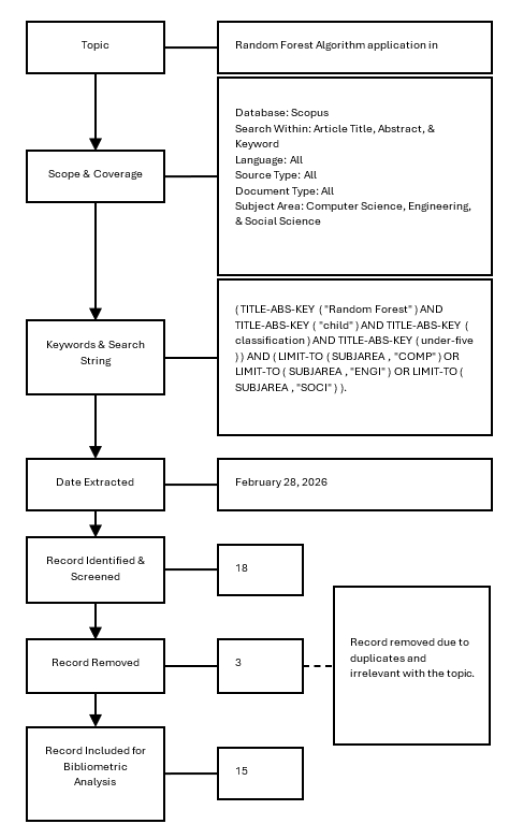
Effective monitoring of health and development in children under five is essential for timely detection, informed clinical decision-making, and cost-effective public health action. Recent advances in machine learning have expanded the potential of under-five monitoring systems, particularly for early screening, population-level risk prediction, and determinant-oriented surveillance. This paper presents a systematic literature review of Random Forest and closely related modelling practices in under-five monitoring, with attention to both opportunities and methodological constraints. The review identified 15 eligible studies, covering applications in respiratory infection monitoring, malaria risk prediction, nutrition and growth surveillance, and developmental assessment, drawing on national survey microdata, clinical records, and imaging or audio modalities. The review concludes by outlining implications for researchers, practitioners, and educators, and by highlighting priorities for stronger evidence—particularly external validation, transparent leakage safeguards, and evaluation aligned with clinical purpose.
References
Brindha, M., Maheswari, S., Vidhyabharathi, S., & Yaspe Francis, M. V. (2024). Utilizing Random Forest to Diagnose Pneumonia in Children. 2024 3rd International Conference on Artificial Intelligence for Internet of Things, AIIoT 2024, (AIIoT), 1–6. https://doi.org/10.1109/AIIoT58432.2024.10574685
Ehtesham, A., Singh, A., Kumar, S., & Khoei, T. T. (2025). Early Detection of Pediatric Pneumonia Using Google’s HeAR Model: A Respiratory Sound Embedding Approach. 2025 IEEE 6th Annual World AI IoT Congress, AIIoT 2025, 185–191. https://doi.org/10.1109/AIIoT65859.2025.11105317
Falagas, M. E., Pitsouni, E. I., Malietzis, G. A., & Pappas, G. (2008). Comparison of PubMed, Scopus, Web of Science, and Google Scholar: Strengths and weaknesses. FASEB Journal, 22(2), 338–342. https://doi.org/10.1096/fj.07-9492LSF
Fenta, H. M., Zewotir, T., & Muluneh, E. K. (2021). A machine learning classifier approach for identifying the determinants of under-five child undernutrition in Ethiopian administrative zones. BMC Medical Informatics and Decision Making, 21(1), 1–12. https://doi.org/10.1186/s12911-021-01652-1
Hasan, M. N., Emon Prodhan, M., Alam, A., Sultana, S., Rahman, M., & Parvin, H. (2024). A Comparative Study of Machine Learning Algorithms in Predicting Acute Respiratory Infection of Under-Five Children in Bangladesh Using Imbalanced Data. 2024 IEEE International Conference on Biomedical Engineering, Computer and Information Technology for Health, BECITHCON 2024, (November), 274–278. https://doi.org/10.1109/BECITHCON64160.2024.10962602
Hossain, M. I., Haq, I., Talukder, A., Suraiya, S., Rahman, M., Saleheen, A. A. S., Methun, M. I. H., Habib, M. J., Hossain, M. S., Nayan, M. I. H., & Hussain, S. (2023). Performance Evaluation of Machine Learning-Based Algorithms to Predict the Early Childhood Development Among Under Five Children in Bangladesh. Journal of Computer Science, 19(5), 641–653. https://doi.org/10.3844/jcssp.2023.641.653
Husaini, A., Hoeronis, I., Lumana, H. H., & Puspareni, L. D. (2023). Early Detection of Stunting in Toddlers Based on Ensemble Machine Learning in Purbaratu Tasikmalaya. Jurnal Sistem Dan Teknologi Informasi (JustIN), 11(3), 487. https://doi.org/10.26418/justin.v11i3.66465
Islam, M., Usman, M., Mahmood, A., Abbasi, A. A., & Song, O. Y. (2020). Predictive analytics framework for accurate estimation of child mortality rates for Internet of Things enabled smart healthcare systems. International Journal of Distributed Sensor Networks, 16(5). https://doi.org/10.1177/1550147720928897
Maasthi, M. J., Gururaj, H. L., Ravi, V., D, B., Almeshari, M., & Alzamil, Y. (2023). Decision-making Support System for Predicting and Eliminating Malnutrition and Anemia. The Open Bioinformatics Journal, 16(1), 1–11. https://doi.org/10.2174/0118750362246898230921054021
Mim, M. A., Khatun, M. R., Hossain, M. M., Rahman, W., & Munir, A. (2025). Exploring Early Learning Challenges in Children Utilizing Statistical and Explainable Machine Learning. Algorithms, 18(1). https://doi.org/10.3390/a18010020
Moher, D., Liberati, A., Tetzlaff, J., Altman, D. G., & PRISMA Group*. (2009). Preferred reporting items for systematic reviews and meta-analyses: the PRISMA statement. Annals of internal medicine, 151(4), 264-269 should be updated to "Moher, D., Liberati, A., Tetzlaff, J., & Altman, D. G. (2009). Preferred reporting items for systematic reviews and meta-analyses: the PRISMA statement. Bmj, 339.
Momand, Z., Zarinkhail, M. S., & Aryan, M. F. (2022). Machine Learning Based Prediction of Edematous Malnutrition in Afghan Children. Lecture Notes in Networks and Systems, 322, 235–245. https://doi.org/10.1007/978-3-030-85990-9_20
Mongeon, P., & Paul-Hus, A. (2016). The journal coverage of Web of Science and Scopus: A comparative analysis. Scientometrics, 106(1), 213–228. https://doi.org/10.1007/s11192-015-1765-5
Mthethwa, S. M., & Melesse, S. F. (2025). A Machine Learning Approach to the Prediction of Malaria in Under-five Children: Analysis of the 2021 Nigerian Malaria Indicator Survey. The Open Public Health Journal, 18(1), 1–12. https://doi.org/10.2174/0118749445396163250604103305
Okagbue, H. I., Oguntunde, P. E., Obasi, E. C. M., Adamu, P. I., & Opanuga, A. A. (2021). Diagnosing malaria from some symptoms: a machine learning approach and public health implications. Health and Technology, 11(1), 23–37. https://doi.org/10.1007/s12553-020-00488-5
Panda, P., & Das, S. (2025). Paediatric Pneumonia Detection Using Edge-Based Feature Extraction Techniques. International Conference on Artificial Intelligence and Emerging Technologies, ICAIET 2025, 1–6. https://doi.org/10.1109/ICAIET65052.2025.11211131
Ziyad, S. R., Liyakathunisa, Aljohani, E., & Saeed, I. A. (2023). Diagnosis of Autism Spectrum Disorder by Imperialistic Competitive Algorithm and Logistic Regression Classifier. Computers, Materials and Continua, 77, 1515–1534. https://doi.org/10.32604/cmc.2023.040874
Downloads
Published
Issue
Section
Categories
License
Copyright (c) 2026 Journal of Applied Science and Emerging Technology

This work is licensed under a Creative Commons Attribution-NonCommercial-NoDerivatives 4.0 International License.


