A Model for Analyzing Shuttlecock Landing Position Using Real-Time Object Detection Techniques
Keywords:
Artificial intelligence, Object detection, Badminton, YOLOv8, Sports analysisAbstract
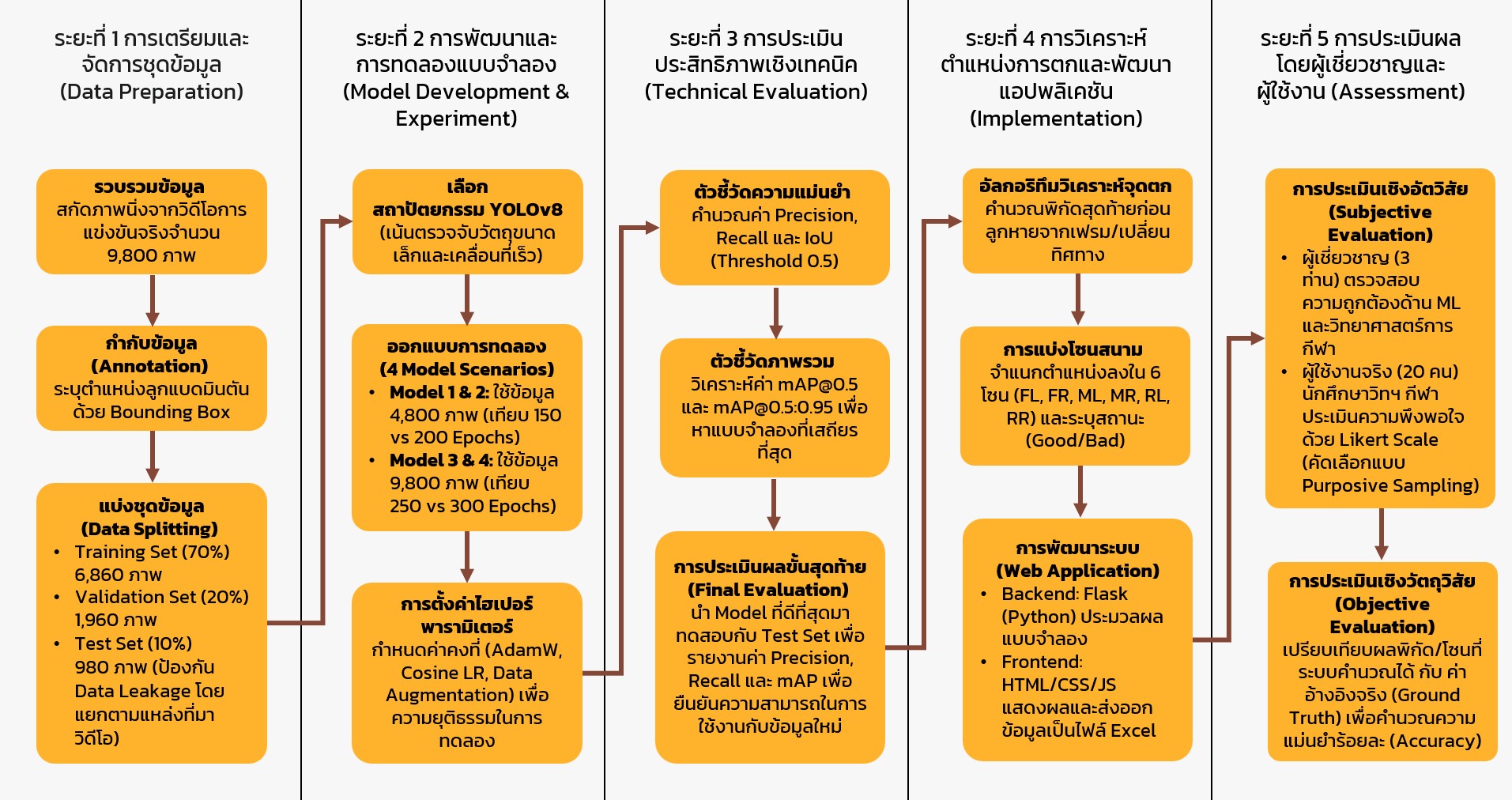
This research aims to develop an Artificial Intelligence (AI) system for detecting and analyzing badminton shuttlecock positions to enhance the efficiency of game planning and training (Scouting). The researchers developed an object detection model based on the YOLOv8 architecture and conducted comparative performance tests under various conditions. The results indicated that the model trained with a dataset of 9,800 images for 300 epochs yielded the highest performance, achieving a Precision of 95%, a Recall of 92%, and a minimum Validation Loss of 2.07. When integrated into a web application and tested by experts and sports science students, the system demonstrated the ability to accurately identify shuttlecock landing positions, classify court zones, and display statistical results. Overall user satisfaction was rated at a very good level, particularly regarding its utility for learning and the convenience of data utilization. However, limitations regarding processing speed and tracking stability in certain scenarios remain.
References
Cao, Z., Liao, T., Song, W., Chen, Z., & Li, C. (2021). Detecting the shuttlecock for a badminton robot: A YOLO based approach. Expert Systems with Applications, 164, 113833. https://doi.org/10.1016/j.eswa.2020.113833
Hsu, Y.-H., Yu, C.-C., & Cheng, H.-Y. (2024). Enhancing Badminton Game Analysis: An Approach to Shot Refinement via a Fusion of Shuttlecock Tracking and Hit Detection from Monocular Camera. Sensors, 24(13), 4372. https://doi.org/10.3390/s24134372
Hussain, M. (2023). YOLO-v1 to YOLO-v8, the Rise of YOLO and Its Complementary Nature toward Digital Manufacturing and Industrial Defect Detection. Machines, 11(7), 677. https://doi.org/10.3390/machines11070677
Jiang, P., Ergu, D., Liu, F., Cai, Y., & Ma, B. (2022). A Review of Yolo Algorithm Developments. Procedia Computer Science, 199, 1066–1073. https://doi.org/10.1016/j.procs.2022.01.135
Kamoljitprapa, P., & Leelasilapasart, P. (2025). Development of Machine Learning Regression Models for CO2 Emission Forecasting in Thailand. In 7th International Conference on Statistics: Theory and Applications (ICSTA'25), Paris, France, pp. 1-7. https://doi.org/10.11159/icsta25.146
Kim, J., & Cheng, K. (2023). AI-powered badminton video detection: Enhancing gameplay analysis and training. TechRxiv. https://doi.org/10.36227/techrxiv.23708325.v1
Kopania, M., Nowisz, J., & Przelaskowski, A. (2022). Automatic Shuttlecock Fall Detection System in or out of a Court in Badminton Games—Challenges, Problems, and Solutions from a Practical Point of View. Sensors, 22(21), 8098. https://doi.org/10.3390/s22218098
Lai, Y., Shi, Z., & Zhu, C. (2025). YO-CSA-T: A real-time badminton tracking system utilizing YOLO based on contextual and spatial attention. arXiv. https://doi.org/10.48550/arXiv.2501.06472
Lippi, M., Bonucci, N., Carpio, R. F., Contarini, M., Speranza, S., & Gasparri, A. (2021). A yolo-based pest detection system for precision agriculture. In 2021 29th Mediterranean Conference on Control and Automation (MED), PUGLIA, Italy, pp. 342-347. https://doi.org/10.1109/MED51440.2021.9480344
Malta, A., Mendes, M. & Farinha, T. (2021). Augmented Reality Maintenance Assistant Using YOLOv5. Applied Sciences, 11(11), 4758. https://doi.org/10.3390/app11114758
Mirzaei, B., Nezamabadi-pour, H., Raoof, A., & Derakhshani, R. (2023). Small Object Detection and Tracking: A Comprehensive Review. Sensors, 23(15), 6887. https://doi.org/10.3390/s23156887
Prempree, A., Kiatwuthiamorn, J. & Cumpim, C. (2024). Ball Tracking System Using Kalman Filter and Deep Learning. Journal of Advanced Development in Engineering and Science, 14(40), 108-133. https://ph03.tci-thaijo.org/index.php/pitjournal/article/view/592
Rozumnyi, D., Matas, J., Sroubek, F., Pollefeys, & Oswald, M.R. (2020). FMODetect: Robust Detection of Fast Moving Objects. In 2021 IEEE/CVF International Conference on Computer Vision (ICCV), pp. 3521-3529.
Singh, S. (2021). Using Deep Learning to Predict the Path of a Shuttlecock in Badminton [Master’s thesis]. Arkansas State University.
Srigrarom, S.m & Chew, K.H. (2020). Hybrid motion-based object detection for detecting and tracking of small and fast moving drones. In 2020 International Conference on Unmanned Aircraft Systems (ICUAS), Athens, Greece, pp. 615-621. https://doi.org/10.1109/ICUAS48674.2020.9213912
Sun, W., Dai, L., Zhang, X., Chang, P., & He, X. (2022). RSOD: Real-time small object detection algorithm in UAV-based traffic monitoring. Applied Intelligence, 52, 8448–8463. https://doi.org/10.1007/s10489-021-02893-3
Vijayakumar, A., & Vairavasundaram, S. (2024). YOLO-based Object Detection Models: A Review and its Applications. Multimedia Tools and Applications, Multimedia Tools and Applications,83, 83535–83574. https://doi.org/10.1007/s11042-024-18872-y
Vrajesh, S.R., Amudhan, A.N., Lijiya, A., & Sudheer, A.P. (2020). Shuttlecock Detection and Fall Point Prediction using Neural Networks. In 2020 International Conference for Emerging Technology (INCET), Belgaum, India, pp. 1-6. https://doi.org/10.1109/INCET49848.2020.9154136
Wang, W. (2021), Using Machine Learning Algorithms to Recognize Shuttlecock Movements. Wireless Communications and Mobile Computing, 9976306. https://doi.org/10.1155/2021/9976306
Zhao, Y. (2023). Automatic shuttlecock motion recognition using deep learning. IEEE Access, 11, 111281–111291. https://doi.org/10.1109/ACCESS.2023.3322455
Downloads
Published
Issue
Section
Categories
License
Copyright (c) 2025 Journal of Applied Science and Emerging Technology

This work is licensed under a Creative Commons Attribution-NonCommercial-NoDerivatives 4.0 International License.


