Thermodynamic Modeling of Experimental Data for the Adsorption of Ternary Antibiotic Mixture from Aqueous Solution Using Flamboyant-Pod-Based Activated Carbon
Keywords:
Activated carbon, Flamboyant pod, Antibiotic, Adsorption, ThermodynamicAbstract
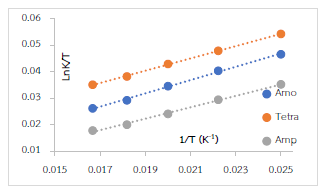
Antibiotic contamination in water poses significant environmental and public health risks, necessitating low-cost and sustainable treatment solutions. This study explores the development of Flamboyant-Pod-based Activated Carbon (FPAC), a bio-based adsorbent, for the removal of a Ternary Antibiotic Mixture (TAM). Raw Flamboyant Pods (FPs) were pretreated, chemically activated with Potassium Hydroxide (KOH), and carbonized at 500 °C for 40 min. The structural and surface modifications of FPAC were characterized using Scanning Electron Microscopy (SEM), Energy-Dispersive X-ray (EDX) analysis and Fourier Transform Infrared Spectroscopy (FTIR) analysis. Batch adsorption experiments were performed under varying conditions of contact time (10-240 min), initial concentrations (20-100 mg/L), and temperatures (40-60 °C). Adsorption thermodynamic parameters, including Gibb’s Free Energy (ΔG°), Enthalpy Change (ΔHo), Entropy Change (Δ𝑠°), Isosteric Heat of Adsorption (ΔHx), Activation Energy (Ea), Sorption Probability (S*), Surface Coverage (θ), and Hopping Number (n), were evaluated to determine adsorption feasibility and mechanisms. FPAC exhibited a porous structure with enhanced carbon content and new functional groups, promoting chemical interactions with antibiotics. Adsorption proceeded rapidly within the first 100 min, achieving maximum capacities of 9.371 mg/g (Amoxicillin, AMO), 9.310 mg/g (Tetracycline, TETRA), and 8.733 mg/g (Ampicillin, AMP). Corresponding removal efficiencies were 85.91, 91.24, and 78.67%. Thermodynamic analysis revealed negative ΔG° and ΔHo values, confirming a spontaneous and exothermic process, while ΔHx and Ea values indicated predominantly physisorption-driven adsorption. The findings establish FPAC as an efficient, low-cost, and environmentally friendly adsorbent with strong potential for the remediation of antibiotic-contaminated wastewater.
References
Abdelkarim, S., & Djamila, H. (2020). Wastewater management challenges and solutions. Journal of Environmental Science and Health, 55(4), 320-330.
Abulude, F. O., & Adejayan, A. O. (2017). Agricultural residues as low-cost adsorbents for wastewater treatment. Applied Water Science, 7(6), 3651-3661.
Al-Asadi, S. T., Al-Qaim, F. F., Al-Saedi, H. F. S., Deyab, I. F., Kamyab, H., & Chelliapan, S. (2023). Adsorption of methylene blue dye from aqueous solution using low-cost adsorbent: kinetic, isotherm adsorption, and thermodynamic studies. Environmental Monitoring and Assessment, 195(6), 676. doi: 10.1007/s10661-023-11334-2.
Alnajrani, M. N., & Alsager, O. A. (2020). Antibiotics in wastewater: Occurrence, fate, and removal technologies. Science of the Total Environment, 720, 137574. https://doi.org/10.1038/s41598-020-57616-4
Amrutha, J. G., Girish, C. R., Prabhu, B., & Mayer, K. (2023). Multi-component adsorption isotherms: review and modeling studies. Environmental processes, 10(2), 38-52 https://doi.org /10.1007/s40710-023-00631-0
Anıagor, C. O., & Menkıtı, M. C. (2020). Relational description of an adsorption system based on isotherm, adsorption density, adsorption potential, hopping number and surface coverage. Sigma Journal of Engineering and Natural Sciences, 38(3), 1073-1098.
Azarpira, H., Mahdavi, M., & Nazari, R. (2019). Removal of pharmaceuticals from water using adsorption: A review. Journal of Cleaner Production, 223, 122-139.
Barbooti, M. M., & Zahraw, Z. J. (2020). Antibiotics in wastewater: Impacts and challenges. Environmental Processes, 7(2), 459-472.
Bello, O. S., Adegoke, K. A., & Olaniyan, A. A. (2012). Adsorptive removal of pharmaceuticals from aqueous solutions. Desalination and Water Treatment, 44(1–3), 1-10.
Choffor-Nchinda, E., Atanga, L. C., Nansseu, J. R., & Djomou, F. (2018). Effectiveness of amoxicillin alone in the treatment of uncomplicated acute otitis media: a systematic review protocol. BMJ open, 8(6), e021133.
Deyi, A. V., Yaumi, A. L., Umar, H., Aji, M. M., & Mustafa, B. G. (2023). Adsorptive properties of Flamboyant seed pod activated carbon for the removal of anionic dye in wastewater. Arid Zone Journal of Basic and Applied Research, 2 (5), 124-131.
Ding, J., Liang, J., Wang, Q., Tan, X., Xie, W., Chen, C., & Chen, X. (2024). Enhanced tetracycline adsorption using KOH-modified biochar derived from waste activated sludge in aqueous solutions. Toxics, 12(10), 69-81.
Dufatanye, I., Lee, Y., Kim, H., & Lee, S. (2022). Industrial wastewater discharge and compliance investigation for environmentally resilient Rwanda. Water, 14(19), 3100. https://doi.org/10.3390/ w14193100
Ebelegi, A. N., Ayawei, N., & Wankasi, D. (2020). Interpretation of adsorption thermodynamics and kinetics. Open Journal of Physical Chemistry, 10(3), 166-182. https://doi.org/10.4236/ojpc.2020. 103010
Echereme, C. B., Nworie, O. E., & Edeh, I. J. (2019). Adsorption of pollutants on porous adsorbents at elevated temperatures. Environmental Technology, 40(15), 2021-2033.
Edet, U. A., & Ifelebuegu, A. O. (2020). Kinetics, Isotherms, and Thermodynamic Modeling of the Adsorption of Phosphates from Model Wastewater Using Recycled Brick Waste. Processes, 8(6), 665. https://doi.org/10.3390/pr8060665
Fomnya, H. J., Ngulde, S. I., Amshi, K. A., & Bilbonga, G. (2021). Antibiotics: Classifications and mechanism of resistance. International Journal of Applied Microbiology and Biotechnology Research, 9(15), 38-50.
Gautam, R., Priyadarshini, E., Patel, A. K., & Arora, T. (2024). Assessing the impact and mechanisms of environmental pollutants (heavy metals and pesticides) on the male reproductive system: a comprehensive review. Journal of Environmental Science and Health, Part C, 42(2), 126-153.
George, A., Brown, R., & Wilson, D. (2014). Analytical methods in FTIR spectroscopy for biomass characterization. Spectrochimica Acta Part A: Molecular and Biomolecular Spectroscopy, 133, 200-208.
Hasan, M. N., Rahman, M., & Alam, A. (2014). Effect of temperature on adsorption of pharmaceuticals. Journal of Environmental Management, 143, 145-152.
Korkmaz, Ş., & Tuna, Ö. Adsorption potential of spherical ZnO particles for sufficient antibiotic removal: isotherm, kinetic and thermodynamics. Journal of Innovative Engineering and Natural Science, 5(1), 19-29.
Lima, E. C., Hosseini-Bandegharaei, A., Moreno-Piraján, J. C., & Anastopoulos, I. (2019). A critical review of the estimation of the thermodynamic parameters on adsorption equilibria. Wrong use of equilibrium constant in the Van't Hoof equation for calculation of thermodynamic parameters of adsorption. Journal of molecular liquids, 273, 425-434. https://doi.org/10.1016/j.molliq.2018.10.048
Marczewski, A. W., Deryło-Marczewska, A., & Jaroniec, M. (2016). Influence of temperature on adsorption capacity of antibiotics. Applied Surface Science, 362, 560-570.
Mashkovtsev, M., Tarasova, N., Baksheev, E., Rychkov, V., Zhuravlev, N., Solodovnikova, P., & Galiaskarova, M. (2023). Spectroscopic Study of Five-Coordinated Thermal Treated Alumina Formation: FTIR and NMR Applying. International Journal of Molecular Sciences, 24(6), 5151. https://doi.org/10.3390/ijms24065151.
Mechnou, I., Meskini, S., El Ayar, D., Lebrun, L., & Hlaibi, M. (2022). Olive mill wastewater from a liquid biological waste to a carbon/oxocalcium composite for selective and efficient removal of methylene blue and paracetamol from aqueous solution. Bioresource technology, 365, 128162. https://doi.org/ 10.1016/j.biortech.2022.128162
Nafisur, R., & Poornima, V. (2020). Assessment of ampicillin removal efficiency from aqueous solution by polydopamine/zirconium (IV) iodate: optimization by response surface methodology. The Royal Society of Chemistry, 10(34), 322–337.
Neimark, A. V., Tarazona, P., & Seaton, N. A. (2017). Thermodynamics of adsorption and isosteric heat evaluation. Colloids and Surfaces A: Physicochemical and Engineering Aspects, 529, 23-33.
Nomngongo, P. N., & Chaba, R. (2019). KOH-activated carbons for wastewater treatment. Journal of Environmental Science and Health, Part A, 54(5), 441-452.
Okoye, C. O., Okoye, P. U., & Obi, C. (2018). Calibration and adsorption study of antibiotics in aqueous solution. Journal of Environmental Chemical Engineering, 6(2), 1531-1540.
Oladimeji, F. O., Alade, A. O., Tijani, I. O., Abdulrasheed, W. A., Olarinde, M. O., Ilori, K. P., & Afolabi, T. J. (2025). Thermodynamic Properties of Polyaromatic Hydrocarbons Adsorption from Wastewater using Pineapple-Crown-Based Cellulose. International Journal of Academic Engineering Research (IJAER) 9(3), 80-87.
Ortúzar, M., Esterhuizen, M., Olicón-Hernández, D. R., González-López, J., & Aranda, E. (2022). Pharmaceutical pollution in aquatic environments: a concise review of environmental impacts and bioremediation systems. Frontiers in microbiology, 13, 869332. https://doi.org/10.3389/fmicb.2022.869332
Patil, P., Jeppu, G., Vallabha, M. S., & Girish, C. R. (2024). Enhanced adsorption of phenolic compounds using biomass-derived high surface area activated carbon: Isotherms, kinetics and thermodynamics. Environmental Science and Pollution Research, 31(60), 67442-67460.
Rahmanian, B., Ali, A., & Bukhari, A. (2018). Effect of concentration on antibiotic adsorption. Environmental Technology and Innovation, 9, 110-119.
Ravichandran, P., Kumar, R., & Raj, R. (2018). KOH activation and carbonization of agricultural residues. Carbon Resources Conversion, 1(3), 233-241.
Renugadevi, K., & Krishnaveni, R. (2021). Comparative evaluation of wastewater treatment methods. Journal of Water Process Engineering, 40, 101967.
Roberts, M., & Chopra, I. (2021). Tetracycline Antibiotics: Mode of Action, Applications, Molecular Biology, and Epidemiology of Bacterial Resistance. American Society for Microbiology, 65(2), 232-260.
Sahoo, P. K., Patel, R. K., & Ray, S. K. (2018). Adsorption kinetics and thermodynamics of tetracycline on activated carbon. Applied Surface Science, 427, 513-523.
Sarwar, A., Ali, M., Khoja, A. H., Nawar, A., Waqas, A., Liaquat, R., & Asjid, M. (2021). Synthesis and characterization of biomass-derived surface-modified activated carbon for enhanced CO2 adsorption. Journal of CO2 Utilization, 46, 101476. https://doi.org/10.1016/J.JCOU.2021.101476
Seshadri, V., Singh, K., & Mehta, M. (2012). FTIR analysis of chemically modified biomass. Spectroscopy Letters, 45(3), 214-222.
Wang, C., Feng, X., Shang, S., Liu, H., Song, Z., & Zhang, H. (2023). Adsorption of methyl orange from aqueous solution with lignin-modified metal–organic frameworks: Selective adsorption and high adsorption capacity. Bioresource Technology, 388, 129781. https://doi.org/10.1016/j.biortech. 2023.129781
Wei, J., Li, X., & Zhang, Y. (2019). Adsorption of antibiotics in multicomponent systems. Journal of Hazardous Materials, 368, 685-693.
Xu, H., Wang, J., & Liu, S. (2021). Thermodynamic insights into antibiotic adsorption. Chemical Engineering Journal, 420, 129646.
Zeng, F., Chen, H., Mei, Y., Ye, L., Zhuang, S., Pu, N., & Wang, L. (2024). Performance and mechanism of sulfonamide-antibiotic adsorption by Ti3 C2 MXene. New Journal of Chemistry, 48(38), 16742-16752.
Downloads
Published
Issue
Section
License
Copyright (c) 2025 Journal of Applied Science and Emerging Technology

This work is licensed under a Creative Commons Attribution-NonCommercial-NoDerivatives 4.0 International License.


