Neuroprotective Potential of CBD and Terpenes from Cannabis sativa L. (Hang Kra Rog Phu Phan ST1) on the Potentiation or Antagonism of Amyloid-β1-42-Induced Apoptosis in SH-SY5Y Neuroblastoma Cells
Keywords:
Alzheimer, CBD, Terpenes, Prevention and Treatment, Cellular Apoptotic from amyloid-β1-42.Abstract
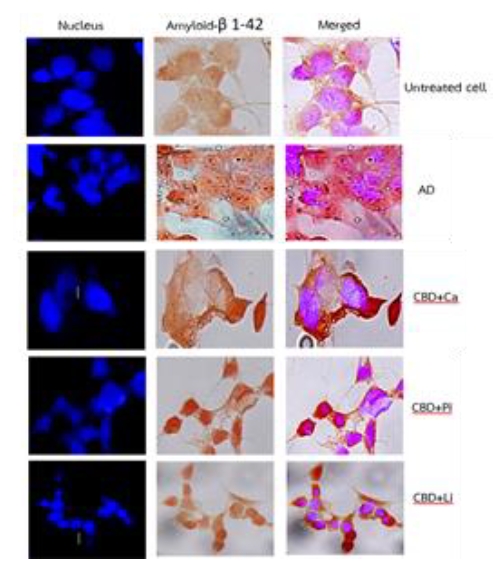
Dementia, particularly Alzheimer’s Disease (AD), is characterized by the extracellular accumulation of Amyloid-β (Aβ) and intracellular Tau hyperphosphorylation, both of which trigger neuroinflammation and neuronal apoptosis. This study investigated the efficacy of Cannabidiol (CBD) combined with three terpenes including α-Pinene, Linalool, and β-Caryophyllene as potential adjuvants to mitigate Aβ1-42-induced neurotoxicity. Using the MTT assay on SH-SY5Y neuroblastoma cells, the optimal non-toxic concentrations were determined to be 150 µM for CBD, α-Pinene, and Linalool, and 100 µM for β-Caryophyllene. Synergistic testing revealed that the combination of CBD with α-Pinene and CBD with Linalool significantly reduced cell mortality (p < 0.01) when administered post-Aβ1-42 accumulation, demonstrating a potential curative effect. However, pre-treatment with these combinations failed to provide a preventive effect against subsequent Aβ1-42 insult. Notably, the combination of CBD with β-Caryophyllene, or the administration of more than two compounds simultaneously, resulted in increased cytotoxicity and significantly higher rates of cell death. These findings suggest that while certain cannabinoid-terpene combinations offer therapeutic potential, their application is limited by specific chemical interactions and timing. Further research into precise formulations and intervention windows is essential to develop safe and effective cannabis-based treatments for Alzheimer's Disease
References
Ali, M., Timsina, J., Western, D., Liu, M., Beric, A., Budde, J., et al. (2025). Multi-cohort cerebrospinal fluid proteomics identifies robust molecular signatures across the Alzheimer disease continuum. Neuron, 113(9), 1363-1379.e1369. https://doi.org/10.1016/j.neuron.2025.02.014
Beltrami, S., Rizzo, S., Schiuma, G., Cianci, G., Narducci, M., Baroni, M., et al. (2025). West Nile virus non-structural protein 1 promotes amyloid Beta deposition and neurodegeneration. International Journal of Biological Macromolecules, 305, 141032. doi:https://doi.org/10.1016/j.ijbiomac.2025.141032
Chen, L., Sun, Y., Li, J., Liu, S., Ding, H., Wang, G., & Li, X. (2023). Assessing Cannabidiol as a Therapeutic Agent for Preventing and Alleviating Alzheimer's Disease Neurodegeneration. Cells, 12(23), 2672. https://doi.org/10.3390/cells12232672
Doering, S., McCullough, A., Gordon, B. A., Chen, C. D., McKay, N., Hobbs, D., .et al. (2024). Deconstructing pathological tau by biological process in early stages of Alzheimer disease: a method for quantifying tau spatial spread in neuroimaging. eBioMedicine, 103, 105080. doi:https://doi.org/10.1016/j.ebiom.2024.105080
El-Hammadi, M. M., Small-Howard, A. L., Fernández-Arévalo, M., Turner, H., & Martín-Banderas, L. (2025). Effects of combined CBGA and cannabis-derived terpene nanoformulations on TRPV1 activation: Implications for enhanced pain management. International Journal of Pharmaceutics, 679, 125766. doi:https://doi.org/10.1016/j.ijpharm.2025.125766
Esposito, G., Scuderi, C., Valenza, M., Togna, G. I., Latina, V., De Filippis, D., Cipriano, M., Carratù, M. R., Iuvone, T., & Steardo, L. (2011). Cannabidiol reduces Aβ-induced neuroinflammation and promotes hippocampal neurogenesis through PPARγ involvement. PloS one, 6(12), e28668. https://doi.org/10.1371/journal.pone.0028668
Greeley, D., Nash, M., Herskowitz, B., Kim, F., Rock, J., Prins, N., et al. (2025). A phase 2 randomized, placebo-controlled study on the efficacy and safety of AR1001, a phosphodiesterase-5 inhibitor, in patients with mild-to-moderate Alzheimer’s disease. The Journal of Prevention of Alzheimer's Disease, 100337. doi:https://doi.org/10.1016/j.tjpad.2025.100337
Harvey, B. S., Ohlsson, K. S., Mååg, J. L. V., Musgrave, I. F., & Smid, S. D. (2012). Contrasting protective effects of cannabinoids against oxidative stress and amyloid-β evoked neurotoxicity in vitro. NeuroToxicology, 33(1), 138-146. doi:https://doi.org/10.1016/j.neuro.2011.12.015
Janefjord, E., Mååg, J. L., Harvey, B. S., & Smid, S. D. (2014). Cannabinoid effects on β amyloid fibril and aggregate formation, neuronal and microglial-activated neurotoxicity in vitro. Cellular and molecular neurobiology, 34(1), 31–42. https://doi.org/10.1007/s10571-013-9984-x
Kang, S., Li, J., Yao, Z., & Liu, J. (2021). Cannabidiol Induces Autophagy to Protects Neural Cells From Mitochondrial Dysfunction by Upregulating SIRT1 to Inhibits NF-κB and NOTCH Pathways. Frontiers in cellular neuroscience, 15, 654340. https://doi.org/10.3389/fncel.2021.654340
Kim, H.-K., Park, S., Kim, S.-W., Jin, Y., Lee, H., Hong, J. Y., et al. (2025). Associations between traumatic brain injury and the prevalence of Alzheimer’s disease dementia and behavioral and psychological symptoms of dementia: A retrospective cohort study. The Journal of Prevention of Alzheimer's Disease, 100360. doi:https://doi.org/10.1016/j.tjpad.2025.100360
Laws, J. S., & Smid, S. D. (2024). Characterizing cannabis-prevalent terpenes for neuroprotection reveal a role for α and β-pinenes in mitigating amyloid β-evoked neurotoxicity and aggregation in vitro. NeuroToxicology, 100, 16-24. doi:https://doi.org/10.1016/j.neuro.2023.12.004
Levy, C. M., Riederer, A. M., Simpson, C. D., Gassett, A. J., Gilbert, A. J., Paulsen, M. H., et al. (2025). Forest terpenes and stress: Examining the associations of filtered vs. non-filtered air in a real-life natural environment. Environmental Research, 276, 121482. doi:https://doi.org/10.1016/j.envres.2025.121482
Li, D., Ilnytskyy, Y., Ghasemi Gojani, E., Kovalchuk, O., & Kovalchuk, I. (2022). Analysis of anti-cancer and anti-inflammatory properties of 25 high-THC cannabis extracts. Molecules, 27(18), 6057 doi:https://doi.org/10.3390/molecules27186057
Sabogal-Guáqueta, A. M., Osorio, E., & Cardona-Gómez, G. P. (2016). Linalool reverses neuropathological and behavioral impairments in old triple transgenic Alzheimer's mice. Neuropharmacology, 102, 111–120. https://doi.org/10.1016/j.neuropharm.2015.11.002
Santos, N. A., Martins, N. M., Sisti, F. M., Fernandes, L. S., Ferreira, R. S., Queiroz, R. H., & Santos, A. C. (2015). The neuroprotection of cannabidiol against MPP⁺-induced toxicity in PC12 cells involves trkA receptors, upregulation of axonal and synaptic proteins, neuritogenesis, and might be relevant to Parkinson's disease. Toxicology in vitro : an international journal published in association with BIBRA, 30(1 Pt B), 231–240. https://doi.org/10.1016/j.tiv.2015.11.004
Tendwa, M. B., Appidi, T., Chitsunge, B., Moreau, M., Okole, B., Kalombo, L., et al. (2025). From farm to bedside: Potential of medical cannabis in global health. Complementary Therapies in Medicine, 93, 103205. doi:https://doi.org/10.1016/j.ctim.2025.103205
Yang, F., Duan, S., Liu, J., An, Z., Liu, W., Wang, X., et al. (2025). Antitumor effects of cannabidiol (CBD) on osteosarcoma by targeting TNF-α/NF-κB/CCL5 signaling axis. Phytomedicine, 145, 157066. doi:https://doi.org/10.1016/j.phymed.2025.157066
Zhang, Y., Li, H., Jin, S., Lu, Y., Peng, Y., Zhao, L., & Wang, X. (2022). Cannabidiol protects against Alzheimer's disease in C. elegans via ROS scavenging activity of its phenolic hydroxyl groups. European journal of pharmacology, 919, 174829. https://doi.org/10.1016/j.ejphar.2022.174829
Downloads
Published
License
Copyright (c) 2026 Journal of Applied Science and Emerging Technology

This work is licensed under a Creative Commons Attribution-NonCommercial-NoDerivatives 4.0 International License.


