Greenhouse Gas Emission Assessment of Bottom Ash Block, Hemp and Pineapple Fibers Concrete Blocks
Keywords:
Greenhouse gas emission assessment, Concrete block, Hemp fiber, Pineapple fiber, Agricultural wasteAbstract
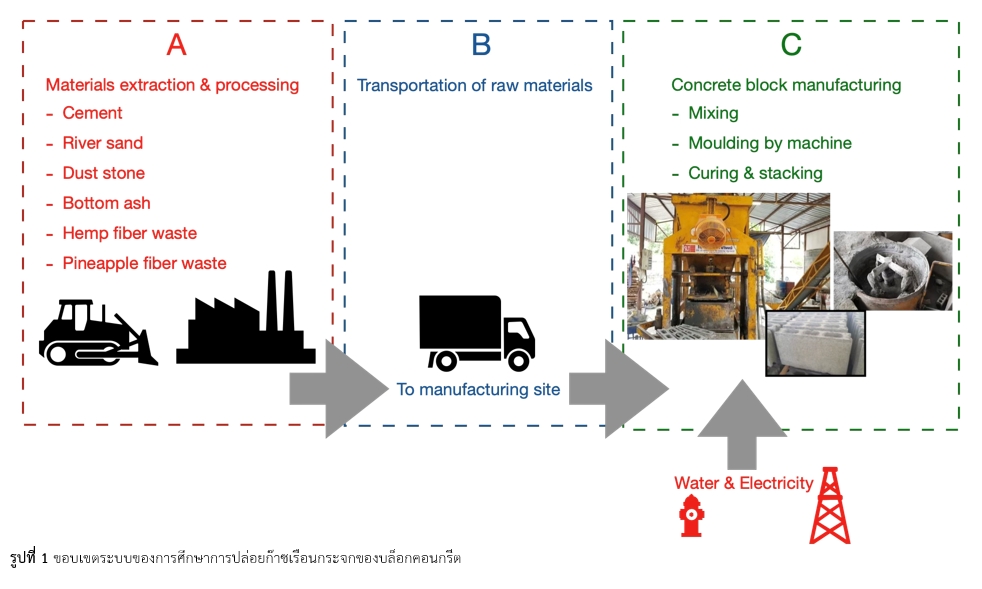
This study aims to assess the greenhouse gas emissions from concrete blocks in comparison to three alternatives: concrete blocks with 100% bottom ashes as a replacement of aggregate (BA100), concrete blocks mixed with 10% hemp (HF10), and concrete blocks mixed with 10% pineapple fibers (PF10) as additional materials by volume of sand. The assessment was evaluated based on the cradle-to-gate, which included the process of extracting and processing materials, transportation of materials to the concrete production plant, and concrete block production. The results found that concrete blocks 1 m3 in size, 70 x 190 x 390 mm, weigh not more than 7 kg, according to the TIST 58-2560 Concrete. The compressive strength of the concrete blocks varies from 4.15 to 5.37 MPa, and their density is classified as that of a general concrete block aged 28 days. The greenhouse gas emissions for the general blocks, BA100, HF10, and PF10, were 194.86, 169.97, 202.45, and 202.56 kgCO2e, respectively. The key emission hotpot comes from raw materials (cement), accounting for 62-74%, followed by the concrete block manufacturing process at 26-36%. The replacement of bottom ash can contribute to efforts in reducing greenhouse gas emissions by 12.77%.
References
Akhtar, M. N., & Malkawi, D. A. H. (2025). Sustainable Concrete Hollow Blocks Using Composite Waste Replacing Fired Clay Bricks-An Experimental Study. Sustainability, 17(24), 10963.
Apichatabut, P. & Khem-khao, M. (2021). Feasibility Study on Using Bottom Ash for Heat-Insulating Concrete Blocks (Case Study: Phuket Community Waste Incinerator)., In The 39th Conference of Industrial Engineering Network 2021 (p. 993-999). Faculty of Engineering, Rajamangala University of Technology Srivijaya. (In Thai)
Aranyasen, S., Srinavin, K., Aksorn, P., & Kusonkhum, W., (2021). Comparison of Carbon Dioxide Emissions (CO2-e) Produced Between Ordinary Concrete Production and Geopolymer Concrete for Environmentally Friendly Construction Industry by Using Life Cycle Assessment Methods. KKU Research Journal (Graduate Studies), 21(4), 71-82.
ASTM. (2003). Standard Specification for Coal Fly Ash and Raw or Calcined Natural Pozzolan for Use in Concrete (ASTM C168) USA: ASTM International.
ASTM. (2008). Standard Performance Specification for Hydraulic Cement (ASTM C1157-08a) USA: ASTM International.
ASTM. (2017). Standard Specification for Nonloadbearing Concrete Masonry Units (ASTM C129) USA: ASTM International.
Bai, Y., Darcy, F., & Basheer, P. A. M. (2005). Strength and drying shrinkage properties of concrete containing furnace bottom ash as fine aggregate. Construction and Building Materials, 19, 691–697.
Celik, K., Meral, C., Gursel, A. P., Mehta, P. K., Horvath, A., & Monteiro, P. J. (2015). Mechanical properties, durability, and life-cycle assessment of self-consolidating concrete mixtures made with blended portland cements containing fly ash and limestone powder. Cement and Concrete Composites, 56, 59-72.
Chen, L., & Lin, D-F., (2009). Stabilization treatment of soft subgrade soil by sewage sludge ash and cement. Journal of Hazardous Materials, 162(1), 321-327.
Chowdhury, J. A., Islam, M. S., Islam, M. A., Al Bari, M. A., & Debnath, A. K. (2025). Analysis of mechanical properties of fly ash and boiler slag integrated geopolymer composites. Sustain. Struct., 5(2), 000073.
Dahmen, J., Kim, J., & Ouellet-Plamondon, C. M. (2018). Life cycle assessment of emergent masonry blocks. Journal of cleaner production, 171, 1622-1637.
Dermatas, D., & Meng, X. (2003). Utilization of fly ash for stabilization/solidification of heavy metal contaminated soils. Engineering Geology, 70(3-4), 377-394.
Freedonia. (2016). World Construction Aggregates - Demand and Sales Forecasts, Market Share, Market Size, Market Leaders, Industry Study No. 3389. the Freedonia group, Cleveland, Ohio, USA 390 p.
Furr, J. E. (Ed.). (2009). Green building and sustainable development: The practical legal guide. American Bar Association.
Guney, Y., Sari, D., Cetin, M., & Tuncan, M. (2007). Impact of cyclic wetting-drying on swelling behavior of lime-stabilized soil. Building and Environment, 42(2), 681-688.
Hossain, M. U., Poon, C. S., Lo, I. M., & Cheng, J. C. (2017). Comparative LCA on using waste materials in the cement industry: A Hong Kong case study. Resources, Conservation and Recycling, 120, 199-208.
Islam, S. R., Majumder, S. N., & Mutsuddy, R. (2024). Life cycle assessment and mechanical strength of cement composites with conventional and recycled fine aggregate. Sustainable Structures, 4, 000052.
ISO. (2018). Greenhouse gases-Carbon footprint of products-Requirements and guidelines for quantification. International Organization for Standardization (ISO 14067: 2018). International Organisation for Standardisation.
Kongkeaw, K., Khemkhao, M., & Suwansaard, A. (2026). Comparative Experimental Study between Hemp and Pineapple Fiber Wastes as Additional Materials to Improve Acoustic Performance in Concrete Blocks. Applied Science and Engineering Progress, 19(1), 7881-7881.
Kou, S. C., & Poon, C. S. (2009). Properties of concrete prepared with crushed fine stone, furnace bottom ash and fine recycled aggregate as fine aggregates. Construction and Building Materials, 23(8), 2877-2886.
Kulsoom, K., Shahzada, K., Noor, U. A., & Xin, R. (2025). Embodied carbon in masonry units: A comparative analysis of brick and concrete block production in Pakistan and the UK. Energy and Buildings, 116298.
Kurad, R., Silvestre, J. D., de Brito, J., & Ahmed, H. (2017). Effect of incorporation of high volume of recycled concrete aggregates and fly ash on the strength and global warming potential of concrete. Journal of Cleaner Production, 166, 485–502.
Kurda, R., Silvestre, J. D., & de Brito, J. (2018). Life cycle assessment of concrete made with high volume of recycled concrete aggregates and fly ash. Resources, Conservation and Recycling, 139, 407-417.
Lin, K. L., & Lin, D. F. (2006). Hydration characteristics of municipal solid waste incinerator bottom ash slag as a pozzolanic material for use in cement. Cement and Concrete Composites, 28(9), 817-823.
Marinković, S., Radonjanin, V., Malesev, M., et al. (2010). Comparative environmental assessment of natural and recycled aggregate concrete. Waste Management, 30(11), 2255–2264.
Nalbantoğlu, Z. (2004). Effectiveness of class C fly ash as an expansive soil stabilizer. Construction and Building Materials, 18(6), 377-381.
NRMCA. (2014). NRMCA Member Industry-wide EPD for Ready Mixed Concrete. Program Operator: NSF International Certified. (NRMCAEPD 10046). Declaration Holder: the National Ready Mixed Concrete Association.
Pushkar, S. (2019). The effect of different concrete designs on the life-cycle assessment of the environmental impacts of concretes containing furnace bottom-ash instead of sand. Sustainability, 11(15), 4083.
Reber, A. P. (2009). Taking the LEED: Determining the Appropriate Amount of Government Regulation in Green Building Projects. Ky. LJ, 98, 573.
Salas, D. A., Ramirez, A. D., Ulloa, N., Baykara, H., & Boero, A. J. (2018). Life cycle assessment of geopolymer concrete. Construction and Building Materials, 190, 170-177.
Sathiparan, N., & Subramaniam, D. N. (2025). Optimizing fly ash and rice husk ash as cement replacements on the mechanical characteristics of pervious concrete. Sustainable Structures, 5.
Sathiparan, N., Jaasim, J. H. M., & Banujan, B. (2022). Sustainable production of cement masonry blocks with the combined use of fly ash and quarry waste. Materialia, 26, 101621.
Sentman, S. D., Del Percio, S. T., & Koerner, P. (2008). A climate for change: Green building policies, programs, and incentives. Journal of green building, 3(2), 46-63.
Shaikh, S. A., Rajpurohit, K., Pandey, A. K., & Bagla, H. K. (2025). Engineering Portland cement and concrete with agricultural-origin functional additives: Valorization of agro-waste. Next Sustainability, 6, 100173.
Souza, A. B., Ferreira, H. S., Vilela, A. P., Viana, Q. S., Mendes, J. F., & Mendes, R. F. (2021). Study on the feasibility of using agricultural waste in the production of concrete blocks. Journal of Building Engineering, 42, 102491.
Suwansaard, A., Kongpun, T., & Khemkhao, M., (2022). Properties of mortars mixed with polystyrene and hemp fiber wastes. Applied Science and Engineering Progress, 15(1). https://doi.org/10.14416/j.asep.2021.09.004
Tait, M. W., & Cheung, W. M. (2016). A comparative cradle-to-gate life cycle assessment of three concrete mix designs. The International Journal of Life Cycle Assessment, 21(6), 847-860.
Tošić, N., Marinković, S., Dašić, T., & Stanić, M. (2015). Multicriteria optimization of natural and recycled aggregate concrete for structural use. Journal of cleaner production, 87, 766-776.
Yong, R. N., & Ouhadi, V. R. (2007). Experimental study on instability of bases on natural and lime/cement-stabilized clayey soils. Applied clay science, 35(3-4), 238-249.
Zhang, J., Fernando, S., Law, D. W., Gunasekara, C., Setunge, S., Sandanayake, M., & Zhang, G. (2023). Life cycle assessment for geopolymer concrete bricks using brown coal fly ash. Sustainability, 15(9), 7718. https://doi.org/10.3390/su15097718
Downloads
Published
Issue
Section
Categories
License
Copyright (c) 2026 Journal of Applied Science and Emerging Technology

This work is licensed under a Creative Commons Attribution-NonCommercial-NoDerivatives 4.0 International License.


