Modeling Global Ice Volume Changes: A Nonlinear Autoregressive Neural Network Approach
Keywords:
Time-series prediction, Neural network, NAR, Backpropagation, Glacial cyclesAbstract
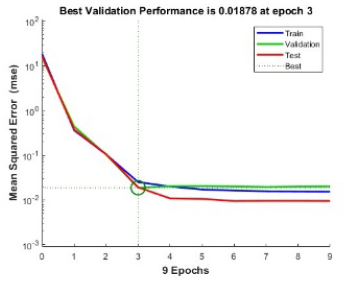
A single time series prediction problem is solved with a neural network. The nonlinear autoregressive (NAR) type of network is used. The network is trained in an open loop and then transformed to closed loop for multistep prediction. The prediction is made 20 time steps into the future. The delay is removed from the network to get the prediction one time step earlier. The shallow neural network is trained on the global ice volume dataset, which contains 219 measurements of global ice volume over 440,000 years. The network is able to predict future ice volume based on past values with a high degree of accuracy. Three different backpropagation training algorithms were used to train the network: Levenberg-Marquardt, Bayesian Regularization, and Scaled Conjugate Gradient. The Levenberg-Marquardt algorithm achieved the lowest MSE (0.02257 at epoch 13) and the highest R² (0.99254). The Bayesian Regularization algorithm achieved an MSE of 0.027209 at epoch 4 and an R² of 0.99192. The Scaled Conjugate Gradient algorithm achieved an MSE of 0.01878 at epoch 3 and an R² of 0.99018. This work contributes to the field of climate studies by providing a tool for predicting future ice volume. This information can be used to better understand Earth’s glacial cycles and to develop strategies for mitigating the effects of climate change.
References
Adedeji, P. A., Akinlabi, S., Ajayi, O., & Madushele, N. (2019). Non-linear autoregressive neural network (NARNET) with SSA filtering for a university energy consumption forecast. Procedia Manufacturing, 33, 176-183. https://doi.org/10.1016/j.promfg.2019.04.022.
Baig, M. A., Zaman, Q., Baig, S. A., Qasim, M., Khalil, U., Khan, S. A., Ismail, M., Muhammad, S., & Ali, S. (2021). Regression analysis of hydro-meteorological variables for climate change prediction: A case study of Chitral Basin, Hindukush region. Science of the Total Environment, 793, 148595. https://doi.org/10.1016/j.scitotenv.2021.
Boussaada, Z., Curea, O., Remaci, A., Camblong, H., & Mrabet Bellaaj, N. (2018). A nonlinear autoregressive exogenous (NARX) neural network model for the prediction of the daily direct solar radiation. Energies, 11(3), 620. https://doi.org/10.3390/en11030620.
Chang, M.-H., Huang, Y.-C., Cheng, Y.-H., Terng, C.-T., Chen, J., & Jan, J. C. (2024). Revisiting regression methods for estimating long-term trends in sea surface temperature. Natural Hazards and Earth System Sciences, 24(1), 2481-2494. https://doi.org/10.5194/nhess-2023-218.
Cummins, D. P., Stephenson, D. B., & Stott, P. A. (2022). Could detection and attribution of climate change trends be spurious regression?. Climate Dynamics, 59(9-10), 2785–2799. https://doi.org/10.1007/s00382-022-06242-z.
Duan, Q., McGrory, C. A., Brown, G., Mengersen, K., & Wang, Y.-G. (2022). Spatio-temporal quantile regression analysis revealing more nuanced patterns of climate change: A study of long-term daily temperature in Australia. PLOS ONE, 17(8), e0271457. https://doi.org/10.1371/journal.pone.0271457.
Grover, R., & Sharma, S. (2024). Impact of climate change on rainfall pattern by using ridge regression analysis. In 2024 International Conference on Computational Intelligence and Computing Applications (ICCICA). (pp. 558-563). https://doi.org/10.1109/ICCICA60014.2024.10585166.
Malik, M. M., Asim, H. W., Kazmi, S. A. A., et al. (2024). ANN and regression based quantification framework for climate change impact assessment on a weak transmission grid of a developing country across Horizon 2050 plus. Environment, Development and Sustainability, 1-20. https://doi.org/10.1007/s10668-024-04977-9.
Mansfield, L. A., Nowack, P. J., Kasoar, M., et al. (2020). Predicting global patterns of long-term climate change from short-term simulations using machine learning. npj Climate and Atmospheric Science, 3(44). https://doi.org/10.1038/s41612-020-00148-5.
Newton, H. J., & North, G. R. (1991). Forecasting global ice volume. Journal of Time Series Analysis, 12(3), 255–265. https://doi.org/10.1111/j.1467-9892.1991.tb00081.x.
Pereira, F. H., Bezerra, F. E., Junior, S., Santos, J., Chabu, I., Souza, G. F. M. d., Micerino, F., & Nabeta, S. I. (2018). Nonlinear autoregressive neural network models for prediction of transformer oil-dissolved gas concentrations. Energies, 11(7), 1691. https://doi.org/10.3390/en11071691.
Subhra, S., Mishra, S., Alkhayyat, A., Sharma, V., & Kukreja, V. (2023, May). Climatic temperature forecasting with regression approach. In 2023 4th international conference on intelligent engineering and management (ICIEM) (pp. 1-5). IEEE. https://doi.org/10.1109/ICIEM59379.2023.10166883.
Takefuji, Y. (2024). Black box analysis with linear regression on global warming. Hygiene and Environmental Health Advances, 12, 100109. https://doi.org/10.1016/j.heha.2024.100109.
Utami, T., Fauzi, F., & Yuliyanto, E. (2023). Statistical downscaling using regression nonparametric of Fourier series-polynomial local of climate change. BAREKENG: Jurnal Matematika & Aplikasi, 17(3), 1411–1418. https://doi.org/10.30598/barekengvol17iss3pp1411-1418.
Wang, L., & Xia, M. (2023). Quantile regression applications in climate change. In Encyclopedia of Data Science and Machine Learning (pp. 1–13). IGI Global. https://doi.org/10.4018/978-1-7998-9220-5.ch147.
Zhou, Y., Zhang, J., & Hu, S. (2021). Regression analysis and driving force model building of CO2 emissions in China. Scientific Reports, 11(1), 6715. https://doi.org/10.1038/s41598-021-86183-5.
Downloads
Published
Issue
Section
Categories
License
Copyright (c) 2025 Journal of Applied Science and Emerging Technology

This work is licensed under a Creative Commons Attribution-NonCommercial-NoDerivatives 4.0 International License.


