A Predictive Model for the Work Needs of the Elderly in Thailand in 2021
Keywords:
Elderly, Work needs, Logistic regression analysisAbstract
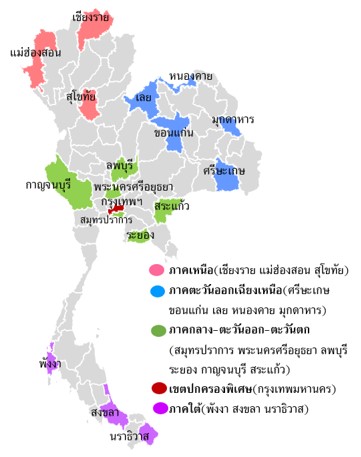
The purpose of this research is to identify the factors associated with the work needs of the elderly and to develop a predictive model for the work needs of the elderly. The sample data included in the study is data on Thai elderly aged 55 years and older, totaling 11,988 people, covering five regions (1. Bangkok, 2. Central-East-West Region, 3. Northeastern Region, 4. Northern Region, 5. Southern Region) from the 2021 according to the National Statistical Office's 2021 Elderly Population Survey Project in Thailand. Statistical analyses used include the Chi-squared test and logistic regression analysis. The research findings indicate that 5,232 elderly people (43.6%) expressed a desire for employment. Pre-retirement elderly individuals have a significantly higher desire for employment (73.5%) compared to post-retirement elderly individuals (32.7%). Factors significantly associated with the work needs of the elderly include region, province, residential area, household size, household living status, gender, age, marital status, number of children, homeownership, highest level of education completed, literacy, occupation during the past 12 months, main source of income, average annual income from all sources, income adequacy, savings, debt status, physical health over the past 7 days, and economic diversity. The predictive model for the work needs of the elderly, with an accuracy of 92.3%, is as follows:
P (Work needs of the elderly) =1/(1+exp(z)) When z = - 4.808 + 6.587 (occupation during the last 12 months).
References
Chaemchan, C., & Charasit, S. (2020). Situations and trend of Thai Older Persons’Labour Force Participation: Analyses from Nationally Representative Household Surveys. Institute for Population and Social Research, Mahidol University.
Chuanchom, P., Chanthuek, Teerawat, & Siriwong, P. (2018). Job Characteristics Suitable for Elderly Workers. Journal of Humanities and Social Sciences Valaya Alongkorn, 13(1), 107-116.
Chuenwattana, W., & Biadnok, C. (2011). The Awareness and Preparation for Entering Old Age among the Pre-Elderly Population in Thailand. Project to develop a center of excellence based on the distinctive identity of Bansomdejchaopraya Rajabhat University. Retrieved March 1, 2024, from https://identity.bsru.ac.th/archives/2800 (in Thai)
Department of Provincial Administration. (2024). Statistical data and key indicators. Retrieved from Population from registration, male, female and household, classified by region and province 2021-2023: https://www.nso.go.th/nsoweb/downloadFile/stat_impt/gG/file_xls_th
Economic Statistics Analysis and Forecasting Group. (2021). Household income and income distribution 2021, provincial level. Statistics Forecasting Division, National Statistical Office, Ministry of Digital Economy and Society. Retrieved March 1, 2024, from https://www.nso.go.th/public/e-book/Analytical-Reports/Income_2564/225/ (in Thai)
Jensantikul, N. (2021). Problems and Models of Hiring Elderly Workers of the Private Establishments in Thailand. School of Administrative Studies Academic Journal, 4(1), 50-66.
Kasemsoet, S. (2019). Factors that promote continued employment after retirement [Master's Degree]. University of the Thai Chamber of Commerce. (in Thai)
Keawsai, W. (2020). Factors affecting demand for working extention after retirement of senior civil servants [Master's thesis, Silpakorn University], Silpakorn University. http://ithesis-ir.su.ac.th/dspace/bitstream/123456789/3070/1/61602349.pdf (in Thai)
Ministry of Social Development and Human Security. (2009). National Elderly Plan No. 2 (2002–2021), First Revision 2009. Retrieved March 1, 2024, from https://www.dop.go.th/download/laws/law_th_20152309144546_1.pdf (in Thai)
Ministry of Social Development and Human Security. (2010). Senior Citizens Act B.E. 2003 (Amended B.E. 2010). Retrieved March 1, 2024, from https://www.dop.go.th/download/laws/regulation_th_20152509163042_1.pdf (in Thai)
Ministry of Social Development and Human Security. (2018). National Elderly Plan No. 2 (2002-2021), second Revision 2018. Retrieved March 1, 2024, from https://www.dop.go.th/download/laws/th1573721522-816_0.pdf (in Thai)
National Statistical Office. (2021). Survey of Elderly in Thailand 2021. Retrieved March 1, 2024, from https://nsodw.nso.go.th/dwportal/Item.aspx?p=+gsaDgQv4TQFrLJCEbyvEQ== (in Thai)
National Statistical Office. (2021). Survey of the Elderly Population in Thailand 2021, Statistical Tables by Province. National Statistical Office. Retrieved November 11, 2024, from https://www.nso.go.th/nsoweb/storage/survey_detail/2023/20230731135832_28841.pdf (in Thai)
National Statistical Office. (2022). The 2021 Survey of The Older Persons in Thailand. National Statistical Office, Ministry of Digital Economy and Society. Retrieved March 1, 2024, from https://www.dop.go.th/download/knowledge/th1687612748-2406_0.pdf (in Thai)
National Statistical Office. (2024). Statistical data and key indicators. Number, percentage and rate of elderly population classified by gender, province and region 2021. Retrieved August 20, 2024, from https://www.nso.go.th/nsoweb/downloadFile/stat_impt/iM/file_xls_th
National Statistical Office. (2024). Statistical Data and Key Indicators: Poverty Line (Expenditure) Classified by Region and Province 2012 - 2023. Retrieved November 11, 2024, from https://www.nso.go.th/nsoweb/nso/statistics_and_indicators?impt_branch=309
Phenphong, S. (2019). Labor Supply in Government Sector After Retirement. Journal of Management Science, Chiang Rai Rajabhat University, 14(2), 42-63.
Phokapunt, K., Sangrugsa, N., & Thamma-apipon, S. (2018). Factors Impact on the Intention of Working After Retirement of Bangkok Metropolitan Administrations Officials. Veridian E-Journal Silpakorn University, 11(1). https://he02.tci-thaijo.org/index.php/Veridian-E-Journal/article/view/118390
Phromphak, C. (2013). Aging society in Thailand. Research and Information Group. Academic Office, Office of the Senate Secretariat, 3(16), 1-23. https://library.senate.go.th/document/Ext6078/6078440_0002.PDF (in Thai)
Poungchieng, T. (2012). Working Needs of Thai Elderly in 2007 [Master's Thesis]. Chulalongkorn University.
Tunlayanisaka, C. (2009). Factors Affecting Post-Retirement Adaptation of the Elderly in Phattalung Province. [Master's Degree]. Prince of Songkla University. https://kb.psu.ac.th/psukb/bitstream/2010/5822/1/307872.pdf (in Thai)
Urawong, K., Ruangmuang, Y., Sukanan, W., Kunsri, N., & Pholpha, K. (2024). A predictive model for the work needs of the elderly in Songkhla and Khon Kaen, 2017. Journal of Science and Technology, Mahasarakham University, 43(2), 131-140.
Wanichbancha, K. (2008). Advanced Statistical Analysis with SPSS for Windows. 6th ed., Chulalongkorn University. (in Thai)
Wanitchakham, A. (2019). Prepartion for Aging Society: A Case Study of Sai Mai District, Bangkok. Journal of Social science and humanities Association of Private Higher Education Institutions of Thailand, 25(1), 164-179.
Yingrattanasuk, P., Chetkiatkul, P., Teskatuk, A., & Kosayawat, S. (2015). Factors related to the work ability of the elderly in Saen Suk Municipality Chonburi Province. Journal of Public Health, 45(2), 184-196.
Downloads
Published
License
Copyright (c) 2025 Journal of Applied Science and Emerging Technology

This work is licensed under a Creative Commons Attribution-NonCommercial-NoDerivatives 4.0 International License.


