Research and Development of a Prototype Student Backpack: Emphasis on Ergonomic Criteria
Keywords:
Ergonomic design, Student Backpacks,, Load Distribution, Proper Fit, User comfortAbstract
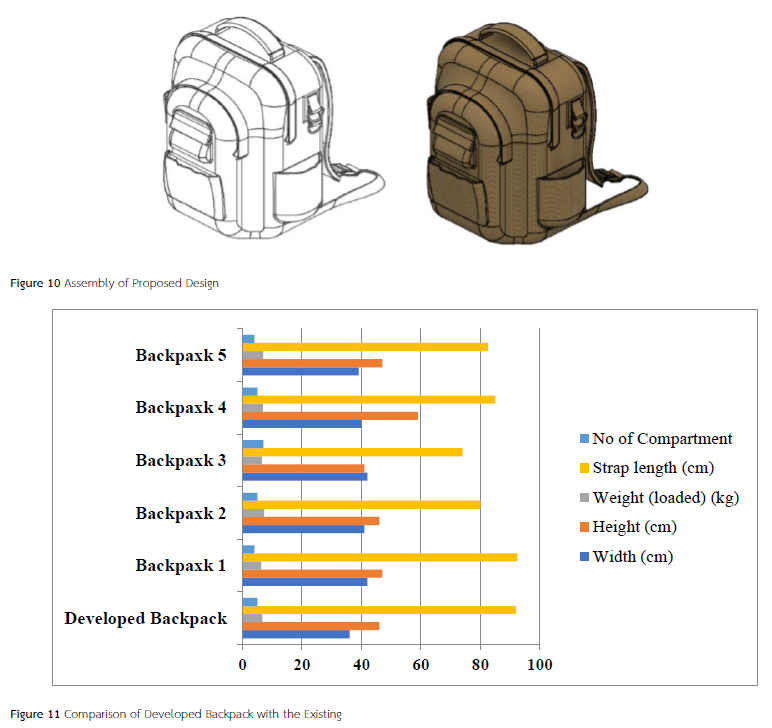
This study investigates the ergonomic design of student backpacks, considering factors such as load distribution, proper fit, strapping, accessibility, and aesthetics. Through a comparative analysis of five sample backpacks and a developed backpack prototype, various performance metrics were evaluated. The analysis revealed notable variations in dimensions, weight, strap length, and compartmentalization among the sample backpacks. Results indicated that the developed backpack prototype exhibited favourable characteristics in load distribution, proper fit, and strapping, outperforming some of the sample backpacks. However, there were areas of improvement identified across all backpacks, particularly in accessibility and aesthetics. The findings underscore the importance of ergonomics in backpack design, highlighting the need for careful consideration of user comfort and functionality. Additionally, the study provides valuable insights for designers and manufacturers to enhance the design of student backpacks, aiming to mitigate the risk of musculoskeletal issues and improve overall user experience. Further research may explore additional design features and conduct empirical testing to validate the effectiveness of proposed ergonomic solutions. In conclusion, this study contributes to advancing the field of ergonomic backpack design, with potential implications for student well-being and academic performance.
References
Adeyemi, A. J., Rohani, J. M. & Rani, M. A., (2014). Back pain arising from schoolbag usage among primary schoolchildren. International Journal of Industrial Ergonomics, 44(4), pp. 590-600.
Amiri, M., Dezfooli, M. S. & Mortezaei, S. R., (2012). Designing an ergonomics backpack for student aged 7-9 with user centred design approach. Work (Reading, Mass.), 1193–1201.
Brumelis, O., (2023). Calculating Your Average Torso Length Relative to Height.
Dianat, I., Sorkhi, N., Pourhossein, A., Alipour, A., & Asghari-Jafarabadi, M. (2014). Neck, shoulder and low back pain in secondary schoolchildren in relation to schoolbag carriage: should the recommended weight limits be gender-specific?. Applied ergonomics, 45(3), 437-442.
Ismaila, S. O. (2018). Safe backpack weight limit for secondary school students in Ibadan, Southwestern Nigeria. Alexandria Engineering Journal, 57(2), 547-554.
Kristina, S., & Amanda, B. (2018, September). Designing an ergonomic backpack for sixth grade elementary school students in Bandung based on the ideal weight of backpack load. In MATEC Web of Conferences (Vol. 204, p. 03011). EDP Sciences.
Mansoorian, M., Ghasemi, M. & Dehghan, N., (2019). Designing a New Ergonomic Student Backpack. Journal of Pharmaceutical Research International, 1-7.
Mertes, A., (2023). History of Backpacks. Quality Logo Products, 28 June.
Moore, M. J., White, G. L. & Moore, D. L., (2007). Association of relative backpack weight with reported pain, pain sites, medical utilization, and lost school time in children and adolescents. The Journal of school health, 77(5), 232–239.
Olatunya, O. (2017). Backpack use and associated problems among primary school children in Nigeria: a call to action by stakeholders. Niger J Paediatr, 44(3), 157-162.
Downloads
Published
Issue
Section
Categories
License
Copyright (c) 2026 Journal of Applied Science and Emerging Technology

This work is licensed under a Creative Commons Attribution-NonCommercial-NoDerivatives 4.0 International License.


