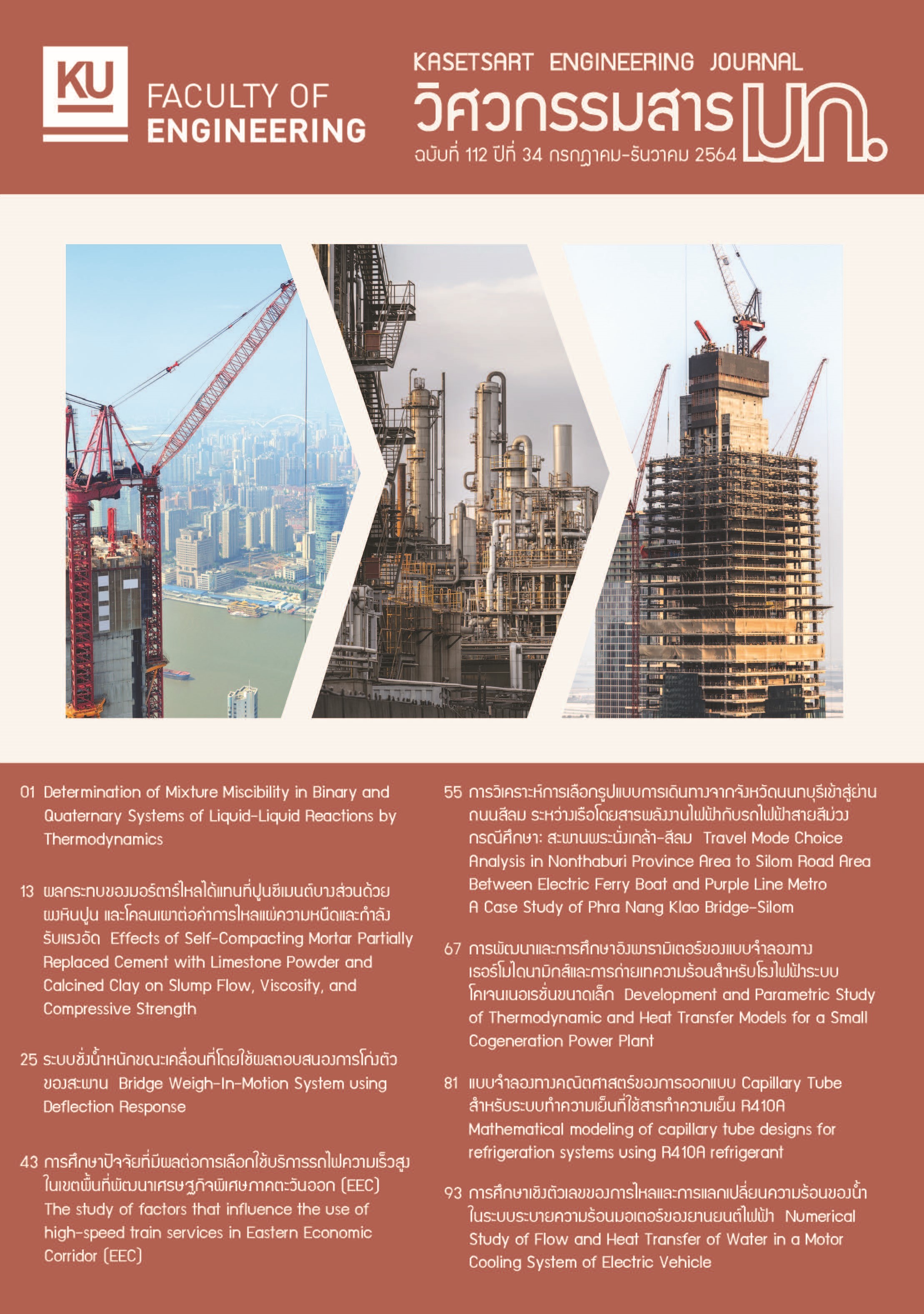
ผลกระทบต่อค่าการไหลแผ่ ความหนืดและกำลังรับแรงอัดของมอร์ตาร์ไหลได้เมื่อแทนปูนซีเมนต์บางส่วนด้วยผงหินปูนและโคลนเผา
คำสำคัญ:
ค่าการไหลแผ่, ความหนืด, มอร์ตาร์ไหลได้, ผงหินปูน, โคลนเผาบทคัดย่อ
งานวิจัยนี้นำเสนอผลของการแทนที่ปูนซีเมนต์บางส่วนด้วยผงหินปูนและโคลนเผาสำหรับผลิตมอร์ตาร์ไหลได้ โดยทดสอบสมบัติการไหลและสมบัติทางกลคือ ค่าการไหลแผ่ ความหนืดและกำลังรับแรงอัด เพื่อเสนอเป็นวัสดุทางเลือกที่เป็นมิตรกับสิ่งแวดล้อมในอุตสาหกรรมก่อสร้าง ปริมาณการแทนที่ปูนซีเมนต์ด้วยโคลนเผาคือร้อยละ 15 และ 25 ขณะที่ปริมาณแทนที่ด้วยผงหินปูนคือร้อยละ 15 ผลการวิจัยพบว่ามอร์ตาร์มีความหนืดเพิ่มขึ้นเมื่อแทนที่ปูนซีเมนต์ด้วยโคลนเผาร้อยละ 15 ดังนั้นจึงต้องใช้สารลดน้ำพิเศษเพิ่มขึ้นประมาณ 2–2.5 เท่า เพื่อมีค่าการไหลแผ่ที่เหมาะสม และต้องใช้สารผสมเพิ่มมากถึง 5–6 เท่าเมื่อเพิ่มผงหินปูนร้อยละ 15 อัตราส่วนน้ำต่อวัสดุประสาน (W/C) ร้อยละ 40 เหมาะสมที่สุดเนื่องจากความหนืดของมอร์ตาร์เปลี่ยนแปลงไม่มากนักโดยมีระยะเวลาไหลผ่านกรวยมาตรฐานมากขึ้นไม่เกิน 3 วินาที เมื่อเวลาผ่านไป 20 นาที และมีระยะเวลาไหลผ่านเริ่มต้น 4–6 วินาที การแทนที่ด้วยโคลนเผาร้อยละ 15 ทำให้กำลังรับแรงอัดเพิ่มขึ้นประมาณร้อยละ 20–38 ที่อายุ 28 วัน โดยมีกำลังรับแรงอัดประมาณ 700-830 กก./ซม.2 นอกจากนี้เมื่อเพิ่มปริมาณการแทนที่เป็นร้อยละ 25 ร่วมกับผงหินปูนร้อยละ 15 พบกว่ากำลังรับแรงอัดมีค่าลดลงประมาณร้อยละ 15–20 โดยกำลังรับแรงอัดประมาณ 450–590 กก./ซม.2 โคลนเผาสามารถนำมาใช้แทนที่ปูนซีเมนต์ในการผลิตมอร์ตาร์ไหลได้ มีสมบัติทางกลที่ดีขึ้นและมีสมบัติการไหลที่ดีที่สุดเมื่อมีอัตราส่วน W/C ร้อยละ 40 โคลนเผาเป็นวัสดุทางเลือกเพื่อช่วยลดปริมาณการใช้ปูนซีเมนต์ได้
เอกสารอ้างอิง
Meanyut B, Tangchirapat W and Jaturapitakkul C (2019). High-Strength Concrete Containing High Volume of Ground Bottom Ash. Journal of Thailand Concrete Association, 7 (2): 14-24. (In Thai)
Kaewmanee K, Tangtermsirikul S and Komsan M (2015). Basic Properties and Durability of Concrete with Fly Ash and CACO3 Powder. Journal of Thailand Concrete Association, 3(2): 8-16.
Makaratat N, Norrarat P, Jaturapitakkul C, and Songpiriyakij S (2019). Influence of High Volume Ternary Blend from Fly Ash and Ground Granulated Blast Furnace Slag on Concrete Properties. Journal of Thailand Concrete Association, 7(2): 1-13. (In Thai)
Srisen A, Tangchirapat W, and Jaturapitakkul C (2014). Properties of Concrete Using Fly Ash and Calcium Carbide Residue as a Cementitious Material. KMUTT Research and Development Journal, 37(2): 165-175. (In Thai)
Kawaguchi N, Kohno K, and Mita M (1996). Influences of Superplasiticizer, Mixing Time, Mixing Temperature and Cement Content on High-Volume Fly Ash Concrete. Materials Science Research International, 2(4): 242-247.
K Scrivener, F Martirena, S Bishnoi, and S Maity (2018). Calcined clay limestone cements (LC3). Cement and Concrete Research, 114: 49-56.
Y Dhandapani, and M Santhanam (2020). Investigation on the microstructure-related characteristics to elucidate performance of composite cement with limestone-calcined clay combination. Cement and Concrete Research, 129: 105959.
S Ferreiro, M M C Canut, J Lund, and D Herfort 2019. Influence of fineness of raw clay and calcination temperature on the performance of calcined clay-limestone blended cements. Applied Clay Science, 169: 81-90.
Y Dhandapani, T Sakthivel, M Santhanam, R Gettu, and R G Pillai (2018). Mechanical properties and durability performance of concretes with Limestone Calcined Clay Cement (LC3). Cement and Concrete Research, 107: 136-151.
C Rodriguez and J I Tobon (2020). Influence of calcined clay/limestone, sulfate and clinker proportions on cement performance. Construction and Building Materials, 251: 119050.
Z Shi et al. (2019). Sulfate resistance of calcined clay – Limestone – Portland cements. Cement and Concrete Research, 116: 238-251.
R G Pillai et al. (2019). Service life and life cycle assessment of reinforced concrete systems with limestone calcined clay cement (LC3). Cement and Concrete Research, 118: 111-119.
Okamura H, and Ouchi M (2003). Self-Compacting Concrete. Journal of Advanced Concrete Technology, 1(15): 5-15.
Japan Society of Civil Engineers (1999). Recommendation for Self-Compacting Concrete.
Attachaiyawuth A (2015). Simple Evaluation of Flowability of Self-Compacting Concrete by Mortar Test. TCA E-Magazine. (In Thai)
Ouchi M, Edamatsu Y, Ozawa K, and Okamura H (1999). A Simple Evaluation Method for Intraction between Coarse Aggregate and Mortar's Particles in Self-Compacting Concrete. Transaction of The Japan Concrete Institute, 21: 1-6.
American Society for Testing and Materials (2017). ASTM C 494: Standard Specification for Chemical Admixtures for Concrete. Philadelphia, ASTM.
American Society for Testing and Materials (2020). ASTM C 109: Standard Test Method for Compressive Strength of Hydraulic Cement Mortars (Using 2-in. or [50-mm] Cube Specimens. Philadelphia, ASTM.
Rath S, Ouchi M, Puthipad N, and Attachaiyawuth A (2017). Improving the Stability of Entrained Air in Self-compacting Concrete by Optimizing the Mix Viscosity and Air Entraining Agent Dosage. Construction and Building Material, 148: 531-537.
ดาวน์โหลด
เผยแพร่แล้ว
ฉบับ
ประเภทบทความ
สัญญาอนุญาต

อนุญาตภายใต้เงื่อนไข Creative Commons Attribution-NonCommercial-NoDerivatives 4.0 International License.

