
Shale pore network and seepage simulation of Huai Hin Lat Formation
Article Sidebar
Main Article Content
Abstract
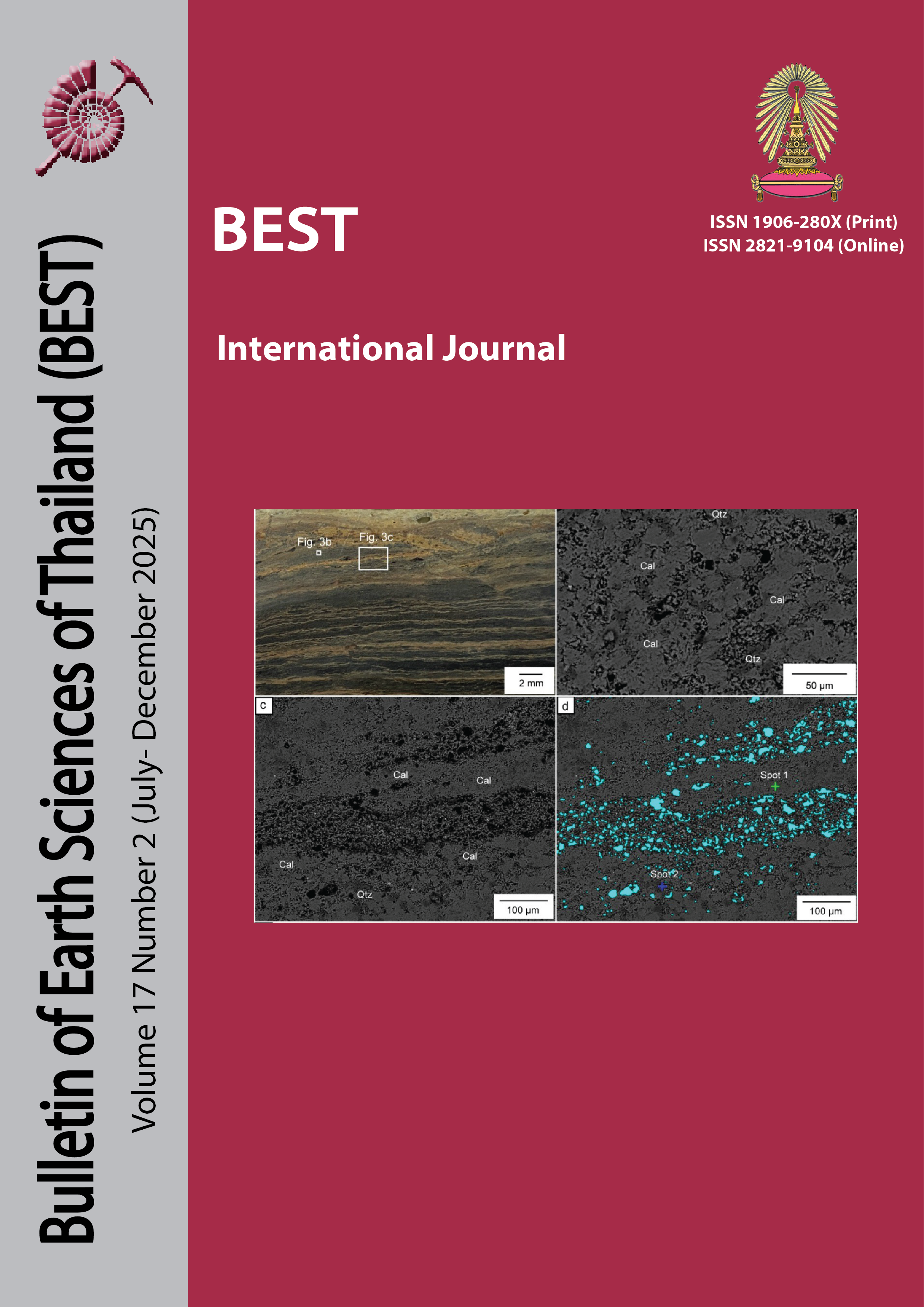
Gas shale is a type of petroleum rock associated with physical properties that simplify fluid migration pathways, necessary for the development of petroleum extraction and recovery in the region. Furthermore, it provides a carbon capture and storage (CCS) seal with low permeability and porosity. Shale porosity challenges the measurement of connected micropores. This study aims to investigate pore morphology, pore networks, and rock simulations of gas shale from Dat Fa sub-member of Huai Hin Lat Formation. The geochemical compositions were assessed using XRD and XRF techniques to identify the rock type. Scanning electron microscopy (SEM) analyzed the 2D pore morphology, distribution, and total porosity. X-ray tomographic microscopy generates pore network models that calculate total and effective porosity for seepage flow simulations, enhancing the analysis of gas transport mechanisms in rock formations. Geochemical analysis categorizes the rock types as calcareous shale and dolomitic shale. SEM images of calcareous shale typically reveal parallel flat pores and pinch-out along the laminations. Dolomitic shale exhibited the lamination of dolomite and calcite, with micropores surrounding mineral grains. The total porosity values for calcareous shale and dolomitic shale are 5.54% and 3.04%, respectively. Micro-CT image analysis revealed that the total porosity of calcareous shale ranged from 2.86% to 4.65%, while the effective porosity decreased down to 0.83% and 1.75%. The total porosity of dolomitic shale was estimated to range from 3.51% to 3.70%, with effective porosity ranging from 1.99% to 3.27%. Seepage simulations provide that calcareous shale has more diffusivity in parallel laminations, while dolomitic shale demonstrates greater diffusivity in perpendicular laminations.
Article Details

This work is licensed under a Creative Commons Attribution-NonCommercial-NoDerivatives 4.0 International License.
Copyright © 2008 Department of Geology, Faculty of Science, Chulalongkorn University. Parts of an article can be photocopied or reproduced without prior written permission from the author(s), but due acknowledgments should be stated or cited accordingly.
References
Arsairai, B., Chonglakmani, C., & Feng, Q. (2016a). Pore type characteristics of the Huai Hin Lat Formation in Sap Phlu Basin, northeastern Thailand: Contribution to the understanding of gas storage in fine-grained rocks. Suranaree Journal of Science & Technology, 23(3).
Arsairai, B., Wannakomol, A., Feng, Q., & Chonglakmani, C. (2016b). Paleoproductivity and paleoredox condition of the Huai Hin Lat Formation in northeastern Thailand. Journal of Earth Science, 27, 350-364.
Askarova, A., Mukhametdinova, A., Markovic, S., Khayrullina, G., Afanasev, P., Popov, E., & Mukhina, E. (2023). An overview of geological CO2 sequestration in oil and gas reservoirs. Energies, 16(6), 2821.
Bollermann, T., Yuan, T., Kulenkampff, J., Stumpf, T., & Fischer, C. (2022). Pore network and solute flux pattern analysis towards improved predictability of diffusive transport in argillaceous host rocks. Chemical Geology, 606, 120997.
Chenrai, P., Assawincharoenkij, T., Jitmahantakul, S., & Chaiseanwang, P. (2022a). Geochemical characteristics of shale gas formation and the potential for carbon storage in Thailand: An example from the Triassic Huai Hin Lat Formation. Frontiers in Earth Science, 10, 1085869.
Chitnarin, A., Kershaw, K., Promduang, A., & Tepnarong, P. (2022). Late triassic freshwater conchostracan, ostracods, and stromatolites from Huai Hin Lat Formation, northeastern Thailand. Thai Geosci. J, 3(3), 32-50.
Chumkratoke, C. (2016). Modeling gas inflow for extremely low permeability shale using CFD. Missouri University of Science and Technology.
Cid, H., Carrasco-Núñez, G., & Manea, V. (2017). Improved method for effective rock microporosity estimation using X-ray microtomography. Micron, 97, 11-21.
Dyni, J. R. (2004). Oil shale. Elsevier.
Han, J., Han, S., Kang, D. H., Kim, Y., Lee, J., & Lee, Y. (2020). Application of digital rock physics using X-ray CT for study on alteration of macropore properties by CO2 EOR in a carbonate oil reservoir. Journal of Petroleum Science and Engineering, 189, 107009.
He, L., Zhao, L., Li, J., Ma, J., Lui, R., Wang, S., & Zhao, W. (2014). Complex relationship between porosity and permeability of carbonate reservoirs and its controlling factors: A case study of platform facies in Pre-Caspian Basin. Petroleum Exploration and Development Online, 41(2), 225-234.
Javadpour, F., Fisher, D., & Unsworth, M. (2007). Nanoscale gas flow in shale gas sediments. Journal of Canadian Petroleum Technology, 46(10).
Jing, D., Meng, X., Ge, S., Zhang, T., Ma, M., & Tong, L. (2021). Reconstruction and seepage simulation of a coal pore-fracture network based on CT technology. PloS one, 16(6), e0252277.
Khan, D., Qiu, L., Liang, C., Mirza, K., Kashif, M., Yang, B., Kra, K. L., Wang, Y., & Li, X. (2022). Formation and distribution of different pore types in the lacustrine calcareous shale: insights from XRD, FE-SEM, and low-pressure nitrogen adsorption analyses. ACS omega, 7(12), 10820-10839.
Lin, W., Li, X., Yang, Z., Xiong, S., Luo, Y., & Zhao, X. (2020). Modeling of 3D rock porous media by combining X-ray CT and Markov chain Monte Carlo. Journal of Energy Resources Technology, 142(1), 013001.
MacInnis, I. N., & Brantley, S. L. (1992). The role of dislocations and surface morphology in calcite dissolution. Geochimica et Cosmochimica Acta, 56(3), 1113-1126.
Meng, T., Liu, Z., Wu, F., Zhang, Z., Liang, X., He, Y., Wu, X., Yang, Y., & Gao, H. (2024). Coupled thermo-hydro-mechanical analysis of porous rocks: Candidate of surrounding rocks for deep geological repositories. Journal of Rock Mechanics and Geotechnical Engineering.
Rashid, F., Glover, P., Lorinczi, P., Collier, R., & Lawrence, J. (2015). Porosity and permeability of tight carbonate reservoir rocks in the north of Iraq. Journal of Petroleum Science and Engineering, 133, 147-161.
Saraf, S., & Bera, A. (2021). A review on pore-scale modeling and CT scan technique to characterize the trapped carbon dioxide in impermeable reservoir rocks during sequestration. Renewable and Sustainable Energy Reviews, 144, 110986.
Song, R., Wang, Y., Sun, S., & Liu, J. (2021). Characterization and microfabrication of natural porous rocks: From micro-CT imaging and digital rock modelling to micro-3D-printed rock analogs. Journal of Petroleum Science and Engineering, 205, 108827.
Xu, K., Wei, W., Chen, Y., Tian, H., Xu, S., & Cai, J. (2022). A pore network approach to study throat size effect on the permeability of reconstructed porous media. Water, 14(1), 77.
Zhang, L., Shan, B., Zhao, Y., & Tang, H. (2018). Comprehensive seepage simulation of fluid flow in multi-scaled shale gas reservoirs. Transport in Porous Media, 121, 263-288.
Zhou, S., Yan, G., Xue, H., Guo, W., & Li, X. (2016). 2D and 3D nanopore characterization of gas shale in Longmaxi formation based on FIB-SEM. Marine and Petroleum Geology, 73, 174-180.
