
Half century of meander evolution from the Mun River, Surin Province, northeastern Thailand
Article Sidebar
Main Article Content
Abstract
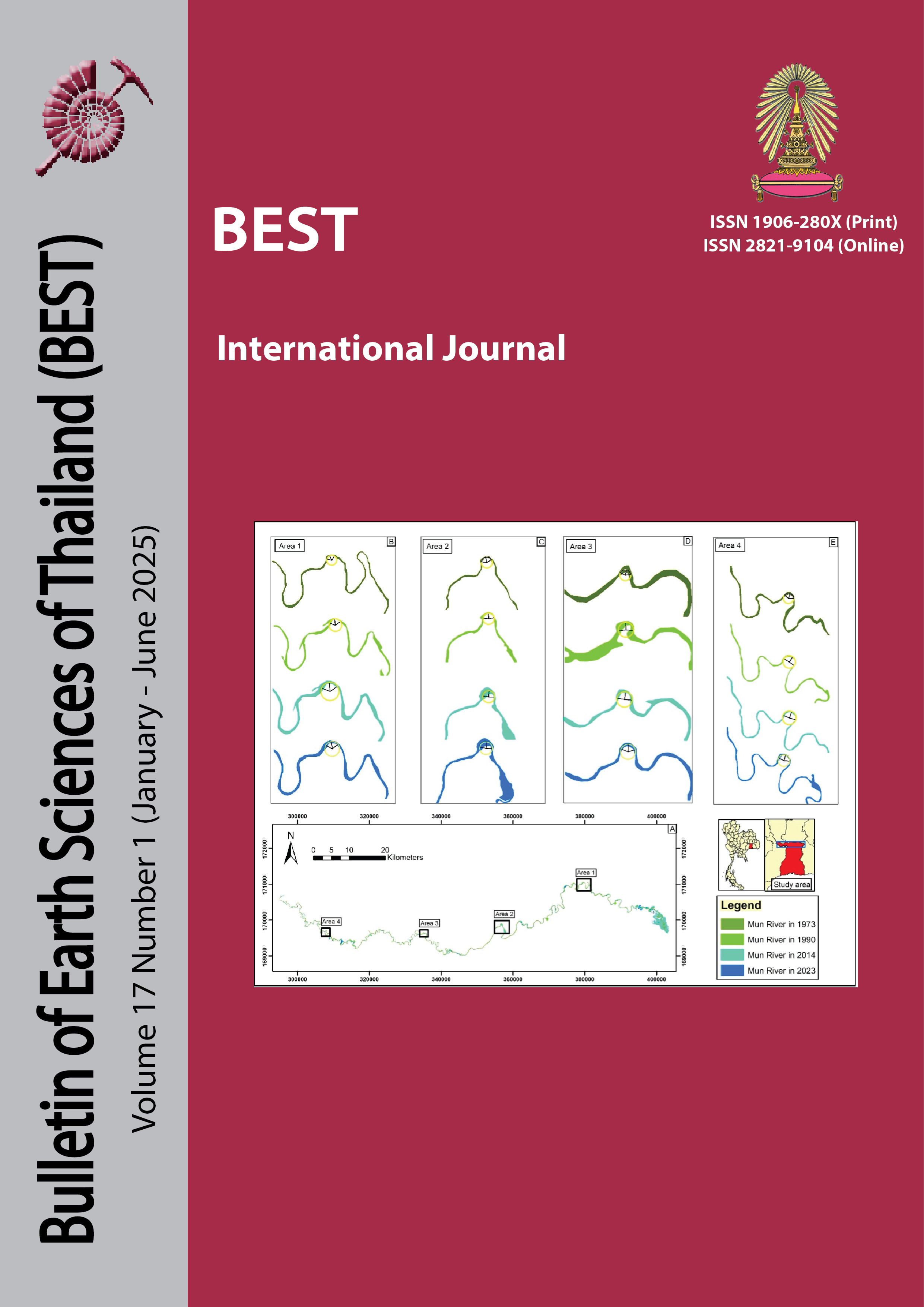
The Mun River, a major tributary of the Mekong River, exhibits a dynamic meandering pattern within its catchment basin. This study reveals a half century of geomorphological changes of the Mun River in Surin province based on geomorphological parameters. Satellite images from 1973 to 2023 were analyzed together with subsurface surveys. The identified landforms alongside the floodplain of the Mun River include paleo-channels, oxbow lakes, and meander scars. To quantify geomorphological changes, four geomorphic metrics were employed: channel width (W), channel length (L), sinuosity index (SI), and radius of curvature (RC). Significant variations in channel width were observed, primarily due to bank erosion and long-term sedimentation in the river. The channel length and sinuosity index have shown a decreasing trend, indicating frequent cut-off process. Erosion rates were found to be higher in the lower reaches, where the river is actively migrating and bending. The upper and middle reaches have experienced past cut-offs and channel patterns were likely stabilized. RC began to decrease after 1990 possibly by increasing river bank protection and settlement expansion.
Article Details

This work is licensed under a Creative Commons Attribution-NonCommercial-NoDerivatives 4.0 International License.
Copyright © 2008 Department of Geology, Faculty of Science, Chulalongkorn University. Parts of an article can be photocopied or reproduced without prior written permission from the author(s), but due acknowledgments should be stated or cited accordingly.
References
Alho, P. & J. Mäkinen (2010) Hydraulic parameter estimations of a 2D model validated with sedimentological findings in the point bar environment. Hydrological Processes, 24, 2578-2593.
Blake, D., Saffel, M., Foran, T., & Manorom, K. (2007). Pak Mun Dam: Perceptions of the fisheries impact study and the Thai Baan research. Water Alternatives, 2(2), 80-99.
Bridhikitti, A., Ruamchalerm, P., Keereesuwannakul, M., Prabamroong, T., Liu, G., & Huang, C. (2022). Magnitude and factors influencing soil loss and sedimentation in the Mun River Basin, Thailand. CATENA, 210, 105872.
Champangern, K., Prasertsri, W., Wuttipan, T., Soontorn, N., Chalermpong, P., & Suepa, T. (n.d.). (2019) Suspended sediment dynamics in the Chi-Mun River Basin, Thailand: Impact of climate change and anthropogenic activities.
Choowong, M. (2011) Basic Geomorphology. Tienwattana Printing, Co., LTD, 202 p.
Glover, B. & P. Johnson (1974) Variations in the natural chemical concentration of river water during flood flows, and the lag effect. Journal of Hydrology, 22, 303-316.
Gregory, K. J. (2006). The human role in changing river channels. Geomorphology, 79(3-4), 172-191.
Hooke, J. M. (2007) Spatial variability, mechanisms and propagation of change in an active meandering river. Geomorphology, 84, 277-296.
Kondolf, G. M. (1997). Hungry water: effects of dams and gravel mining on river channels. Environmental Management, 21(4), 533-551.
Knighton, D. (1998). Fluvial Forms and Processes: A New Perspective. Arnold, London.
Kummu, M., & Sarkkula, J. (2008). The Impacts of Dams and River Regulations on Sediment Transport in the Mekong River Basin. Environmental Management, 42(4), 576-590.
Leopold, L. B. (1960). Flow resistance in sinuous or irregular channels. US Government Printing Office.
McCully, P. (1996). Silenced Rivers: The Ecology and Politics of Large Dams. Zed Books.
Nimnate, P., Thitimakorn, T., Choowong, M., & Hisada, K. (2017). Imaging and locating paleo-channels using geophysical data from meandering system of the Mun River, Khorat Plateau, Northeastern Thailand. Open Geosciences, 9(1).
Prabnakorn, S., Ruangpan, L., Tangdamrongsub, N., Suryadi, F. X., & de Fraiture, C. (2021). Improving flood and drought management in agricultural river basins: An application to the Mun River Basin in Thailand. Water Policy. 23(5). 1153–1169.
Schmudde, T. H. (1997). FLOODPLAIN Flood plain. In Geomorphology, 359-362. Berlin, Heidelberg: Springer Berlin Heidelberg.
Srisunthon, P., & Choowong, M. (2019). Quaternary meandering evolution and architecture of a point bar in the Mun River on the sandstone-dominated Khorat Plateau from northeastern Thailand. Quaternary International, 525, 25-35.
Surian, N., & Rinaldi, M. (2003). Morphological response to river engineering and management in alluvial channels in Italy. Geomorphology, 50(4), 307-326.
Udomsak, S., Choowong, N., Choowong, M. & Chutakositkanon, V. (2021). Thousands of Potholes in the Mekong River and Giant Pedestal Rock from North-eastern Thailand: Introduction to a Future Geological Heritage Site. Geoheritage, Vol. 13, No. 5
Wattanachareekul P, Choowong N, Pailoplee S, Choowong M (2022) Resilience to unusual flooding from 2021 tropical storms from part of mainland Southeast Asia. Front ecol and evol 10: 1072993
Williams, G. P. (1984) Paleohydrologic equations for rivers. Developments and applications of geomorphology, 343-367.
Wohl, E. (2014). Rivers in the Landscape: Science and Management. Wiley Blackwell.
